Bones Worksheet For Kids


- Grades
- Grade 3
- Pages
- 1
- File type
- Preparation
- Print ready


- Subject
- Human Body, Biology, Life Sciences, Science
- Topic
- Human Body, Skeleton
- Preparation
- Print ready
From the author
About this resource
Activity Introduction
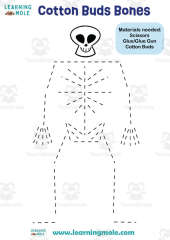
An amazing activity designed for the Grade 3 students to learn the anatomy of the bones inside our skeletal system.
The Skeletal System
The adult human skeletal system includes 206 bones, while the infantile skeletal system has many more, since not all of the bones have fused together yet.
The femur, or thighbone, is the longest and strongest bone of the human skeleton, and the stapes, in the middle ear, is the smallest and lightest bone of the human skeleton.
Bones Count Activity
The activity is designed to Elevate both eagerness for learning and researching skills for kids. Students will have fun counting how many bones in the human body, while learning the importance of the skeletal system.
Bones Count
This friendly designed worksheet is suitable for students at school, homeschooling, and as a group activity.
Instructions
How many bones are in each body part? Write your estimate in the boxes below and then do some research to check.
Format
Available in a PDF format.
Related resources
More resources teachers may find useful
More resources on the same subject and topic.


In the classroom
Teaching tips & learning objectives

Learning objectives
Estimate a reasonable number of bones in a given body part before researching the actual count.
Use an outside source to check or correct an initial estimate.

Teaching tips
Pair this page with a labelled skeleton diagram or a short reference text, since the worksheet itself provides no bone-count answers for students to check against.
Have students complete the estimate column independently first, then research in pairs or small groups, so the estimation step stays a genuine guess rather than a copied answer.
Use as a quick hook before a human-body or skeletal-system unit, since the estimate-then-verify format naturally invites curiosity about the actual numbers.

Skills covered
Estimation — students commit to a numeric guess for each body part before looking up the answer.
Research and verification — students use an outside source to check their estimate against the actual bone count.
Good to know
Questions teachers ask about this resource
Does the page give the actual bone counts, or do students find them elsewhere?
Students find them elsewhere — the page only provides estimate boxes and the instruction to research and check, so a reference source (textbook, diagram, or class discussion) is needed alongside it.

No reviews yet
Downloaded this resource? Tell other teachers how it went.
Resource details
Concepts & topics
Core concepts
 Core concepts
Skeletal system
Estimation
Research skills
Topics
 Topics
Explore more
Categories this resource belongs to
Explore related searches


More to explore