Crash Course Psychology 16 Aphasia



- Grades
- Grades 7–12
- Pages
- 2
- File type
- Zip


- Subject
- Psychology, History, Social Studies
- Topic
- Language Development, Crash Course
- Resource types
- Worksheets
From the author
About this resource
Related resources
More resources teachers may find useful
More resources on the same subject and topic.


In the classroom
Teaching tips & learning objectives

Learning objectives
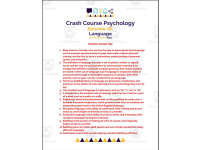
Define language and explain how the definition chosen decides whether humans are alone in using it
Name the three building blocks of language — phonemes, morphemes and grammar — and explain how a morpheme relates to a phoneme
Trace early language development from recognising speech differences and reading lips at about four months, through receptive language and babbling, to productive language
Explain Chomsky's universal grammar, including the claim that all human languages contain nouns, verbs and adjectives and that humans are born predisposed to learn grammatical rules
Discuss how thinking and language are related, including the idea that the language someone uses may frame their ideas

Teaching tips
Play the episode straight through once before handing the sheet out — the fifteen questions run in the order the video covers them, so a second viewing can be spent writing
Pair questions 7 and 8 in discussion: receptive and productive language are defined against each other, and question 8 asks directly how they differ
Question 6 is the only numerical item — about forty phonemes, over a hundred thousand morphemes and more than six hundred and sixteen thousand dictionary words — so it is worth pausing the episode at that point
Treat questions 14 and 15 as the extended-writing pair; universal grammar and the thinking-language relationship both invite a paragraph rather than a single line
The editable versions let you shorten the set for a substitute day or a single lesson, since each numbered question stands on its own

Skills covered
Video note-taking — students answer fifteen numbered questions in the lettered spaces provided while working through the linked episode.
Linguistic terminology — the questions require students to define phoneme, morpheme, grammar, receptive language and productive language and to give an example of a phoneme.
Developmental sequencing — question 13 asks how humans learn language and when the process begins, pulling the four-month starting point, receptive language, babbling and productive language into a single order.
Theory recall — question 14 asks what universal grammar is, answered with Chomsky's claim that we are hard-wired for language rather than linguistic blank slates.
Open-ended reasoning — question 15 asks how thinking and language are both separate and intricately entwined, and the response given for it is framed as an unresolved question rather than a settled fact.
Good to know
Questions teachers ask about this resource
Which parts of the language episode do the fifteen items cover?
The set opens on Kanzi the bonobo, then moves through the definition of language, the three building blocks, phonemes and morphemes, receptive versus productive language, babbling and deaf babies signing, and finishes on universal grammar and the thinking-language relationship — following the episode's own running order.
Are these recall questions or discussion questions?
Mostly recall, with an open finish. Items 1 through 14 have definite responses taken from the episode — the smallest unit of language, when babbling begins, what Chomsky argued. Item 15 is genuinely open, and the response supplied for it says it is hard to say whether non-verbal ideas come first or thoughts are born in language.
How do students reach the episode itself?
Every version of the sheet carries a "Link to Episode" line at the top, and the worksheet's single direction reads "Use the video linked above to answer the following questions." The episode is Crash Course Psychology #16: Language, hosted on the Crash Course channel.

No reviews yet
Downloaded this resource? Tell other teachers how it went.
Resource details
Concepts & topics
Core concepts
 Core concepts
Language acquisition
Phonemes and morphemes
Receptive and productive language
Universal grammar
Language and thought
 Topics
Explore more
Categories this resource belongs to
Explore related searches


More to explore