Decomposing Shapes To Find Area Worksheets PDF

- Grades
- Grade 3
- File type
- Preparation
- Print ready


- Subject
- Measurements, Math
- Topic
- Shapes, Math Homework
- Resource types
- Worksheets & Printables
- Preparation
- Print ready
From the author
About this resource
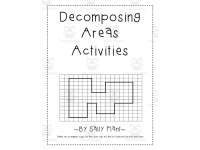
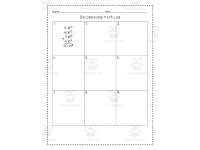
This is a Decomposing Areas Activity Pack.
There are 2 worksheets included.
For the first worksheet, students will:
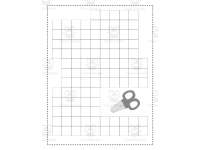
-Cut out the whole rectilinear shape.
-Then cut (decompose) the whole shape into smaller rectilinear shapes to help determine the area of the whole.
-Each square represents 1 square inch (or 1 in²).
-Draw the outline of each smaller shape they created on the grid at the bottom of the page.
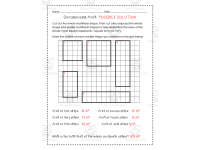
The recording page has space for up to six parts; the possible solution uses five. When they have done so, they will find the total area of the whole rectilinear shape.
An example of a possible solution is included.
For the second worksheet, students will:
-Look at the shapes shown on the graph paper.
-Draw lines to decompose them into squares or rectangles and write the areas of each before adding them up.
-Write their answers on the following page.
-The first one is done for them.
An answer key is included.
Both of these worksheets can be completed independently, in small groups, or as homework.
If this is a skill that has already been introduced and reviewed, this worksheet can be completed independently if you want to take a grade on it. Give students enough time to complete one (or both) of the worksheets without feeling rushed.
If this is a new skill, small groups would be great so that you can informally assess how well students are beginning to master this skill.
Small groups or homework will provide students with the additional practice they may need.
Related resources
More resources teachers may find useful
More resources on the same subject and topic.


In the classroom
Teaching tips & learning objectives

Learning objectives
Decompose a rectilinear figure into non-overlapping rectangles
Find the area of a rectangle by counting or calculating unit squares
Recognize area as additive by summing the areas of decomposed parts to find a whole figure's total area

Teaching tips
Have students physically cut apart the first activity's shape before decomposing it, then compare their five- or six-piece solution to the possible-solution page to see that a rectilinear shape can be split more than one correct way.
Assign the second worksheet's model example (figure 1, solved for them) as a guided walkthrough before students attempt figures 2 through 9 independently.
Use the second worksheet's separate log page to keep the graph-paper figures reusable, since students record their area work on the log page rather than marking directly on the shapes.

Skills covered
Decomposing rectilinear shapes — students divide a whole figure into non-overlapping rectangles, either by physically cutting it apart or by drawing dividing lines on graph paper.
Area calculation — students find the area of each decomposed rectangle in square inches, using the grid's 1-square-inch units.
Recognizing area as additive — students sum the areas of the individual rectangles they created to determine the whole shape's total area.
Good to know
Questions teachers ask about this resource
Do the two worksheets use the same method for decomposing shapes?
No — the first has students physically cut a shape apart into pieces, while the second keeps the figure intact and has students draw dividing lines on graph paper instead.
Is there more than one correct way to decompose the shapes?
Yes — the first worksheet's own solution page is labelled as just one possibility, splitting the shape into five pieces that total 103 square inches, implying other valid divisions exist.

No reviews yet
Downloaded this resource? Tell other teachers how it went.
Resource details
Concepts & topics
Core concepts
 Core concepts
Area
Decomposing shapes
Rectilinear figures
Additive area
Topics
 Topics
Explore more
Categories this resource belongs to
Explore related searches


More to explore