Fact and Opinion Anchor Chart


- Grades
- Grades 2–5
- File type
- Preparation
- Print ready


- Subject
- Strategies, ELA
- Topic
- Fact, Opinion
- Resource types
- Anchor Charts
- Preparation
- Print ready
From the author
About this resource
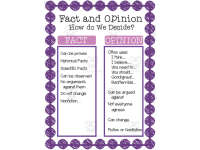
This resource is a set of 2 anchor charts for fact and opinion. The first chart is complete. The second chart is fill in the blank. These charts work well displayed on a bulletin board or inserted into students' interactive reading notebooks.
Related resources
More resources teachers may find useful
More resources on the same subject and topic.



In the classroom
Teaching tips & learning objectives

Learning objectives
Distinguish a fact from an opinion using specific characteristics (provable/observable vs. arguable/changeable).
Identify opinion-signaling language, such as 'I think,' 'I believe,' or 'You should.'
Label the FACT and OPINION headers on the blank chart based on the descriptors already listed in each column.

Teaching tips
Display the completed chart on a bulletin board or insert a printed copy into students' interactive reading notebooks.
Use the blank-header version as a quick formative check: have students label FACT and OPINION themselves before revealing the completed chart.
Point out the phrase list under Opinion ('I think...', 'I believe...', 'You should...') as sentence starters students can watch for while reading.

Skills covered
Fact vs. opinion identification — students use the chart's criteria (provable, observable, unchanging vs. arguable, changeable) to sort statements.
Opinion-language recognition — students learn to spot signal phrases like 'I think,' 'I believe,' and 'You should' that typically introduce an opinion.

No reviews yet
Downloaded this resource? Tell other teachers how it went.
Resource details
Concepts & topics
Core concepts
 Core concepts
Fact vs. opinion
Opinion signal words
 Topics
Explore more
Categories this resource belongs to
Explore related searches


More to explore