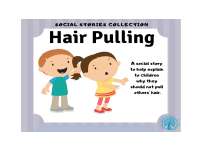
Hair Pulling Social Story

- File type
- Preparation
- Print ready


- Subject
- Social Skills, Special Resources
- Topic
- Social Story, Behaviour
- Preparation
- Print ready
From the author
About this resource
Social stories use a patient and reassuring tone to teach children about social situations in a way that can be easily understood. Social stories are particularly useful for children on the autistic spectrum for whom social cues can be challenging and who often suffer anxiety if they do not know what to expect from a situation however social stories can also be useful for any child who is struggling to understand a situation or concept or needs help to understand a social skill or social cue, expectations, perspectives, common responses or is troubled about an upcoming event.
This social story is to support a child who has been pulling other people’s hair. It explains that this hurts others and is not acceptable.
These books should be used over and over to reinforce the point so I would suggest either putting the pages into a display book or laminating and binding them.
Clipart images courtesy of Kari Bolt.
Related resources
More resources teachers may find useful
More resources on the same subject and topic.


In the classroom
Teaching tips & learning objectives

Learning objectives
Identify and name personal feelings (angry, frustrated, excited) that can trigger the target behaviour.
Recognize that pulling another person's hair causes real harm, regardless of which feeling triggered it.
State a personal commitment to stop the target behaviour, modelled on the story's own closing line.

Teaching tips
Read the story repeatedly with the child, since each page builds toward the same 'so I should never pull hair' conclusion through a different consequence (hurts others, makes them sad, loses a friend).
Validate the underlying feeling first, as the story itself does on page 6 ('It is OK to feel angry... frustrated... excited'), before addressing the behaviour on the following page.
Pair the final page's personal commitment ('I will remember to not pull anyone's hair') with a follow-up check-in, since the story ends on a self-directed reminder rather than an external rule.

Skills covered
Emotional identification — the child names three specific triggering feelings (angry, frustrated, excited) before connecting them to the target behaviour.
Cause-and-effect understanding of behaviour — the child follows three separate consequences of hair pulling (physical hurt, sadness, loss of friendship) across three parallel pages.
Self-regulation commitment — the child ends the story with a first-person statement of intent to stop the behaviour.

No reviews yet
Downloaded this resource? Tell other teachers how it went.
Resource details
Concepts & topics
Core concepts
 Core concepts
Emotional regulation
Social story
Behaviour support
Cause and effect
 Topics
Explore more
Categories this resource belongs to
Explore related searches

More to explore