Dovere Conjugation Italian


- Grades
- Grades 7–12
- Pages
- 2
- File type
- Preparation
- Print ready


- Subject
- Foreign Languages
- Topic
- Italian, World Languages
- Resource types
- Worksheets
- Preparation
- Print ready
From the author
About this resource
Italian Grammar Worksheets on "Verbo Dovere"
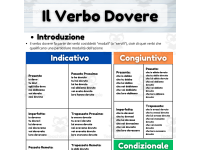
This Italian Language Teaching Resource offers detailed grammar worksheets on Verb "Dovere", designed to support students in understanding one of the essential elements of Italian grammar.
These worksheets are perfect for a wide range of learners, from middle school (Grade 7) to high school students (up to Grade 12), and even suitable for higher education and adult learners. Whether you're teaching a beginner's class or refreshing the skills of more advanced students, this resource is tailored to meet the needs of diverse age groups and learning levels.
This PDF printable resource is specifically designed to introduce and reinforce the use of Italian Verb "Dovere". Verb "Dovere" is foundational in mastering the Italian language, and this resource provides an in-depth explanation, along with exercises to help students apply their knowledge. The worksheets can serve as a primary learning tool for beginner students or as a refresher for those needing extra practice.
This Italian Grammar Worksheets on Verb "Dovere" include:
A general introduction to Verb "Dovere" + Conjugation
6 Italian grammar exercises
Italiano con Alan is an Italian Language and Culture Store that aims to help Italian Language Teachers, Educators and Tutors around the Globe (be it online or offline) to achieve their teaching objectives while creating a fun and stimulating environment. Never Forget! Learning is fun, so learn the Italian Language!
If you want to browse more of my PDF Italian Language and Culture Teaching Resources, click here Italiano con Alan!
Related resources
More resources teachers may find useful
More resources on the same subject and topic.


In the classroom
Teaching tips & learning objectives

Learning objectives
Recall the correct conjugated form of dovere for a given subject pronoun and tense or mood.
Choose the appropriate tense of dovere to complete an Italian sentence based on its context (e.g., a completed past action vs. a hypothetical condition).
Explain why dovere lacks an imperative form, based on its meaning as an expression of obligation rather than direct command.

Teaching tips
Since no English translation is provided anywhere in the file, use this resource with students who can already read intermediate-level Italian sentences, or supply translation support separately.
Introduce the reference chart's less common tenses (passato remoto, congiuntivo trapassato) before assigning the matching exercise sets, since these are typically taught later than the presente and passato prossimo.
There is no answer key, so plan to review answers as a class or prepare your own key before assigning the exercises independently.
Use the reference chart's note on the missing imperative form as a discussion prompt about how a verb's meaning shapes which grammatical forms it can take.

Skills covered
Modal verb conjugation — students produce the correct form of dovere across presente, passato prossimo, condizionale presente, futuro semplice, condizionale passato, and passato remoto.
Context-based tense selection — students choose the tense that fits each sentence's meaning, such as distinguishing a regretted past obligation ('Io avrei dovuto studiare di più...') from a simple future one ('Domani io dovrò alzarmi presto...').
Grammar reasoning — students connect a verb's meaning (obligation/necessity) to a grammatical gap, explaining why dovere has no imperative form.
Good to know
Questions teachers ask about this resource
What language are the worksheet and exercises written in?
Entirely in Italian — the reference chart, grammar notes, and all 30 fill-in-the-blank sentences use no English translation.
Why doesn't dovere have an imperative form?
Because dovere expresses obligation or necessity, which conflicts with the direct-command function of the imperative mood — a distinction the reference page explains directly.

No reviews yet
Downloaded this resource? Tell other teachers how it went.
Resource details
Concepts & topics
Core concepts
 Core concepts
Dovere conjugation
Italian verb tenses and moods
Modal verbs
 Topics
Explore more
Categories this resource belongs to
Explore related searches





More to explore
You may also like