Novel Study Worksheets - Good Morning, Gorillas - Magic Tree House

- Grades
- Grades 3–6
- Pages
- 3
- File type
- Preparation
- Print ready


- Subject
- Reading Comprehension, Reading, ELA
- Topic
- Novel Study, Worksheets
- Resource types
- Worksheets
- Preparation
- Print ready
From the author
About this resource
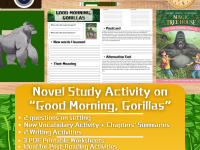
This comprehensive English teaching resource offers a structured novel study activity centred on Mary Pope Osborne's beloved book, "Good Morning, Gorillas" part of The Magic Tree House series. Spanning three printable PDF pages, this resource is perfect for enhancing students' understanding and engagement with the novel.
Designed for primary and middle school students in grades 3 through 6, this resource is an excellent choice for post-reading activities that reinforce key elements of the story. The novel study includes a variety of exercises aimed at deepening comprehension and encouraging creative expression.
Key components of this resource include:
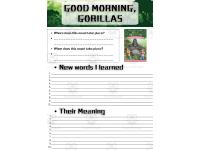
Setting Analysis: Students will answer two questions focusing on where and when the story takes place, helping them to grasp the importance of setting in the narrative.
Vocabulary Development: A dedicated section prompts students to identify and explore new vocabulary words encountered in the text, enhancing their language skills.
Chapter Summaries: Students are guided to summarize each chapter, reinforcing their understanding of the plot and key events.
Creative Writing Activities: Two engaging writing exercises are included to spark imagination. The first invites students to imagine themselves alongside Jack and Annie, the book's protagonists, and write a postcard to a friend or family member describing their adventure. The second activity challenges them to create an alternative ending to the story, fostering critical thinking and narrative skills.
This novel study resource not only aids in comprehension and vocabulary building but also encourages students to think critically and creatively about the story. It’s an ideal tool for teachers looking to enhance their English curriculum with interactive and thought-provoking activities related to The Magic Tree House series.
This English Language Novel Study on "Good Morning, Gorillas" PDF Printable Worksheets (3 slides) can be great for learners from Grade 3 to Grade 6 to study this Magic Tree House Novel
Learning with Alan is a Brand New Teaching Resource/Educational Material Store whose aim is to help Teachers, Educators and Tutors to achieve their teaching objectives while creating a fun and stimulating environment. Never Forget!
If you want to browse more of my Teaching Resources, click here Learning with Alan!
Related resources
More resources teachers may find useful
More resources on the same subject and topic.


In the classroom
Teaching tips & learning objectives

Learning objectives
State where and when the story takes place, drawing both from the text
Summarise each of the ten chapters in turn, keeping each summary inside twelve lines
Write in role as a traveller returning from the story's setting, covering place, events, learning and feeling in a single short piece
Construct an alternate ending by changing a character's decisions, and explain the effect of that change on the story's message and themes
Present that alternate ending to the class and discuss how the change alters a reader's understanding of the story

Teaching tips
A copy of the novel is needed alongside the pages: none of the story's text is reprinted and every space is a response frame
The chapter boxes are printed two to a row, so a class reading a chapter a day can complete one box at a time without needing the whole sheet at once
Twelve lines per chapter is a fixed budget, which makes the summaries a useful exercise in cutting detail rather than retelling everything
The postcard task names four things to cover — the place, what was learned about gorillas, events witnessed and how the writer felt — so it can be marked against its own checklist
The alternate-ending task ends in a class share, so allow discussion time after the writing rather than collecting the essays straight in

Skills covered
Identifying setting — the opening two questions ask students to name where and when the novel takes place before any other work begins.
Chapter-level summarising — ten boxes, one per chapter and twelve lines each, require the story to be retold in sections rather than as a whole.
Writing in role — the postcard task puts the student alongside Jack and Annie returning from the African Rainforest and asks for a first-person account of the trip.
Descriptive writing — the same task calls for vivid description so that a reader feels present, and for the writer's own feelings, whether scared, excited or amazed.
Reasoning about cause and consequence — the essay task asks how different character decisions would have produced a different conclusion, and what that does to the story's message and themes.
Good to know
Questions teachers ask about this resource
How much space does each chapter summary get?
Twelve ruled lines, in a box headed with the chapter number. The boxes run two to a row — Chapter 1 beside Chapter 2, Chapter 3 beside Chapter 4 — with Chapters 1 to 8 on the second page and Chapters 9 and 10 opening the third.
What does a student need alongside these pages?
A copy of "Good Morning, Gorillas" itself. No text from the novel is reprinted anywhere in the set; every space is a frame for the student's own response, keyed to the book's ten chapters and its setting, so the pages are worked with the book to hand.

No reviews yet
Downloaded this resource? Tell other teachers how it went.
Resource details
Concepts & topics
Core concepts
 Core concepts
Novel study
Setting
Summarizing
Creative writing
Alternate endings
 Topics
Explore more
Categories this resource belongs to
Explore related searches



More to explore