Classic Regency Novels


- Grades
- Grades 9–12
- Pages
- 5
- File type
- Preparation
- Print ready


- Subject
- Reading Comprehension, Reading, ELA
- Topic
- Novel Study, Literature
- Resource types
- Worksheets
- Preparation
- Print ready
From the author
About this resource
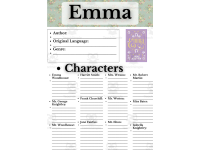
Study Emma by Jane Austen with a 5-page PDF from Learning with Alan. Students record general book information, describe 12 characters and 6 settings, and summarize 55 chapters.
The closing section offers 6 essay prompts, including a personal review and literary analysis. Supply the book and separate paper for extended responses; the PDF contains prompts and note spaces, not the novel or completed answers.
Related resources
More resources teachers may find useful
More resources on the same subject and topic.


In the classroom
Teaching tips & learning objectives

Learning objectives
Track and summarize the plot of Emma chapter by chapter across all 55 chapters
Describe twelve major characters and six key settings using evidence from the novel
Analyze how Austen uses marriage, social class, and gender roles to develop the novel's themes
Write an analytical essay tracing Emma Woodhouse's character development from self-assured matchmaker to self-aware individual

Teaching tips
Assign the chapter-summary grid as an ongoing reading log rather than a single sitting, since it covers all 55 chapters of the novel
Have students complete the character and setting profiles early in the unit as a reference sheet they can return to before writing the closing essays
Choose one or two of the six essay prompts per class rather than assigning all six, since each asks for a full analytical response (e.g. marriage and social class, or Emma's use of imagination)
Pair the setting-description blanks with a class map or timeline of Highbury to help students visualize the confined Regency-era world Austen describes

Skills covered
Chapter summarization — students record what happens across all 55 chapters of Emma in a running summary grid.
Character analysis — students profile twelve named characters, building toward the closing essay on Emma Woodhouse's development.
Thematic literary analysis — students analyze Austen's treatment of marriage, social class, and gender roles through targeted essay prompts.
Argumentative essay writing — students write a personal book review and defend an analytical claim about self-deception, decorum, or character growth.
Good to know
Questions teachers ask about this resource
How does the essay section build on the character and chapter work earlier in the guide?
The six essay prompts ask students to draw directly on the character profiles and chapter summaries completed earlier — for example, the prompt on Emma's imagination and self-deception references her relationships with Harriet Smith, Mr. Elton, and Frank Churchill, all of whom appear in the character-profile section.

No reviews yet
Downloaded this resource? Tell other teachers how it went.
Resource details
Concepts & topics
Core concepts
 Core concepts
Character development
Theme analysis
Regency-era social class
Chapter summarization
 Topics
Explore more
Categories this resource belongs to
Explore related searches




More to explore