Solving Equations With Variables On Both Sides Worksheets PDF

- Grades
- Grades 9–12
- File type
- Preparation
- Print ready


- Subject
- Algebra, Math
- Topic
- Variables, Solving Equations
- Resource types
- Worksheets
- Preparation
- Print ready
From the author
About this resource
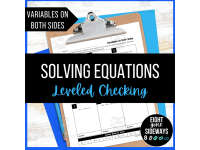
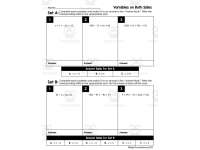
This is a Solving Equations with Variables on Both Sides - Levelled Checking Worksheet.
There are 4 sets with 3 problems each.
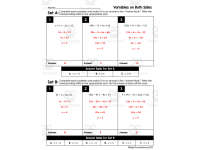
For Sets A and B, students will complete each problem and match it to an answer in the “Answer Bank.” Then they will write the corresponding letter in the appropriate spot.
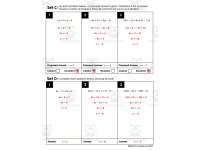
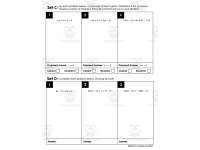
For Set C, a proposed answer is given. They will determine if the proposed Set C: answer is correct or incorrect and show all work that led them to their decision.
For Set D, they will complete each problem and show all their work.
Answer keys included.
Related resources
More resources teachers may find useful
More resources on the same subject and topic.



In the classroom
Teaching tips & learning objectives

Learning objectives
Solve a linear equation with variables on both sides, such as 9x - 4 = 8x + 2.
Apply the distributive property before combining like terms when a side of the equation is in parentheses, such as 2x + 1 = 3(x - 13).
Verify a proposed solution by substituting it back into the original equation and checking whether both sides are equal.
Select the correct solution from a set of plausible distractor answers rather than only generating one from scratch.

Teaching tips
Assign Set A and B before Set C and D, since the answer-bank format offers a self-checking scaffold that the later sets remove.
Use Set C explicitly to practice solution-checking as its own skill, separate from solving, since students must justify why a given answer is right or wrong.
Point out that Set B's answer bank includes extra choices that are never used, so students can't just eliminate down to the last remaining letter.
Use the fully worked answer key to model one problem from each set before students begin, since the four sets require different response formats.

Skills covered
Solving equations with variables on both sides — students collect variable terms and constants across both sides, as in 9x - 4 = 8x + 2.
Applying the distributive property — students expand expressions like 3(x - 13) or -2(x - 3) before solving.
Solution verification — in Set C, students substitute a given proposed answer back into the equation to judge whether it is correct or incorrect.
Answer-bank matching under distractors — in Set B, students select the correct solution from six choices when not all will be used.
Good to know
Questions teachers ask about this resource
Are all the answer-bank choices in Set B used?
No — Set B's answer bank has six lettered choices for only three problems, so some choices are deliberately left unused as distractors.

No reviews yet
Downloaded this resource? Tell other teachers how it went.
Resource details
Concepts & topics
Core concepts
 Core concepts
Variables on both sides
Distributive property
Linear equations
Solution verification
Topics
 Topics
Explore more
Categories this resource belongs to
Explore related searches




More to explore