Spanish Greetings Word Search – With Categories

- Grades
- Grades 7–9
- Pages
- 7
- File type
- Answer key
- Included


- Subject
- Spanish, Foreign Languages
- Topic
- Greetings, Worksheets
- Resource types
- Word Searches
- Answer key
- Included
From the author
About this resource
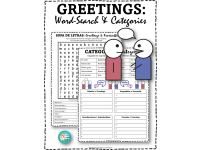
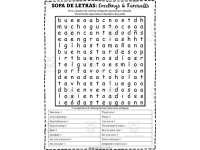
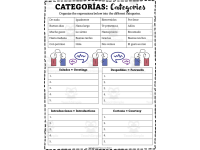
Help your students practice greetings, farewells, introductions and basic questions with our Greetings Worksheets for the Spanish class! This resource includes a word search puzzle activity in which students have to write the expressions in Spanish and then find these expressions within the puzzle in Spanish. It also includes an activity for students to sort the expressions into four categories: greetings, farewells, introductions and words of courtesy.
The objective of these worksheets is for students to familiarize themselves with common greeting expressions in Spanish and also with the basic questions that are typically asked on initial conversations when meeting someone.
Grades/Ages:
This resource is intended for beginner learners or as a review for higher levels of Spanish.
In this resource you can find:
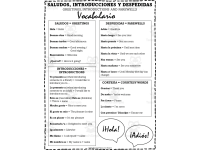
Information sheet with expressions divided in four categories: Greetings, Farewells, Introductions and Words of Courtesy
Information sheet with basic questions in Spanish and the way to answer them correctly (directed to a friend or someone you are familiar with)
Information sheet with basic questions in Spanish and the way to answer them correctly (directed to adults or people whom you should treat with respect/formally).
A word-search puzzle in which students have to write the expressions in Spanish and then they have to find the expression in the puzzle.
A writing activity in which students have to sort the expressions into 4 different categories.
Answer key for the matching activity
How to use these worksheets? Use the worksheets as:
Practice after introducing the topic of greetings.
Homework
Part of a substitute packet
Turn the worksheets to a game with a friendly competition of who finishes first with most accuracy
These worksheets offer students the opportunity to practice, memorize and retain expressions of greetings, farewells, introductions and words of courtesy in Spanish. With these expressions as part of their ever growing repertoire, students will be able to enhance their speaking, reading and writing abilities, which they can later transfer to real conversations.
Related resources
More resources teachers may find useful
More resources on the same subject and topic.



In the classroom
Teaching tips & learning objectives

Learning objectives
Translate common Spanish greeting, farewell, introduction, and courtesy expressions into and out of English.
Distinguish informal (tú) from formal (usted) question forms when asking someone their name, age, or origin in Spanish.
Sort Spanish expressions into the correct category of greetings, farewells, introductions, or courtesy words.
Locate translated vocabulary words within a word-search puzzle grid.

Teaching tips
Introduce the vocabulary reference on page 2 before the word search, since students must recall each Spanish translation from memory to fill in the puzzle's answer blanks.
Present the informal (page 3) and formal (page 4) question sets side by side to teach the tú/usted distinction directly, since both pages model the identical set of questions.
Assign the categorization exercise (pages 7-8) after the word search, since several of the same expressions (bienvenidos, gracias, adiós) reappear and reinforce recall.
Use the emotions/conditions and numbers lists on pages 3-4 as a bonus vocabulary extension beyond the greetings focus of the word search and categories.

Skills covered
Spanish-English vocabulary recall — students translate greeting, farewell, introduction, and courtesy expressions before locating them in a word-search grid.
Formal/informal register — students compare tú-form and usted-form versions of the same basic questions about name, age, origin, and feelings.
Categorization — students sort 16 Spanish expressions into four semantic groups: greetings, farewells, introductions, courtesy.
Puzzle-solving — students search forward, down, and diagonal directions to find translated vocabulary words.
Good to know
Questions teachers ask about this resource
How are the basic conversational questions presented?
The same set of questions about name, feelings, origin, and age appears twice: once in the informal tú form for addressing a friend, and again in the formal usted form for addressing an adult.
How is the word search meant to be completed?
Students first write the Spanish translation for each of fourteen English cues, such as welcome and see you soon, then search the puzzle grid forward, down, and diagonally to find the words they wrote.

No reviews yet
Downloaded this resource? Tell other teachers how it went.
Resource details
Concepts & topics
Core concepts
 Core concepts
Spanish greetings and farewells
Formal vs. informal address
Vocabulary categorization
 Topics
Explore more
Categories this resource belongs to
Explore related searches



More to explore
You may also like