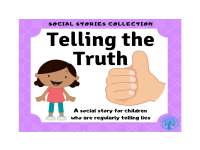
Telling the Truth Social Story

- File type
- Preparation
- Print ready


- Subject
- Social Skills, Special Resources
- Topic
- Social Story, Telling the Truth
- Preparation
- Print ready
From the author
About this resource
This twelve-page illustrated social story includes ten short first-person statements about telling the truth. Read it with a child and use familiar examples to discuss honesty, pretend play and mistakes.
The download contains the story, cover and publisher page. For repeated reading, place printed pages in a display book or laminate and bind them. Clipart is credited to Kari Bolt.
Related resources
More resources teachers may find useful
More resources on the same subject and topic.



In the classroom
Teaching tips & learning objectives

Learning objectives
Identify what makes a statement a lie, using the story's own definition: "when you say something that did not really happen."
Describe how lying can affect other people's feelings, citing the story's own examples of sadness and anger.
State a personal commitment to telling the truth, using the story's closing line ("I will always try to tell the truth") as a model.

Teaching tips
Read the ten statement pages aloud in sequence with a child, since each page builds on the honesty theme established by the one before it.
Because each page carries only one short sentence, pause after each page to ask the child to connect that statement to a situation they've experienced.
Use the repeated sentence stem ("When I tell lies it makes everyone feel...") as a discussion prompt, asking the child to predict the ending before turning the page.

Skills covered
Perspective-taking — the child considers how lying affects other people's feelings, moving from "sad" to "angry" across consecutive pages.
Behavioural self-commitment — the child rehearses a first-person promise to tell the truth, modelled on the story's closing statement.
Concept contrast — the child distinguishes a lie ("something that did not really happen") from the truth ("things exactly as they happened") using the story's own definitions.

No reviews yet
Downloaded this resource? Tell other teachers how it went.
Resource details
Concepts & topics
Core concepts
 Core concepts
Honesty
Lying versus truth-telling
Social-emotional learning
Consequences of lying
Topics
 Topics
Explore more
Categories this resource belongs to
Explore related searches


More to explore