resources by type
resources by grade
resources by subject
other resources

3,500 products added recently

Page 45 - 2nd Grade Worksheets

Provide your second graders with worksheets that promote growth in literacy, numeracy, and critical thinking. These resources align with curriculum standards and offer engaging activities. Incorporate them to strengthen understanding and encourage enthusiasm for learning.

Relevant
alt down
Any Time
alt down
filter by
alt down
All File Types
alt down
filter nav Show filters
Sort by: Relevant
CLEAR
resources by type
Activities
down arrow
Classroom Decor
down arrow
Teacher Tools
down arrow
Worksheets & Printables
up arrow
Drawing Templates & Outlines
Flashcards
Novel Studies
Parts of and Anatomy of
Task Cards
Word Problems
Writing Prompts
Worksheets
up arrow
Coloring Pages
Crosswords Puzzles
Dot To Dots
Mazes
Word Searches
Workbooks
resources by grade
Early Learning
down arrow
Pre-K
down arrow
Elementary
up arrow
Grade 1
Grade 2
Grade 3
Grade 4
Grade 5
Middle School
down arrow
High School
down arrow
Adult Education
Not Grade Specific
resources by subject
Creative Arts
down arrow
ELA
down arrow
Holiday & Seasonal
down arrow
Life Studies
down arrow
Math
down arrow
P.E. & Health
down arrow
Social Studies
down arrow
Special Resources
down arrow
Science
down arrow
Foreign Languages
down arrow
Resources for Teachers
down arrow
other resources
Common Core
Homeschool Resources
down arrow
Montessori
Research
STEM
Fossils Reading Comprehension Passage - Cored Ed Encyclopedia
Free Download

Fossils Reading Comprehension Passage - Cored Ed Encyclopedia
ELA, Reading Comprehension, Reading, Science, Technology, Earth and Environmental Sciences, Life Sciences, Pre-Reading, Language Development, Vocabulary, Grade 2, 3, 4, 5, Worksheets & Printables, Worksheets, Teacher Tools, Centers, Activities, Writing Prompts, Assessments, Quizzes and Tests, Quizzes, Lesson Plans

This fossils reading comprehension with lesson plan includes: Visualization (on the front cover) Start your lesson by taking a minute to think and share something about the topic. Read the script aloud (slowly), perhaps prepare some music or sound effects. Student close their eyes and let their imaginations wander. Students open their eyes, read the question aloud and give them a few minutes to complete. Ask a few students to share or keep answers until the end to compare with what they learn in the passage. Quick pause—thousands of Cored Education products are included with your TeachSimple membership. Download links and encyclopedia index available here. Pre-Reading Trivia Students will write down one thing they already know about the subject and then read five more facts and discuss. These facts are fun, and the students will enjoy learning about the subject before reading more. Give 1 minute for students to write what they already know (no pressure—best guess is fine). Read the five facts together. After each fact, do ask a student for their opinion, was it surprising? Set a purpose by asking students to highlight/underline one fact they want to learn more about during the reading. Reading Passage The text is a high-interest reading passage with set paragraphs, roughly three to four paragraphs long. It contains a variety of themes about the topic, anywhere from history to technology. The passage is between 250 and 350 words in length. First, ask students to look at the headings and see what they’ll learn about today. What do they know about the topic/heading? First read options: Teacher read-aloud (best for support). Partner reading (paragraph by paragraph). While reading, students underline important details, and vocabulary words they think may come up in the questions section. Mixed Questions The first question page contains four multiple-choice questions, each with a choice of four answers, and three written response questions that require a sentence or two from the student. Students complete the mcqs first independently, then review quickly as a class. For the 3 written responses, try to get students giving the answer with some form of evidence: “I think ___ because the text says ___.” If students get stuck, send them back to check the passage. Vocabulary Questions Practice seven key words from the text in this section across two activities. First section is scrambled words where students will unscramble three words given a clue for each. The second section is a word to meaning matching activity. Before starting, have some students read out words they underlined in the passage. Ask students to say the word and read aloud the sentence(s) around each word. Ask students to do scrambled words and the matching exercise in pairs then go through answers as a class. For the scrambled spelling task, get four pairs to come up to the board and write the words for extra practice with the other student reading out the clue. For the matching task, prompt students to give full sentences: “I matched ___ with ___ because ___.” Creative Writing In this question, the student will be required to write a five to eight sentence paragraph on a question related to the topic. Before starting, ask students write down 3 key ideas they are going to include in their piece. Ask students for ideas to share around the class to help those struggling. Pro writing expectations: 5–8 sentences At least 2 facts or details from the passage At least 2 vocabulary words from the previous page Students read their paragraphs while classmates listen for facts and vocabulary words. Extension Activities This page is optional for fast finishers or to take home. There are several activities, each one requiring a different skill. Do some, do none, do all, completely optional - but you will feel reassured knowing every possibility is planned for. Includes summary writting question and additional facts. Answer Key There are answers for the multiple-choice questions, written response questions have sample answers, vocabulary answers and if there is a summary question then a sample summary will be provided as well. Lesson Plan Included Customized lesson plan for this lesson is included. Lesson Snapshot Title: Fossils Genre: Nonfiction (Informational Text) Subject: Science (Earth Science/Life Science) / Reading (Informational Text) Primary Topic: Fossils, how they form, and what they reveal Estimated Guided Reading Level (A–Z): Q What This Lesson Teaches Best Defines a fossil and explains that fossils can be body parts (tooth, bone) or traces (footprint, burrow, fossilized poop) that become clues in the “fossil record.” Explains how fossils form when remains are quickly covered by sediment , and minerals in water replace material or fill empty spaces until remains harden like stone. Teaches mold and cast formation: a body can disappear, leaving a hollow mold that later fills to make a cast. Introduces paleontology and shows how scientists “read” patterns in sedimentary rock layers to learn how life has changed over time. Shows how fossils can guide new discoveries , including using rock layers to search for missing kinds of creatures (Tiktaalik example). Learning Goals Students will identify two kinds of fossils named in the text and give an example of each. Students will explain how sediment and minerals help remains become hard “as stone.” Students will describe how a mold and a cast can form, using the text’s explanation. Students will explain how scientists use patterns in sedimentary rock layers to learn which fossils are older. Students will describe why the fossil record is “not complete,” based on the passage. Students will describe how fossils can help scientists decide where to search for new discoveries. Key Vocabulary From the Text sediment — dirt and tiny bits of rock. minerals — materials in water that can harden remains. mold — a hollow shape left after a body is gone. cast — a filled-in copy of a hollow shape. paleontology — the study of ancient life using fossils. FULL CATALOG OF DOWNLOAD LINKS AND ENCYCLOPEDIA INDEX HERE

Author Cored Education

Rating

Tags Vocabulary, Reading Comprehension, Reading Passages, Lesson Plans, Ela Lesson Plans, Reading Comprehension Lesson Plans, Pre-reading, Science Lesson Plans, Earth Science, Life Science

Guided Reading Level K - The World of Goats (with Lesson Plan)
Free Download

Guided Reading Level K - The World of Goats (with Lesson Plan)
ELA, Resources for Teachers, Reading Comprehension, Reading, Science, Language Development, Life Sciences, Animals, Pre-Reading, Vocabulary, Grade 2, 3, 4, Worksheets & Printables, Worksheets, Teacher Tools, Centers, Activities, Literacy Readers, Quizzes, Quizzes and Tests, Assessments, Lesson Plans

This Guided Reading Book - The World of Goats (Level K) with lesson plan includes: Guided Reading Color Label (front cover x1) This is a quick way to match the book’s demands to what students can generally handle.. The overall goal is to use the level/color to pick books for several smaller groups. To qualify for a certain level, a student is expected to read a book from that level with about 90–94% accuracy. If a student is consistently accurate and understands, move up a level. If the student is struggling at that level, drop down and add more support. Each student will improve at completely different rates, but it is generally one of the best ways to check progress across the class. DOWNLOAD THE CATALOG TO VIEW ALL GUIDED READING BOOKS AVAILABLE (SORTED LEVELS A-Z) Pre-Reading Question (x1) Teacher asks the prompt aloud, can be while showing the cover or first page. Students share what they already know, or make educated guesses from the cover. Prompt them to use the target vocabulary. Write some of their responses on the board to look back at during the reading. Vocabulary Words (x5) Introduce the five words, best doing it one at a time. Start by saying it, while students repeat and then see if anyone knows what it means before reading further. Read through the meaning and try to briefly connect each word to a picture or gesture so it’s meaningful. Ask students to flip through the book pages and point to where they see each of the vocabulary words. While reading the book pause upon coming across one of the vocab words or read the sentence twice to make sure students understand the word has appeared. Optional: Ask students to raise hands whenever they see/hear one of the new words. Guided Reading Pages (x10) Check the book snapshot (below) for: primary topic - do you need to prep extra reading or intro materials on this? what is taught best - decide on 1-2 bullets to focus on, use the prompt or words provided here for best results. learning goals - what you are checking for students to be able to do after the session, elicit answers using prompts or words provided. key vocabulary (see section above). questions overview - so you know what is coming up and if you need to prep extra materials to assist understanding. Run the lesson You may have already looked at a few of the pages together, but you can show them some of the pictures again first to set meaning. Depending on how much time you have and how familiar your students are with guided reading class, you may want to read the book aloud first with the group first. Students whisper or partner read, while you listen in. If time, do it as a group, one student reading a page each. Use the guided page’s prompts to coach: “Check the picture / does it make sense?” “Point under the words / try the first sound” “Reread the sentence smoothly”. Try to focus more on one student per session (rotating every time), so you can work out if they are ready to move up or need to move down a level. Comprehension Questions (back cover x3) This is your way to check that students didn’t just say the words, but actually understood the text. First, let students answer by pointing to the page/picture and saying a short sentence. After any answer, follow with: “Show me where you found that in the text.” In bigger groups, have partners answer first (10–20 seconds), then call on 2–3 students to share. Differentiation tips: Emerging speakers/struggling readers: oral + pointing On-level: oral in a full sentence Higher: one written sentence or draw + label Book Snapshot Title: The World of Goats Genre: Nonfiction (informational text) Subject: Life Science + Reading (Informational Text) Primary Topic: Goat traits, behaviors, and how they help Estimated Guided Reading Level (A–Z): K What This Book Teaches Best Describes goats as “smart and curious” animals that live in many places around the world. Explains body parts that help goats move and stay safe (horns, hooves, and special eyes that help them “see all around”). Teaches what goats eat by defining them as “herbivores” and naming plants they munch on (grass, leafy bushes, bark). Highlights goat abilities and behaviors (climbing steep, rocky cliffs; kids running and jumping; goats playing and gently bumping heads). Connects goats to farm life by stating they provide milk and wool. Learning Goals Students will identify key goat traits and behaviors described in the text. Students will explain how horns and hooves help goats, using details from the text. Students will describe how a goat’s special eyes help it stay safe. Students will explain what herbivores eat and list plants goats munch on from the text. Students will describe how goats communicate and what a “bleat” can help a mother goat do. Students will describe how goats can be helpful to people on a farm, according to the text. Key Vocabulary From the Text curious — wanting to learn more by exploring. hooves — hard feet that help goats walk. rectangles — shapes with four sides and four corners. herbivores — animals that eat only plants. bleat — the sound a goat makes. Discussion Prompts Pre-reading question: What features might help goats live in different places? Comprehension questions: How do a goat’s special eyes help it stay safe? Comprehension questions: What kinds of plants does the book say goats like to munch on? Comprehension questions: Why do goats gently bump their heads when they play together? Printing Tips 1. Best Printing Method (Recommended) “Booklet” Printing (Best if Available) If your printer or PDF viewer supports Booklet Printing , use this. Settings to use: Print mode: Booklet Paper size: Letter or A4 (either works) Orientation: Landscape Print on both sides: Yes Flip on: Short edge Scaling: Fit to printable area Booklet subset: First test: Front sides only Then: Back sides only This will automatically: Pair pages correctly Put the cover on the outside Align everything for folding After printing, fold in half and staple along the spine . 2. If “Booklet” Printing Is NOT Available You can still print this correctly with manual duplex printing . Step-by-step: Open the PDF. Choose Print . Set: Orientation: Landscape Pages per sheet: 1 Print on both sides: Yes Flip on: Short edge Print all pages . Because each PDF page already contains two facing book pages, the result will still fold cleanly into a book. Thousands of Cored Education products are included with your TeachSimple membership. Download links and encyclopedia index available here.

Author Cored Education

Rating

Tags Reading Comprehension, Reading Passages, Reading, Guided Reading, Guided Reading Lesson Plan, Guided Reading Activity, Pre-reading, Science Lesson Plans, Life Science, Animals

4*4 SUDOKU GALAXY FOR FUN!! ( 5 puzzles + answer keys )

4*4 SUDOKU GALAXY FOR FUN!! ( 5 puzzles + answer keys )
Math, Grade 1, 2, 3, Worksheets & Printables, Worksheets

05 SUDOKU GALAXY 4*4 FOR FUN!! 1- Introduction : welcome to creative classroom collection store _ where we mix fun with learning ! Our store presents 4x4 Sudoku galaxy puzzles for your students to help them become smarter and have a great time. 2-Objective : with our sudoku puzzles your students will develop logical thinking , problem-solving , and concentration skills and of course while having fun 4x4 Sudoku is a simple version of sudoku so thats perfect for beginners and young learners it's perfect for ages around 4 to 7 years old and for Kindergarten to grade 2 or 3. how teacher can use our 4x4 Sudoku puzzles : morning warm-up use it at the start of class to help students focus early finisher activities :Perfect for smart students who always finish their work and activities early. group work :Students can work in groups to solve the puzzle and develop communication and teamwork skills. You can also use it during break time. Our document is a PDF and includes 5 Sudoku puzzles with their answer keys. We hope you have a better class with your students 😊

Author Creative Classroom Collection

Rating

Tags Critical Thinking, Logic Puzzles, Math Centers, Early Math, Visual Discrimination, Problem Solving, Pattern Recognition, Space, Astronomy, First Grade

The Chunk Neighborhood | Phonics Printable

The Chunk Neighborhood | Phonics Printable
ELA, Language Development, Phonics, Preschool, Grade 1, 2, Worksheets & Printables, Worksheets

This resource is a Chunk Neighborhood Set. Each page features a mini house with vowel chunks at the top. Students will use the blank lines in the house to write words that have that vowel pattern. They can be printed 2 per page or 1 per page.

Author Monaco Lane Curriculum for Early Literacy

Tags Digraphs, Consonant Blends, Phonics, Chunks, Language Skills

o-e Phonic Worksheets for Early Years/Intervention

o-e Phonic Worksheets for Early Years/Intervention
Special Resources, ELA, Language Development, Phonics, Reading, Spelling, Kindergarten, Preschool, Grade 1, 2, Activities, Worksheets & Printables, Worksheets

This is a pack of 12 phonic worksheets for the Long Vowel O-E (as in rope) specially designed for those with special needs, including those with dyslexia or who may be suspected of being dyslexic but will work equally well with young learners in Kindergarten/EYFS/Y1. A pack of 12 worksheets with a variety of exercises to help build phonemic awareness and reading fluency. These sheets are LETRS and UK GOV requirements aligned. These worksheets also align with the most popular phonic programmes, including RWI and Letters and Sounds. What is included? 12 worksheets for the sound O-E taking pupils from hearing the sounds in words to reading and spelling them at word and sentence level. all following my special method devised as I privately tutor children of all ages with profound special needs. Your phonics lessons covered! Tracking, fluency triangles, spelling, reading, games, comprehension exercises....and more! Who are these worksheets for? I have written them for pupils who struggle with processing information - especially sounds. This includes children who are DYSLEXIC or have ANY other kind of processing disorder. Such children may have failed with other methods of teaching phonics. Such pupils need activities that: ·are highly structured - one tiny step at a time building on the one before using only a limited number of words to start with and only using words that the child has already learnt to sound out, with no nasty surprises. ·Have only a little on each pageas these pupils tire easily. What makes these worksheets special? I have a powerful three-step process which I use with my special needs pupils, which is worked out over the course of the 12 worksheets: 1. See it!where we focus on becoming aware of the new sound in words. This involves first hearing the new sound in words and then seeing it in words (tracking). 2. Sound-it-out!Having learnt to see the new sound in words, we learn to sound out these words to read and write them. We begin by usingsound-it-out boxesfor reading and spelling which help the child to segment the word prior to blending the sounds together. Once the child can read and write individual words, we work on fluency by building familiarity with the common words in the new sound family. Once the child can sound the words out to read and spell confidently, we move on to recognising them/using them in longer reading and dictation passages, as soon as the child is able. I provide 2 reading passages with comprehension exercises and one dictation passage, with a page in the workbook dedicated to it, with room for a picture, which again cements understanding. 3. Write it! Incorporated into the above two steps, we constantly write the new sound. This adds a multi-sensory dimension to our work - we see with our eyes, we sound it with our mouth parts and voice, and then we move by writing. All three steps work together to help the child feel in control of his/her learning and to become a successful, confident learner. We finish each sound with a dictation which culminates our work before we move on to the next sound. I try to give the dictation a week after we finish the work on the EA sound to act as revision. The dictation: Read this passage to your pupil, who should write it. Have the child read his/her work and check for errors. Make sure the writing is completely accurate before saying the child has finished, including full stops and capital letters correctly used. Flashcards are included of some common O-E words. What is included? 1 PDF with flashcards and 12 O-E worksheets

Author Lilibette's Resources

Tags Magic E, Phonic Worksheets, Special Needs, Phonic Games, Print N Play Phonic Game, Split Digraph O-e, O-e Worsheets, Silent E, Split Digraph O-e, Phonics O-e

Initial Sound in a Word

Initial Sound in a Word
ELA, Language Development, Phonics, Preschool, Grade 1, 2, Worksheets & Printables, Worksheets

Initial Sound in a Word is a phonics resource designed to help early elementary students learn how to identify the beginning sound in words. This packet contains worksheets featuring engaging clipart images of common objects. Students will look at each picture, identify what the object is, and determine the first letter that makes the beginning sound of the word. They will then locate that letter among the letters listed and color it in. These worksheets can be used individually or in small groups as a fun way for K-2 students to practice phonics skills. The PDF worksheets work well for whole class instruction, independent practice, homework, or morning work. This resource provides a multisensory approach to build phonics skills using visual, auditory, and fine motor practice tracing and coloring the beginning letter.

Author SEN Resource Source

Tags Phonics, Early Reading, Beginning Sound, Initial Sound

Shapes Crosswords (PDF)

Shapes Crosswords (PDF)
ELA, Language Development, Resources for Teachers, Vocabulary, Spelling, ESL, Shapes, Early Math, Math, Grade 2, 3, 4, 5, Worksheets & Printables, Worksheets, Teacher Tools, Crosswords Puzzles, Centers, Activities

Crossword Series This crossword series is designed for students in grades 2–5. Each set of crosswords is built around a clear vocabulary theme, allowing students to strengthen their word recognition, build subject-based knowledge, and reinforce early literacy and thinking skills. Each topic includes six crossword sets , and each set features the following consistent structure: 1. 8 vocabulary clues 2. Crossword puzzle 3. Answer key 4. 1 Did You Know fact related to the set These crosswords are designed to be student-friendly, classroom-ready, and easily integrated into thematic units, seasonal learning, morning work, or independent literacy stations. Shapes Crosswords Word List 1. Basic Shapes Circle, Square, Triangle, Rectangle, Oval, Star, Heart, Diamond 2. 3D Shapes Cube, Sphere, Cylinder, Cone, Pyramid, Rectangular prism, Hemisphere, Torus 3. Shapes in Everyday Life Wheel, Window, Stop sign, Ball, Pizza slice, Dice, Ice cream cone, Tabletop 4. Describing Shapes Round, Pointy, Flat, Curved, Straight, Symmetrical, Wide, Narrow 5. Fun & Unique Shapes Hexagon, Pentagon, Octagon, Crescent, Trapezoid, Parallelogram, Spiral, Arrow 6. Jobs & Tools Using Shapes Architect, Artist, Engineer, Designer, Carpenter, Mapmaker, Mathematician, Puzzle maker PDF Version Other versions will appear here when available. Follow the store for the lastest on new products. How to Use This Crossword These crosswords are ideal for whole-class work, small groups, literacy centers, or take-home activities. Use one set per day, or spread them across a week or month depending on your curriculum needs. Each clue has been crafted to align with the reading level of grades 2–5, with support for both decoding and meaning. The Did You Know? facts offer additional extension opportunities for writing, drawing, or display work. Whether you're reinforcing vocabulary, exploring a seasonal topic, or adding variety to your literacy block, these crosswords provide a fun, flexible, and focused way to boost early literacy in an engaging format. More Shapes Themed Products Nothing yet, but follow for the latest on new products. FULL CATALOG OF DOWNLOAD LINKS HERE Addition PDF Animals PDF Around the Home PDF Birthday PDF Candy PDF Christmas PDF Cinco de Mayo PDF Clothes PDF Colors PDF Days and Months PDF Division PDF Earth Day PDF Easter PDF Easy Crosswords PDF Fall PDF Father's Day PDF Food PDF Geography (Set 1) PDF Geography (Set 2) PDF Geography (Set 3) PDF Graduation PDF Health PDF History (Set 1) PDF History (Set 2) PDF History (Set 3) PDF Human Body PDF Kindness PDF Life Skills PDF Mother's Day PDF Multiplication PDF Science Crosswords (Set 1) PDF Science Crosswords (Set 2) PDF Science Crosswords (Set 3) PDF Shapes PDF Social Skills PDF Spring PDF Sports PDF St. Patrick's Day PDF Subtraction PDF Summer PDF Thanksgiving PDF Transport PDF Valentine's Day PDF Winter PDF Crosswords in Depth Structure Each crossword clue is written in simplified language to suit early readers, and follows a strict number-and-clue format (e.g., 1.A shape with four sides ). Students complete each puzzle using the themed vocabulary provided, helping to build both content knowledge and spelling confidence. Each completed set includes: A questions section with clearly formatted clues An answers section to support teacher checking or independent correction A Did You Know? fact tied to the topic (one per set) to add curiosity and cross-curricular value Themes Included The crosswords cover a wide variety of engaging, age-appropriate themes such as: Seasons & Holidays (e.g., Winter, Easter, Valentine’s Day) Math Concepts (e.g., Addition, Subtraction, Multiplication, Division) Everyday Topics (e.g., School, Colors, Animals, Weather) Special Units (e.g., Health, Earth Day, Sports, Graduation, Kindness) Each theme is carefully selected to reflect the experiences and interests of young learners, while reinforcing vocabulary and comprehension. For similar downloads and other frees, do check out Cored Group on TeachSimple.

Author Cored Education

Rating

Tags Vocabulary, Spelling, Crosswords, Basic Shapes, 3D Shapes, Shapes, Shape Crosswords, Math, Math Crosswords, Describing Shapes

Summer Addition & Subtraction Riddles

Summer Addition & Subtraction Riddles
Math, Numbers, Preschool, Grade 1, 2, Worksheets & Printables, Worksheets

A Summer-themed printables /worksheets/worksheets-by-subject/math-worksheets">math worksheet to help your students practice addition, subtraction, and have fun solving the math riddles! Look at the numbers on each picture. Write the same number next to each small picture below. Solve the problems.

Author Cherry Workshop

Tags Summer, Addition, Subtraction, Numbers, Math, Summer Riddle, Summer Riddles

Cute Cat Dot to Dot Worksheet Activity, Cats Connect the Dots

Cute Cat Dot to Dot Worksheet Activity, Cats Connect the Dots
Creative Arts, Art, Fine Arts, Graphic Arts, Preschool, Grade 1, 2, 3, 4, 5, Dot To Dots, Worksheets, Worksheets & Printables

Cute Cat Dot to Dot Worksheet Activity , Cats Dot to Dot Morning Work Activities / Kawaii Cat Connect the Dots / Digital Resources: Kawaii Cat Animal Connect The Dots Worksheets - Morning Work Activities : ⭐ These worksheets provide a playful opportunity for kids to practice their fine motor skills while uncovering intricate feline illustrations. ⭐ Meow-tastic Cat Designs: These dot-to-dot worksheets feature an array of adorable cat-themed illustrations, from playful kittens to majestic, regal cats, each waiting to be uncovered. ⭐ Educational Fun: Encourage cognitive development and learning in a fun and interactive way. Children will sharpen their number recognition skills while engaging with captivating cat characters. ⭐ Perfect for All Ages: Our dot-to-dot worksheets are suitable for various age groups, making them an adaptable activity for preschoolers, elementary students, and even cat-loving adults! ⭐ Early Morning Engagement: Set a positive tone for the day by offering these delightful cat-themed worksheets as morning work. It's a wonderful way to begin the day with a dose of fun and learning. ⭐ Print and Play: Easily print these worksheets for classroom use or create an at-home morning routine that's both entertaining and educational. What's Included: You will receive a download with a zip file containing 10 x A4 sheets.

Author Lapiiin Art Activities

Tags Cat Dot To Dot , Cat Connect The Dots, Tracing Lines, Morning Work, Digital Resources, Fine Motor, Coloring Pages, Printables, Pen Control, Animals Worksheet Activity

Jugglers Reading Comprehension Passage - Cored Ed Encyclopedia
Free Download

Jugglers Reading Comprehension Passage - Cored Ed Encyclopedia
ELA, Reading Comprehension, Reading, Language Development, History, Social Studies, Geography, Pre-Reading, Vocabulary, Spelling, Grade 2, 3, 4, 5, Worksheets & Printables, Worksheets, Teacher Tools, Centers, Activities, Writing Prompts, Assessments, Quizzes and Tests, Quizzes, Lesson Plans

This Jugglers reading comprehension with lesson plan includes: Visualization (on the front cover) Start your lesson by taking a minute to think and share something about the topic. Read the script aloud (slowly), perhaps prepare some music or sound effects. Student close their eyes and let their imaginations wander. Students open their eyes, read the question aloud and give them a few minutes to complete. Ask a few students to share or keep answers until the end to compare with what they learn in the passage. Quick pause—thousands of Cored Education products are included with your TeachSimple membership. Download links and encyclopedia index available here. Pre-Reading Trivia Students will write down one thing they already know about the subject and then read five more facts and discuss. These facts are fun, and the students will enjoy learning about the subject before reading more. Give 1 minute for students to write what they already know (no pressure—best guess is fine). Read the five facts together. After each fact, do ask a student for their opinion, was it surprising? Set a purpose by asking students to highlight/underline one fact they want to learn more about during the reading. Reading Passage The text is a high-interest reading passage with set paragraphs, roughly three to four paragraphs long. It contains a variety of themes about the topic, anywhere from history to technology. The passage is between 250 and 350 words in length. First, ask students to look at the headings and see what they’ll learn about today. What do they know about the topic/heading? First read options: Teacher read-aloud (best for support). Partner reading (paragraph by paragraph). While reading, students underline important details, and vocabulary words they think may come up in the questions section. Mixed Questions The first question page contains four multiple-choice questions, each with a choice of four answers, and three written response questions that require a sentence or two from the student. Students complete the mcqs first independently, then review quickly as a class. For the 3 written responses, try to get students giving the answer with some form of evidence: “I think ___ because the text says ___.” If students get stuck, send them back to check the passage. Vocabulary Questions Practice seven key words from the text in this section across two activities. First section is scrambled words where students will unscramble three words given a clue for each. The second section is a word to meaning matching activity. Before starting, have some students read out words they underlined in the passage. Ask students to say the word and read aloud the sentence(s) around each word. Ask students to do scrambled words and the matching exercise in pairs then go through answers as a class. For the scrambled spelling task, get four pairs to come up to the board and write the words for extra practice with the other student reading out the clue. For the matching task, prompt students to give full sentences: “I matched ___ with ___ because ___.” Creative Writing In this question, the student will be required to write a five to eight sentence paragraph on a question related to the topic. Before starting, ask students write down 3 key ideas they are going to include in their piece. Ask students for ideas to share around the class to help those struggling. Pro writing expectations: 5–8 sentences At least 2 facts or details from the passage At least 2 vocabulary words from the previous page Students read their paragraphs while classmates listen for facts and vocabulary words. Extension Activities This page is optional for fast finishers or to take home. There are several activities, each one requiring a different skill. Do some, do none, do all, completely optional - but you will feel reassured knowing every possibility is planned for. Includes summary writting question and additional facts. Answer Key There are answers for the multiple-choice questions, written response questions have sample answers, vocabulary answers and if there is a summary question then a sample summary will be provided as well. Lesson Plan Included Customized lesson plan for this lesson is included. Lesson Snapshot Title: Jugglers Genre: Nonfiction (informational text) Subject: Reading (Informational Text) / Social Studies / Arts Primary Topic: Juggling across history and repeating patterns Estimated Guided Reading Level (A–Z): S What This Lesson Teaches Best Traces juggling through time and places (ancient Egypt, China, Greece/Rome, Europe, and today). Uses a historical example (an Egyptian tomb painting) to explain evidence of early juggling and what it suggests about audiences. Highlights performance skills jugglers show—control, timing, courage—and how crowds can understand the act “without any words.” Explains change over time: juggling’s reputation in Europe after the Roman Empire weakened, and how modern circuses brought it into the spotlight. Emphasizes the repeating pattern at the heart of juggling (throw, wait, catch, repeat) and connects it to learning rhythm with patience. Learning Goals Describe what the Egyptian tomb painting shows and why the passage calls it an early picture of toss juggling. Explain how juggling was used to impress or amaze people in different cultures mentioned in the text. Describe how some people in Europe viewed jugglers later and explain what the skill did instead of disappearing. Identify the basic juggling pattern named in the passage and explain why it matters. Compare where a juggler might perform today (stage, circus ring, sidewalk) and explain what stays the same. Key Vocabulary From the Text tomb — a place where someone is buried. audiences — groups of people watching a performance. festivals — celebrations with events and crowds. rhythm — a steady beat or timing pattern. wrongdoing — doing something people believe is wrong. FULL CATALOG OF DOWNLOAD LINKS AND ENCYCLOPEDIA INDEX HERE

Author Cored Education

Rating

Tags Vocabulary, Reading Comprehension, Reading Passages, Lesson Plans, Ela Lesson Plans, Reading Comprehension Lesson Plans, Pre-reading, Social Studies Lesson Plans, History, Geography

Geography Crosswords - Set 2 (PDF)

Geography Crosswords - Set 2 (PDF)
ELA, Language Development, Vocabulary, Spelling, ESL, Resources for Teachers, Geography, Social Studies, Grade 2, 3, 4, 5, Worksheets & Printables, Worksheets, Teacher Tools, Crosswords Puzzles, Centers, Activities

Crossword Series This crossword series is designed for students in grades 2–5. Each set of crosswords is built around a clear vocabulary theme, allowing students to strengthen their word recognition, build subject-based knowledge, and reinforce early literacy and thinking skills. Each topic includes six crossword sets , and each set features the following consistent structure: 1. 8 vocabulary clues 2. Crossword puzzle 3. Answer key 4. 1 Did You Know fact related to the set These crosswords are designed to be student-friendly, classroom-ready, and easily integrated into thematic units, seasonal learning, morning work, or independent literacy stations. Geography Crosswords Set 2 Word List 1. More Countries of the World Germany, Italy, Russia, South Africa, Argentina, Saudi Arabia, Thailand, Canada 2. More Famous Cities Los Angeles, Beijing, Moscow, Berlin, Dubai, Madrid, Buenos Aires, Seoul 3. More Famous Landmarks Machu Picchu, Big Ben, Leaning Tower, Christ the Redeemer, Stonehenge, Mount Rushmore, Petra, The Louvre 4. Bodies of Water Amazon River, Nile River, Mississippi River, Lake Superior, Mediterranean Sea, Arctic Ocean, Gulf of Mexico, Dead Sea 5. Climate and Weather Tropical, Desert, Polar, Humidity, Hurricane, Tornado, Drought, Monsoon 6. Geography Tools and Maps Globe, Map, Compass, Latitude, Longitude, Equator, Hemisphere, Legend PDF Version Other versions will appear here when available. Follow the store for the lastest on new products. How to Use This Crossword These crosswords are ideal for whole-class work, small groups, literacy centers, or take-home activities. Use one set per day, or spread them across a week or month depending on your curriculum needs. Each clue has been crafted to align with the reading level of grades 2–5, with support for both decoding and meaning. The Did You Know? facts offer additional extension opportunities for writing, drawing, or display work. Whether you're reinforcing vocabulary, exploring a seasonal topic, or adding variety to your literacy block, these crosswords provide a fun, flexible, and focused way to boost early literacy in an engaging format. More Geography Themed Products Geography Crosswords (Set 1) PDF Geography Crosswords (Set 3) PDF FULL CATALOG OF DOWNLOAD LINKS HERE Themed Crossword Links Addition PDF Animals PDF Around the Home PDF Birthday PDF Candy PDF Christmas PDF Cinco de Mayo PDF Clothes PDF Colors PDF Days and Months PDF Division PDF Earth Day PDF Easter PDF Easy Crosswords PDF Fall PDF Father's Day PDF Food PDF Geography (Set 1) PDF Geography (Set 2) PDF Geography (Set 3) PDF Graduation PDF Health PDF History (Set 1) PDF History (Set 2) PDF History (Set 3) PDF Human Body PDF Kindness PDF Life Skills PDF Mother's Day PDF Multiplication PDF Science Crosswords (Set 1) PDF Science Crosswords (Set 2) PDF Science Crosswords (Set 3) PDF Shapes PDF Social Skills PDF Spring PDF Sports PDF St. Patrick's Day PDF Subtraction PDF Summer PDF Thanksgiving PDF Transport PDF Valentine's Day PDF Winter PDF Crosswords in Depth Structure Each crossword clue is written in simplified language to suit early readers, and follows a strict number-and-clue format (e.g., 1.A shape with four sides ). Students complete each puzzle using the themed vocabulary provided, helping to build both content knowledge and spelling confidence. Each completed set includes: A questions section with clearly formatted clues An answers section to support teacher checking or independent correction A Did You Know? fact tied to the topic (one per set) to add curiosity and cross-curricular value Themes Included The crosswords cover a wide variety of engaging, age-appropriate themes such as: Seasons & Holidays (e.g., Winter, Easter, Valentine’s Day) Math Concepts (e.g., Addition, Subtraction, Multiplication, Division) Everyday Topics (e.g., School, Colors, Animals, Weather) Special Units (e.g., Health, Earth Day, Sports, Graduation, Kindness) Each theme is carefully selected to reflect the experiences and interests of young learners, while reinforcing vocabulary and comprehension. For similar downloads and other frees, do check out Cored Group on TeachSimple.

Author Cored Education

Rating

Tags Vocabulary, Spelling, Crosswords, Geography, Geography Crosswords, Countries Of The World, Famous Cities, Famous Landmarks, Bodies Of Water, Climate And Weather

Inverse Operations Addition and Subtraction Worksheet

Inverse Operations Addition and Subtraction Worksheet
Math, Addition and Subtraction, Addition, Subtraction, Grade 2, Worksheets & Printables, Worksheets

Inverse Operations Addition and Subtraction Worksheet This 2-page printable allows students to practice addition and subtraction by using inverse operations. Inverse operations are a set of two opposite operations that undo each other. On the first page, students are given 3 numbers in each of the 12 boxes. Their task is to write 4 equations for each number set - 2 addition equations and 2 subtraction equations. This tests their understanding of inverse operations. The second page provides a bigger challenge, as students create their own number sets and write 4 corresponding equations. This activity pushes their conceptual knowledge further and lets teachers assess mastery of the inverse operations concept. Teachers can implement this versatile resource in small groups, centers, partner work, homework, exit tickets, or assessments. For partner work, students can create number sets then trade papers and solve each other's problems. Checking work and discussing different solution methods deepens learning. Learning to apply inverse operations flexibly aids development of number sense and mental math skills. This worksheet offers engaging practice towards those ends through self-checking and collaboration.

Author Elementary Resources 4 U

Tags Opposite Operations, Inverse Operations, Addition, Subtraction, Small Group, Partner Work, Math Homework, Writing Sums, Math Centers, The Inverse Of Addition Is, Inverse Operation Worksheet, Inverse Operations Addition And Subtraction, What Is The Inverse Of Subtraction?, Inverse Operation Of Subtraction, What Is The Inverse Operation Of Addition, Inverse Of Subtraction, Inverse Of Addition, Addition And Subtraction Are Inverse Operations

Poppy & Ma's May Daily Math Practice.

Poppy & Ma's May Daily Math Practice.
, Grade 2, Worksheets & Printables, Word Problems, Worksheets

Poppy & Ma's May Daily Math Practice This is a mindful resource designed specifically for grade 2 educators aiming to fortify foundational math concepts. This comprehensive PDF contains 24 ready-to-print pages filled with meticulously designed activities. Coverage of Essential Topics Poppy's Odd Pages: Filled with lessons on addition and subtraction facts, double & triple digit calculations with regrouping, money comprehension, understanding place values and expanded forms, geometric shapes exploration & operation properties, and estimation skills. Ma’s Even Pages: Create an immersion in timekeeping along with additional challenges in double-digit problems that involve regrouping and introduction to multiplication & division concepts. The students are also engaged in dealing with remaining division problems. Versatility of Usage This package can be effectively used in both whole group learning rotations or small study groups requiring specific focus on particular Common Core standards needing repletion or reinforcement. It is also a valuable tool for conducting weekly mini- assessments for measuring levels of comprehension on newly taught Common Core math skills or revisiting previous topics. Apart from school hours usage, it serves well as supplemental homework practice ensuring persistent revision at home. In Summary: Poppy & Ma's May Daily Math Practice- Encounter an innovative teaching approach via this dynamic resource that harmonizes maths fun and complete comprehension!

Author Second Grade Smartypants

Tags Math Concepts, Daily Practice, Elementary Mathematics, Addition And Subtraction, Timekeeping

Single Digit Subtraction Worksheets and Timed Assessments

Single Digit Subtraction Worksheets and Timed Assessments
Math, Addition and Subtraction, Subtraction, Preschool, Grade 1, 2, Worksheets, Worksheets & Printables

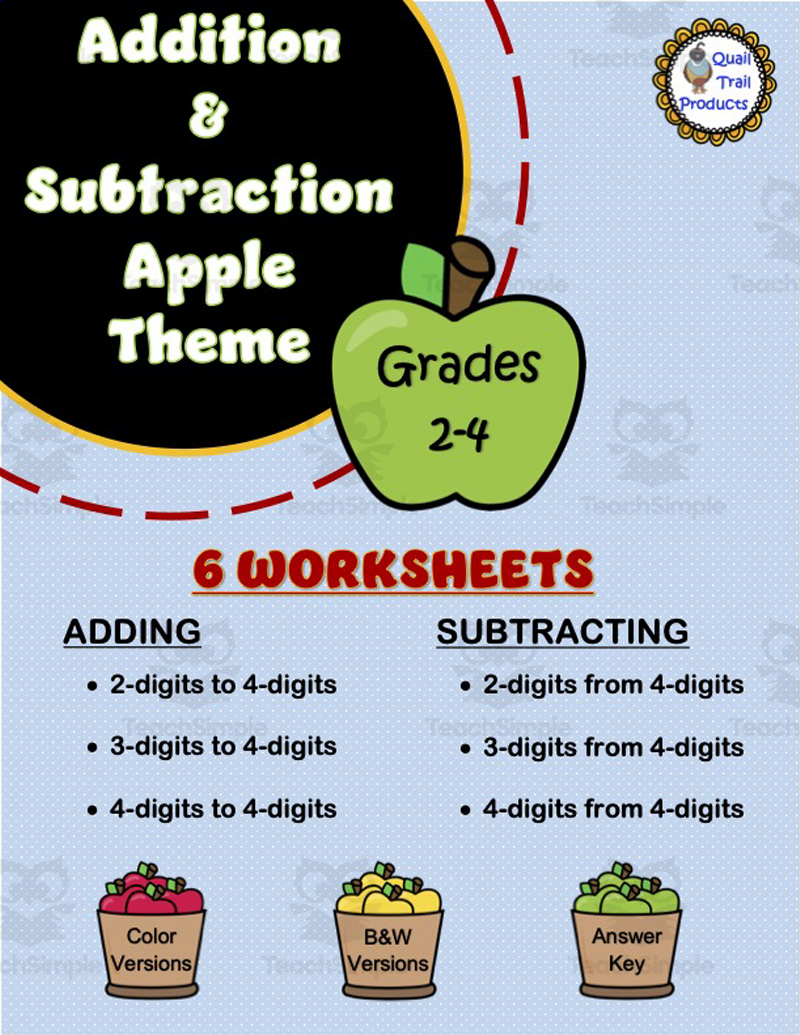
Single Digit Subtraction Worksheets and Timed Assessments The Single Digit Subtraction Worksheets and Timed Assessments are a comprehensive teaching resource for kindergarten, grade 1, and grade 2 students. This product boasts of less-stress subtraction worksheets, drills, and timed assessments within the number range of 0-10 - suggesting it as an all-rounded platform promoting knowledge gain at different learning stages. This instructional set offers different skill levels made specifically to accommodate various learning stages. Using this resource pack, students can track their progress in solving subtraction problems while simultaneously improving their speed. Inclusions A wide assortment of themed assessment pages ranging from racing cars to honeybees. Each theme comes with its unique number problem count escalating from twelve problems on a page till twenty-eight problems on others for added variety in engagement. An array of practice worksheets paired with each theme: visualize solving math equations through race car styled mazes or climbing ice cream scoops by deciphering algebraic riddles. Scheduled subtraction drills have been established ensuring frequent practicing focusing specifically on pairs like "1's & 2's", slowly progressing till "9's &10's". Flexible Nature Favourable for both classrooms as well as homeschool setups alike these materials can be assigned either for whole class sessions or split into smaller groups supporting individual attention catering also into weekly homework assignments expanding its scope multi-fold. In total there are twenty pages ripe with stimulating themes ready to make math an adventurous venture rather than a perceived dull topic transmuted into easily downloadable PDF format facilitating user ease making it one-stop-shop material for educators pursuing multifaceted teaching methods especially focusing on early year grades.

Author Quail Trail Products

Tags Subtraction Worksheets, Timed Assessments, Kindergarten Math, Grade 1 Math, Grade 2 Math

Guided Reading Level N - All About Deserts (with Lesson Plan)

Guided Reading Level N - All About Deserts (with Lesson Plan)
ELA, Resources for Teachers, Reading Comprehension, Reading, Language Development, Life Sciences, Science, Earth and Environmental Sciences, Geography, Social Studies, Grade 2, 3, 4, Worksheets & Printables, Worksheets, Teacher Tools, Centers, Activities, Literacy Readers, Quizzes, Quizzes and Tests, Assessments

This Guided Reading Book - All About Deserts (Level N) with lesson plan includes: Guided Reading Color Label (front cover x1) This is a quick way to match the book’s demands to what students can generally handle.. The overall goal is to use the level/color to pick books for several smaller groups. To qualify for a certain level, a student is expected to read a book from that level with about 90–94% accuracy. If a student is consistently accurate and understands, move up a level. If the student is struggling at that level, drop down and add more support. Each student will improve at completely different rates, but it is generally one of the best ways to check progress across the class. DOWNLOAD THE CATALOG TO VIEW ALL GUIDED READING BOOKS AVAILABLE (SORTED LEVELS A-Z) Pre-Reading Question (x1) Teacher asks the prompt aloud, can be while showing the cover or first page. Students share what they already know, or make educated guesses from the cover. Prompt them to use the target vocabulary. Write some of their responses on the board to look back at during the reading. Vocabulary Words (x5) Introduce the five words, best doing it one at a time. Start by saying it, while students repeat and then see if anyone knows what it means before reading further. Read through the meaning and try to briefly connect each word to a picture or gesture so it’s meaningful. Ask students to flip through the book pages and point to where they see each of the vocabulary words. While reading the book pause upon coming across one of the vocab words or read the sentence twice to make sure students understand the word has appeared. Optional: Ask students to raise hands whenever they see/hear one of the new words. Guided Reading Pages (x10) Check the book snapshot (below) for: primary topic - do you need to prep extra reading or intro materials on this? what is taught best - decide on 1-2 bullets to focus on, use the prompt or words provided here for best results. learning goals - what you are checking for students to be able to do after the session, elicit answers using prompts or words provided. key vocabulary (see section above). questions overview - so you know what is coming up and if you need to prep extra materials to assist understanding. Run the lesson You may have already looked at a few of the pages together, but you can show them some of the pictures again first to set meaning. Depending on how much time you have and how familiar your students are with guided reading class, you may want to read the book aloud first with the group first. Students whisper or partner read, while you listen in. If time, do it as a group, one student reading a page each. Use the guided page’s prompts to coach: “Check the picture / does it make sense?” “Point under the words / try the first sound” “Reread the sentence smoothly”. Try to focus more on one student per session (rotating every time), so you can work out if they are ready to move up or need to move down a level. Comprehension Questions (back cover x3) This is your way to check that students didn’t just say the words, but actually understood the text. First, let students answer by pointing to the page/picture and saying a short sentence. After any answer, follow with: “Show me where you found that in the text.” In bigger groups, have partners answer first (10–20 seconds), then call on 2–3 students to share. Differentiation tips: Emerging speakers/struggling readers: oral + pointing On-level: oral in a full sentence Higher: one written sentence or draw + label Book Snapshot Title: All About Deserts Genre: Nonfiction (informational) Subject: Earth Science Primary Topic: Desert dryness, types, landforms, and living things Estimated Guided Reading Level (A–Z): N What This Book Teaches Best Defines a desert by low precipitation and explains how deserts are classified (less than 10 inches of rain or snow in a year). Compares hot and cold deserts and identifies what they share: extreme dryness. Explains how wind shapes desert landforms, including dunes and how they shift. Describes how plants and animals survive desert conditions using specific examples (saguaro cactus; dromedary camel; fennec fox). Shows how deserts can change over time through erosion and rare rain events like a “super-bloom,” and explains what an oasis is. Learning Goals Identify the defining feature of a desert using details from the text. Compare hot deserts and cold deserts using information from the book. Explain how wind can shape deserts by forming dunes and changing rocks over time. Describe how at least one desert plant and one desert animal survive using text evidence. Describe what happens during a “super-bloom,” according to the book. Explain what an oasis is and why it is important in the desert. Key Vocabulary From the Text precipitation — water that falls as rain or snow. classified — sorted into a group using rules. dunes — giant mounds of sand shaped by wind. adaptations — traits that help an animal survive. erosion — rock wearing away slowly over time. Discussion Prompts Pre-reading question: What do you think makes a place a desert? Comprehension questions: What does the book say is the defining feature that hot and cold deserts share? How does wind-blown sand change desert rocks over millions of years? What does the book say happens when a heavy rainstorm creates a “super-bloom”? Printing Tips 1. Best Printing Method (Recommended) “Booklet” Printing (Best if Available) If your printer or PDF viewer supports Booklet Printing , use this. Settings to use: Print mode: Booklet Paper size: Letter or A4 (either works) Orientation: Landscape Print on both sides: Yes Flip on: Short edge Scaling: Fit to printable area Booklet subset: First test: Front sides only Then: Back sides only This will automatically: Pair pages correctly Put the cover on the outside Align everything for folding After printing, fold in half and staple along the spine . 2. If “Booklet” Printing Is NOT Available You can still print this correctly with manual duplex printing . Step-by-step: Open the PDF. Choose Print . Set: Orientation: Landscape Pages per sheet: 1 Print on both sides: Yes Flip on: Short edge Print all pages . Because each PDF page already contains two facing book pages, the result will still fold cleanly into a book. Thousands of Cored Education products are included with your TeachSimple membership. Download links and encyclopedia index available here.

Author Cored Education

Rating

Tags Reading Comprehension, Reading Passages, Reading, Guided Reading, Guided Reading Lesson Plan, Guided Reading Activity, Pre-reading, Vocabulary, Science Lesson Plans, Geography Lesson Plans

Biography: Hariett Tubman

Biography: Hariett Tubman
Social Studies, Biographies, Preschool, Grade 1, 2, 3, Worksheets & Printables, Worksheets

Biography: Hariett Tubman is a great resource for students to learn about the life of Hariett Tubman. The resource presents a short text to read about her life, questions for students to answer, and a space for them to exercise creative writing.

Author FlairSquare Educational Resources

Tags Biography, Hariett Tubman, Writing, Reading Comprehension, Creative Writing, Black History Month, Informational Text

Sight Word Fluency Packet - means

Sight Word Fluency Packet - means
ELA, Reading, Grade 2, Worksheets & Printables, Worksheets

Sight Word Fluency Packet - means - These sight word worksheets encourage all students to practice sight word reading fluency for the target sight word. There are three different fluency practice pages that all focus on learning to recognize, spell, and read the target sight word in context. Allowing students to practice the sight word in context gives students the ability to connect the sight word's meaning and grammatical usage to help gain a greater understanding of the target word. Each passage repeats the target word multiple times for extra practice with the word. Students will practice reading, writing, reading comprehension, and spelling high frequency words with these fluency pages. Included in this sight word fluency packet: * One reading fluency page that contains a single passage for students to read and find the sight word. * One write and read fluency page where students will write the target sight word and then read the passage. * One read, write, and draw fluency page where students will read a sentence, copy the sentence then draw a picture to illustrate the sentence. When can these be used? * Literacy activities * Independent Reading Practice * Small group activities * Shared or Partner reading activities * Homework * Morning Work * Emergency sub plans * Extra reading practice The reading fluency page and the write and read page include the same passage and is the perfect way to differentiate between students who need to focus on just recognizing the word while reading and those who need more practice with writing and spelling the sight word in the correct context. These sight word pages are no prep. Teachers only need to print the pages and hand them to the students to read and complete. This packet focuses on the sight word: means.

Author The Connett Connection

Tags Sight Words, Sight Word Means, Sight Word Fluency, Sight Word Worksheets, Sight Word Reading Passages, High Frequency Words, Reading Fluency, Reading Passages, Sight Word Stories

Holiday Swag Tags: Christmas

Holiday Swag Tags: Christmas
, Kindergarten, Preschool, Grade 1, 2, 3, 4, Worksheets & Printables, Worksheets

Holiday Swag Tags: Christmas is an innovative teaching resource that adds a refreshing twist to your classroom management strategy. These tags provide a fun, tangible way for students to showcase their academic and behavioral achievements, replacing the routine rewards such as stickers, stamps or treasure chests. This unique set of swag tags celebrates the festive spirit of Christmas. The package includes: Four pages of visually appealing tags - two in vibrant colors and two in classic black & white theme. An easy-to-handle PDF format ebook featuring four sheets of swag tags (both color and black & white). Please note: This product is not editable because it adheres to terms established by clip art artists. Nevertheless, it maintains an attractive appeal making it equally useful for home-based learning environments besides conventional classrooms. Ages / Grade Levels The Holiday Swag Tags: Christmas are suitable for a broad age range from Preschool through Grade 4—ensuring nobody misses out on the holiday cheer! Applications The Holiday Swag Tags offer a multi-functional reward system that could be used across diverse areas under 'Other' subjects category. Its application isn’t limited to specific subjects or topics. Inspire students by using them as classroom exercise rewards during group activities or individual work assignments. You can also extend its utility beyond school premises, using these as homework incentives. An integral part of any educational setting can be reinforcing positive attitudes? That’s where these swag tags truly shine! In conclusion, switch up your teaching process with the delightful twist on reward systems provided by Holiday Swagg Tags: Christmas!

Author Knowledge Box Central

Tags Christmas, Rewards, Motivation, Achievement, Effort

Animal Adaptations in the Desert – Grades 2–3

Animal Adaptations in the Desert – Grades 2–3
Science, Life Sciences, Animals, Grade 2, 3, Worksheets & Printables, Worksheets

Learners in grade 2 and grade 3 who are focusing on animal habitats will enjoy this multi-subject activity. First, they will read brief paragraphs about specific animals in and out of the desert habitat. They will then use this information to list adaptations the animals use to live in the desert environment. Lastly, they will do a writing activity in which they contrast a desert animal and one other animal of their choice from a different habitat. In this product you will find worksheets for 3 different skill levels, allowing for differentiated learning. Please note, the color and B&W versions of this product are identical. Here is what this product includes: 4 pages of information about animals that live in the desert, as well as some that live in other habitats 3 worksheets instructing learners to list adaptations specific to desert animals Worksheet 1: learners list one adaptation Worksheet 2: learners list two adaptations Worksheet 3: learners list three adaptations 3 worksheets instructing learners to list adaptations specific to desert animals. They will also be given the task to list why three non-desert animals could not survive in the desert. Worksheet 1: learners list one adaptation and reason Worksheet 2: learners list two adaptations and two reasons Worksheet 3: learners list three adaptation and three reasons 1 worksheet that instructs learners to choose one desert animal and one non-desert animal and explain/write why their specific adaptations either allow or don't allow them to live in the desert.

Author Quail Trail Products

Rating

Tags Adaptations, Desert, Animal, Habitats, Differentiated, How Have Animals Adapted To The Desert, Desert Animal Adaptations, Animal Adaptations Game, Animals That Live In The Desert And Their Adaptations, Animal Adaptations Games, Animal Adaptation Games, Desert Adaptations Of Animals, Animals Adaptations In The Desert, Desert Animal Adaptation, Animal Adaptations Desert, Animal Adaptations For The Desert, 3 Desert Animals, Desert Adapted Animals, Animal Adaptations For Desert, Animal Desert Adaptations

Daily Morning Work for February

Daily Morning Work for February
, Grade 2, 3, Worksheets & Printables, Worksheets

This is a Daily Morning Work for February. There are 18 worksheets included that are great review practice for math and language arts. Students will count money, practice spelling and handwriting, correct sentences and so much more.

Author Our Strange Class

Tags Cross-curricular, Math Spiral, Morning Work, February, Valentine's Day

Three Little Pigs Masks – Printable Story Crafts

Three Little Pigs Masks – Printable Story Crafts
Creative Arts, Art, Drama, Preschool, Kindergarten, Grade 1, 2, 3, Coloring Pages, Worksheets, Worksheets & Printables

These fun Three Little Pigs masks are a great way for young children to explore this famous traditional tale and their own creativity! Included are 4 designs in both full-color and coloring versions (pdf format).

Author Little Owls Resources

Rating

Tags Story, Printables, Dramatic Play, Masks, Traditional Tales, Three Little Pigs Cut Out, Free Printable Three Little Pigs Cut Out, 3 Little Pigs Printables, Free Three Little Pigs Printables, Printable Three Little Pigs, Three Little Pigs Template, Printout Masks, Three Little Pigs Free Printables, 3 Little Pigs Printable, Pig Mask Templates, Three Little Pigs Printable, Three Little Pigs Coloring, Pigs Printables, Pig Masks Template, Pigs Mask Template

Thanksgiving ABC Order

Thanksgiving ABC Order
ELA, Language Development, Spelling, Preschool, Grade 1, 2, Worksheets & Printables, Worksheets

Thanksgiving ABC Order: A Fun and Interactive Worksheet This educational resource is purpose-made for students in kindergarten to grade 2. With a delightful Thanksgiving theme, it provides an interactive method to fortify fundamental Language Arts skills in a captivating manner. Cut-and-Glue Experience for Alphabetic Mastery Like many effective hands-on activities, our worksheet inspires students to physically manipulate words related to Thanksgiving, ordering them into alphabetical sequence. The hands-on activity ingrains the understanding of alphabetic order and notably boosts dictionary skills. Additionally, it helps stimulate cognitive connections differently than traditional worksheets due to its tactile nature. Potentially, such involvement fosters broader comprehension and higher retention rates amongst young learners. Versatile Teaching Resource in PDF Format One single printable page in PDF format that integrates seamlessly within various teaching scenarios; be it whole class instruction or individual workstations. It can be conveniently used as part of small group language arts sessions or as enrichment homework assignments related to holiday themes. Value Addition Within Spelling Units: This worksheet serves as an excellent tool for teachers targeting improvement student proficiency within language arts by concentrating on crucial sub-disciplines like spelling. A Novel Strategy To Reinforce Alphabet Knowledge With Festive Excitement: The Thanksgiving ABC Order worksheet ingeniously combines expanded alphabet knowledge with the seasonal enthusiasm evident amongst young learners. This amalgamation results in making learning not only easy but also enjoyable. In conclusion, this teaching resource stands out with its simple format that allows practicality while being efficient through focused content application. It reflects the perfect marriage between conventional holiday exploration with vital academic skills development.

Author Cherry Workshop

Tags Thanksgiving, ABC Order, Language Arts, Spelling, Holiday

Mini-Office Resource Folder

Mini-Office Resource Folder
ELA, Writing, Grade 1, 2, 3, Worksheets & Printables, Worksheets

This resource is a Mini-Office Resource Folder. It is jam-packed with printables to assemble these folders that students will love utilizing. You can use ALL the resources or just the ones your students need. Assembly instructions are included.

Author Easy Peasy Primary Resources

Tags Resource Folder, File Folder, Writing, Homeschool, Alphabet Chart

My Favorites A to Z

My Favorites A to Z
Resources for Teachers, Kindergarten, Preschool, Grade 1, 2, 3, Worksheets & Printables, Worksheets

My Favorites A to Z: A First Week of School Resource "My Favorites A to Z" is a teaching resource designed to enhance the first week of school experience for both teachers and students. This tool spans from preschool through 3rd grade and has a primary focus on assisting children in getting comfortable in their new classrooms, all while providing a much-needed break for educators. The Resource Features: "First Friday Favorites": A means for students to record or illustrate their highlights from their initial week at school. This provides not just an enjoyable activity , but valuable insight into what excites each child. "Favorites A to Z": Here, students list or draw out their favorite items alphabetically - promoting creativity alongside language skills reinforcement. Teachers also get the chance to align future contents based on individual student preferences. “Donut Glyph”: An exercise where children craft personalized donut patterns that reflect distinct aspects about themselves - making this both informative and fun! In addition, this resource knows no clock-out time! Exclusive pennants emblazoned with "I made it through my first week of __ grade" are available as badges which students can take home—ranging from Pre-K all the way up until Grade 8. All activities come as easy-to-use worksheets in PDF file format. A Classroom Organization Aid: Catering specifically for those seeking teacher resources under Classroom Organization subcategory, My Favorites A to Z offers more than fillers within primary learning schedules—it integrates individual preferences and behavioral patterns into daily curriculum seamlessly. A perfect balance of entertainment and usefulness – that’s My Favorites A to Z!

Author Teach With Baker

Tags Early Education, Classroom Activities, Curriculum Enhancement, Teacher Resources, Student Engagement