


5 Themes of Geography- 5th-6th grades Text, Questions, Assessment


- Grades
- Grades 5–6, Middle School, Elementary
- Pages
- 67
- File type
- Google Docs
- Answer key
- Included


- Subject
- Social Studies, Geography
- Topic
- 5 Themes of Geography 5th grade, 5 Themes of Geography 6th grade
- Resource types
- Assessments, Teacher Tools
- Answer key
- Included
- Standards
- CCSS.RI.5.1 CCSS.RI.5.2 +8
About this resource
What's inside this resource
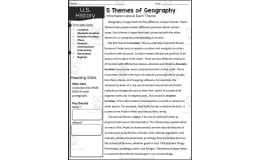
Introduce your students to The Five Themes of Geography- Text, Questions, Discussion, and Assessment for 5th and 6th grades, a 67-page resource which gets your students reading, writing, discussing, and critically thinking as they learn about the importance of the 5 Themes of Geography-- location, place, movement, interaction, and region. This lesson pairs nicely with my other 5 Themes of Geography lessons, especially The Five Themes of Geography- Text, Questions, Discussion, and Assessment for 7th and 8th grades. Your ELL, RSP, 504, and other students who may be struggling with reading can use the 5th-6th grade lesson and the rest of your class can use the 7th-8th grade lesson. Although there are some differences in the questions, review, and test, the students are essentially receiving the same information tailored to their reading comprehension needs.
The resource includes the following-
a link to a force copy google doc so you can edit it to meet your needs
About this Resource- a handy guide that orients you, the teacher, to everything in the resource
a hyper-linked Table of Contents
a standards-aligned detailed lesson plan with objectives and learning targets
essential and guiding questions
an engaging reading with 3 different formats for the text: a two-column layout of text and questions, a one-column layout with embedded questions, and a one-column layout with a question sheet which students can read and discuss with a partner, or a small group.
a 15-word crossword puzzle to reinforce vocabulary.
an Interactive Notebook assignment in which students explain each of the themes in their own words and explore their personal connections to each of the themes
a comprehensive collaborative review and study guide.
a summative assessment which consists of multiple choice, true and false questions as well as real-world incidents in which students have to identify which theme the scenario is and explain why it is that theme
All assignments include answer keys.
Your students will be well-informed after completing this lesson, and teachers will be able to connect the five themes to their 5th and 6th grade social studies curriculums. Based on the California State Standards for Social Students
In 5th grade: the Five Themes can be woven into your curriculum to examine the geographical factors that influenced early American history to Westward Expansion by analyzing:
Native Americans Before European Exploration: Study how different tribes adapted to and interacted with their environments, such as how the Plains tribes relied on buffalo and how coastal tribes utilized ocean resources.
European Exploration and Colonization: Examine how geographical factors, like the location of rivers and fertile land, influenced the establishment and development of the original thirteen colonies.
American Revolution: Explore how geography played a role in key battles and strategies, such as the significance of the Appalachian Mountains and the Atlantic coastline.
Westward Expansion: Analyze how physical features, such as the Mississippi River and the Rocky Mountains, impacted settlement patterns, economic activities, and interactions with Native American tribes.
In 6th grade, the Five Themes can be woven into your curriculum to examine the geographical factors that influenced the development of Early Humans, and the Ancient River Civilizations: Ancient Mesopotamia, Ancient Egypt, and Ancient India, among others.
Early Humans: Study how the environment influenced the migration, settlement, and survival strategies of early humans, including the use of tools and the development of agriculture.
Ancient Mesopotamia: Examine how the Tigris and Euphrates rivers supported the growth of early cities and influenced human-environment interaction through irrigation and farming.
Ancient Egypt: Explore how the Nile River's location influenced Egyptian civilization, including agriculture, trade, and cultural development.
Ancient India: Analyze how the Indus and the Ganges Rivers and the monsoon climate affected the development of of early Indian civilizations.
Pair the questions with a five themes of geography reading packet when students need another explanation of the themes.
Related resources
More resources teachers may find useful
24 related resources were found using this product's title, contributor, categories and tags.


In the classroom
Teaching tips & learning objectives

Learning objectives
- Define each of the five themes of geography
- Connect each theme to places and experiences in their own lives

Teaching tips
- The same geography text comes in a two-column layout, an embedded-question layout and a single-column layout, so students can work from different formats in one lesson.

Skills covered
- Reading comprehension — answering questions embedded in or beside the informational text
- Vocabulary — completing a crossword of geography terms

No reviews yet
Downloaded this resource? Tell other teachers how it went.
Curriculum
Standards, concepts & topics
Standards
 Standards
- CCSS.RI.5.1 — Quote accurately from a text when explaining what the text says explicitly and when drawing inferences from the text
- CCSS.RI.5.2 — Determine two or more main ideas of a text and explain how they are supported by key details; summarize the text.
- CCSS.RI.6.1 — Cite textual evidence to support analysis of what the text says explicitly as well as inferences drawn from the text.
- CCSS.RI.6.2 — Determine a central idea of a text and how it is conveyed through particular details; provide a summary of the text distinct from personal opinions or judgments.
- CCSS.RI.5.10 — By the end of the year, read and comprehend informational texts, including history/social studies, science, and technical texts, at the high end of the grades 4–5 text complexity band independently and proficiently.
- CCSS.RI.6.10 — By the end of the year, read and comprehend literary nonfiction in the grades 6–8 text complexity band proficiently, with scaffolding as needed at the high end of the range.
- CCSS.SL.5.6 — Adapt speech to a variety of contexts and tasks, using formal English when appropriate to task and situation. (See grade 5 Language standards 1 and 3 on page 28 for specific expectations.)
- CCSS.SL.6.6 — Adapt speech to a variety of contexts and tasks, demonstrating command of formal English when indicated or appropriate. (See grade 6 Language standards 1 and 3 on page 53 for specific expectations.)
- CCSS.SL.5.1 — Engage effectively in a range of collaborative discussions (one-on-one, in groups, and teacherled) with diverse partners on grade 5 topics and texts, building on others’ ideas and expressing their own clearly. a. Come to discussions prepared, having read or studied required material; explicitly draw on that preparation and other information known about the topic to explore ideas under discussion. b. Follow agreed-upon rules for discussions and carry out assigned roles. c. Pose and respond to specific questions by making comments that contribute to the discussion and elaborate on the remarks of others. d. Review the key ideas expressed and draw conclusions in light of information and knowledge gained from the discussions.
- CCSS.SL.6.1 — Engage effectively in a range of collaborative discussions (one-on-one, in groups, and teacherled) with diverse partners on grade 6 topics, texts, and issues, building on others’ ideas and expressing their own clearly. a. Come to discussions prepared, having read or studied required material; explicitly draw on that preparation by referring to evidence on the topic, text, or issue to probe and reflect on ideas under discussion. b. Follow rules for collegial discussions, set specific goals and deadlines, and define individual roles as needed. c. Pose and respond to specific questions with elaboration and detail by making comments that contribute to the topic, text, or issue under discussion. d. Review the key ideas expressed and demonstrate understanding of multiple perspectives through reflection and paraphrasing.
Core concepts
 Core concepts
- Location
- Place
- Human-environment interaction
- Movement
- Region
 Topics
Explore more
Categories this resource belongs to
Explore related searches
More to explore
You may also like


