Mixed Numbers Recipe Doubling – Real-World Math



- Grades
- Grades 4–6
- Pages
- 5
- File type
- Answer key
- Included


- Subject
- Math, Fractions
- Topic
- Mixed numbers, Improper fractions
- Answer key
- Included
- Standards
- 5.NF.B.6
Product description
From the author
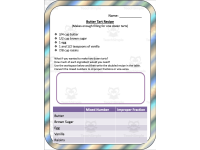
Butter Tart Recipe (based on my grandma's actual delicious family recipe!)
Here is a real-life example to help students practice adding and multiplying mixed numbers and improper fractions. When students ask, "When will we ever use this in real-life?!" you can show them this lesson and say that working with fractions is so common in baking.
This delicious activity will allow students to practice using fractions with a realistic everyday example: baking!
Students will take a recipe that has several fractions in it and double it. Half a cup of something becomes a cup and 3/4 of a cup becomes 1 and a half cups. After that, they need to figure out how much of each ingredient would be needed if the recipe was made five times bigger (perhaps in a bakery setting or for a large event). I encourage my students to use different strategies to complete this task: drawing pictures with squares, repeated addition, or multiplication. Boxes for diagrams and math calculations are included to encourage students to show their work. You could even have different students come up to show their personal strategies to the rest of the class.
As an extension, students can bring in their own recipes from home in the next class and double them or multiply them by five as well. You might even want to actually make something tasty to eat too!
What's Included:
A total of 5 pages in PDF:
Title Page
2 page assignment
2 page answer key
Related resources available separately
Creator: Grace Under Pressure
Related resources
More resources teachers may find useful
24 related resources were found using this product's title, contributor, categories and tags.


In the classroom
Teaching tips & learning objectives

Learning objectives
Double fractional and mixed-number quantities — 3/4, 1/2, 7/8 and 1 1/2 — and record each doubled amount
Multiply those same quantities by five, producing results such as 15/4, 35/8 and 15/2
Convert fractional scaled amounts between mixed numbers and improper fractions; record whole-number egg counts separately

Teaching tips
Page 1 is written to the teacher and pages 2 and 3 are the student sheets, so the doubling task can be run on its own before the five-dozen page is handed out
The Egg row carries no fraction — the worked page writes N/A in the Improper Fraction column — which makes it a natural first row for students who need an entry point before tackling the 7/8 cup of raisins
The closing extension — find a recipe at home or online and double it — works as a next-lesson task, since students need a day to bring a recipe in

Skills covered
Doubling fractions and mixed numbers — students take 3/4, 1/2, 1 1/2 and 7/8 straight from the recipe and enter each doubled amount in the table.
Multiplying a fraction by a whole number — the five-dozen page requires 3/4 x 5 = 15/4, 7/8 x 5 = 35/8 and 1 1/2 x 5 = 15/2.
Converting between mixed numbers and improper fractions — students complete the fraction conversions for both recipes; the key records whole-number egg counts and marks their improper-fraction cells N/A.
Good to know
Questions teachers ask about this resource
How are the scaled raisin amounts shown?
For the doubled recipe, the source gives 1 6/8 cups and 14/8 = 7/4; 1 6/8 can also be written 1 3/4. At five times the recipe it gives 4 3/8 cups and 35/8.
Which measurement units are printed?
Ingredient amounts use cups and teaspoons, with eggs counted separately. The original recipe makes filling for one dozen tarts.

No reviews yet
Downloaded this resource? Tell other teachers how it went.
Curriculum
Standards, concepts & topics
Standards
 Standards
- 5.NF.B.6
Core concepts
 Core concepts
Mixed numbers
Improper fractions
Multiplying fractions by whole numbers
Scaling recipes
Real-world math
 Topics
Explore more
Categories this resource belongs to
Explore related searches
More to explore
You may also like