Addition and Subtraction with Dienes within 100


- Grades
- Grade 1, Elementary
- File type
- Preparation
- Print ready


- Subject
- Math, Addition and Subtraction, Addition, Subtraction
- Topic
- math concepts, addition
- Resource types
- Worksheets & Printables, Worksheets
- Preparation
- Print ready
About this resource
What's inside this resource
Addition and Subtraction with Dienes within 100: A Comprehensive Teaching Resource
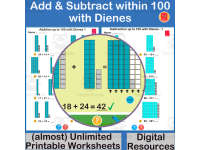
The teaching resource named Addition and Subtraction with Dienes within 100 is a valuable asset for educators seeking creative ways to make math concepts more conceptually accessible to their students. Specifically crafted for grade 1, this resource focuses on the key areas of addition and subtraction - core subjects that require a solid understanding for mathematical progression.
Making Math Concepts Accessible:
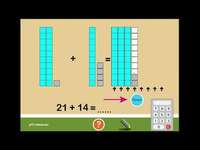
This comprehensive package masterfully transitions your pupils from the physical world of mathematical tools like base-ten Dienes blocks, often used in early school years, into a visual and conceptual recognition. This vital leap enables students to move beyond basic tangible manipulations towards achieving proficiency with standard algorithms involved in addition and subtraction.
Incorporation of Base-Ten Dienes Blocks:
The included resources are meticulously designed, starting with calculations using rods to signify tens and units representing ones followed by introducing complex scenarios necessitating regrouping or borrowing while adding or subtracting respectively.
- Accompanying worksheets mirror the interactive lessons: initial exercises focus on numbers whose sum falls below ten before advancing onto calculations requiring regrouping.
- Similarly, children will learn subtraction methods that both avoid borrowing as well as employ it when necessary.
An Ever-ready Toolbox for Teachers:
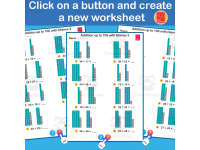
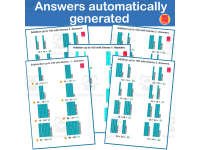
As refreshing conveniences for teachers, this product is an ever-ready toolbox offering an unlimited number of randomized questions suitable not only for classwork but also homework assignments or even quick filler activities ensuring the complete assimilation of these concepts. Importantly too, should you need material ready at hand during those unavoidable substitute teacher days - worry not! The no-preparation-needed feature ensures seamless continuity in learning.
Facilitating Constructive Learning:
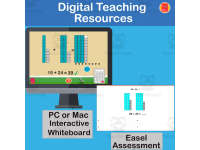
For effective classroom implementation look towards the Self Checking Interactive Presentation included: primed ideally as an introductory tool prior to assigning worksheets providing immediate feedback when responses are inputted at the whiteboard by your students - promoting constructive learning through instant correction!
Exhibiting Compliance with Common Core Standards:
Unsurprisingly perhaps was our thorough compliance exhibited with Common Core Standards particularly around key areas like understanding numerical values associated with tens & ones (CCSS1.NBT.B), realizing computations within 100 using both models & reasoning (CCSS1.NBT.C).
Concluding Remarks:
This educational resource, available as a PDF file, is reliant on Adobe Acrobat Reader for full functionality. Its array of formats: Whiteboard integrated lessons contributing to the broader pedagogy, Common Core compliance illustrating alignment with learning standards and diverse worksheets – ensure that educators and homeschoolers alike have the tools necessary to strengthen their students' understanding of addition and subtraction.
Related resources
More resources teachers may find useful
24 related resources were found using this product's title, contributor, categories and tags.


In the classroom
Teaching tips & learning objectives

Learning objectives
- Add two-digit numbers within 100, with and without regrouping
- Subtract two-digit numbers within 100, with and without borrowing
- Use base-ten blocks to show tens and ones

Skills covered
- Regrouping — exchanging ten ones for a ten, or a ten for ten ones, while solving two-digit problems

No reviews yet
Downloaded this resource? Tell other teachers how it went.
Curriculum
Standards, concepts & topics
Standards
 Standards
- 1.NBT.C.4 — Add within 100, including adding a two-digit number and a one-digit number, and adding a two-digit number and a multiple of 10, using concrete models or drawings and strategies based on place value, properties of operations, and/or the relationship between addition and subtraction; relate the strategy to a written method and explain the reasoning used. Understand that in adding two-digit numbers, one adds tens and tens, ones and ones; and sometimes it is necessary to compose a ten.
- 1.NBT.B.2 — Understand that the two digits of a two-digit number represent amounts of tens and ones. Understand the following as special cases: a. 10 can be thought of as a bundle of ten ones — called a “ten.” b. The numbers from 11 to 19 are composed of a ten and one, two, three, four, five, six, seven, eight, or nine ones. c. The numbers 10, 20, 30, 40, 50, 60, 70, 80, 90 refer to one, two, three, four, five, six, seven, eight, or nine tens (and 0 ones).
Core concepts
 Core concepts
- Base-ten blocks
- Place value
- Regrouping
- Two-digit addition
- Two-digit subtraction
 Topics
Explore more
Categories this resource belongs to
Explore related searches
More to explore
You may also like