AUTUMN VERBS Worksheets and Activities




- Grades
- Grades 3–4, Elementary
- Pages
- 23
- File type
- Multiple File Types
- Answer key
- Included


- Subject
- Holiday & Seasonal, ELA, Seasons, Fall, Grammar
- Topic
- verbs, parts of speech
- Resource types
- Worksheets, Worksheets & Printables
- Answer key
- Included
- Standards
- CCSS.L.3.1 CCSS.L.4.1 +3
About this resource
What's inside this resource
Your grade 3 and grade 4 learners are going to enjoy practicing their grammar skills with this set of Autumn themed worksheets and learning games. Designed specifically to focus on verbs, these activities will provide your learners with the opportunity to strengthen a variety of skill sets. Throughout the 6 worksheets they’ll practice identifying verbs, expanding their vocabulary with synonyms and antonyms, and developing strong writing skills. The two learning games will get your learners up and moving, as well as working collaboratively to identify a variety of verbs associated with the Autumn themed pictures. There’s no better way to reinforce skills that with whole body learning. The product rounds out with a quiz presented in 12 Power Point slides. Questions are taken directly from the worksheets, reducing test anxiety. Not only that, but it’s a great way for you to assess if current learning goals are being met. All around, this is the perfect product for you and your learners. The activities can be used over the span of 3 months. The worksheets are beneficial for individual or group work, homework, or rainy-day seat work. When your learners are a bit squirrely, set aside the worksheets and engage them with either of the learning games. Both the worksheets and games are available in a color version, as well as a black & white version. An answer key is also provided for each worksheet. The Power Point quiz is only available in color however, the answer recording sheet includes both versions. Take a look the details of each page in the list below.
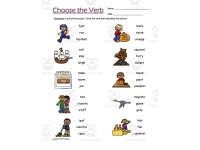
PAGE 1: Learners will identify the verb among 3 given words for each Autumn-themed picture.
PAGE 2: Learners will unscramble each verb that is provided next to an Autumn-themed picture.
PAGE 3: Learners will write the past tense form of the verb that is provided next to an Autumn-themed picture.
PAGE 4: Learners will write two verbs for each Autumn-themed picture.
PAGE 5: Learners will write a synonym or antonym for the provided verb next to each Autumn-themed picture.
PAGE 6: Learners will use the words in the word bank to write action sentences that follow an Autumn theme.
PAGE 7: Directions for the learning game, Sam Says, where learners perform a variety of verbs based on directions called out by the teacher.
PAGES 8-10: Directions and picture cards for the learning game, What’cha Doin?, where learners work in groups to identify as many verbs as possible for the given Autumn-themed picture.
PAGE 11: Two answer recording sheets for the Power Point slides quiz.
Answer key
POWER POINT SLIDES: 12 slides that include questions for learners to answer about concepts presented within the six worksheets.
Are you teaching nouns and adjectives as well? Add these additional products to your ELA curriculum. Find them in my store, Quail Trail Products.
AUTUMN NOUNS Worksheets and Activities
AUTUMN ADJECTIVES Worksheets and Activities
Related resources
More resources teachers may find useful
24 related resources were found using this product's title, contributor, categories and tags.


In the classroom
Teaching tips & learning objectives

Learning objectives
- Identify the verb that matches a picture
- Write the past tense form of common verbs
- Supply synonyms and antonyms for verbs

Teaching tips
- What'cha Doin'? uses Post-it notes in several colors, fall picture cards and a whiteboard, so set these out before groups start.

Skills covered
- Past tense formation — students write the past tense of each pictured verb
- Word relationships — students write a synonym or antonym for given verbs
- Sentence writing — students write fall sentences and circle the verbs

No reviews yet
Downloaded this resource? Tell other teachers how it went.
Curriculum
Standards, concepts & topics
Standards
 Standards
- CCSS.L.3.1 — Demonstrate command of the conventions of standard English grammar and usage when writing or speaking. a. Explain the function of nouns, pronouns, verbs, adjectives, and adverbs in general and their functions in particular sentences. b. Form and use regular and irregular plural nouns. c. Use abstract nouns (e.g., childhood). d. Form and use regular and irregular verbs. e. Form and use the simple (e.g., I walked; I walk; I will walk) verb tenses. f. Ensure subject-verb and pronoun-antecedent agreement.* g. Form and use comparative and superlative adjectives and adverbs, and choose between them depending on what is to be modified. h. Use coordinating and subordinating conjunctions. i. Produce simple, compound, and complex sentences.
- CCSS.L.4.1 — Demonstrate command of the conventions of standard English grammar and usage when writing or speaking. a. Use relative pronouns (who, whose, whom, which, that) and relative adverbs (where, when, why). b. Form and use the progressive (e.g., I was walking; I am walking; I will be walking) verb tenses. c. Use modal auxiliaries (e.g., can, may, must) to convey various conditions. d. Order adjectives within sentences according to conventional patterns (e.g., a small red bag rather than a red small bag). e. Form and use prepositional phrases. f. Produce complete sentences, recognizing and correcting inappropriate fragments and run-ons.* g. Correctly use frequently confused words (e.g., to, too, two; there, their).*
- CCSS.L.4.2 — Demonstrate command of the conventions of standard English grammar and usage when writing or speaking. a. Use relative pronouns (who, whose, whom, which, that) and relative adverbs (where, when, why). b. Form and use the progressive (e.g., I was walking; I am walking; I will be walking) verb tenses. c. Use modal auxiliaries (e.g., can, may, must) to convey various conditions. d. Order adjectives within sentences according to conventional patterns (e.g., a small red bag rather than a red small bag). e. Form and use prepositional phrases. f. Produce complete sentences, recognizing and correcting inappropriate fragments and run-ons.* g. Correctly use frequently confused words (e.g., to, too, two; there, their).*
- CCSS.L.3.3 — Use knowledge of language and its conventions when writing, speaking, reading, or listening. a. Choose words and phrases for effect.* b. Recognize and observe differences between the conventions of spoken and written standard English.
- CCSS.L.4.3 — Use knowledge of language and its conventions when writing, speaking, reading, or listening. a. Choose words and phrases to convey ideas precisely.* b. Choose punctuation for effect.* c. Differentiate between contexts that call for formal English (e.g., presenting ideas) and situations where informal discourse is appropriate (e.g., small-group discussion).
Core concepts
 Core concepts
- Verbs
- Past tense
- Synonyms
- Antonyms
 Topics
Explore more
Categories this resource belongs to
Explore related searches
More to explore
You may also like