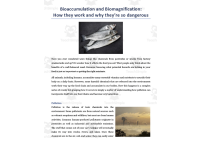
Bioaccumulation and Biomagnification - Science Reading Article - Grade 8 and…



- Grades
- Grades 8–12, High School
- File type
- Multiple File Types


- Subject
- Science, Life Sciences, Biology
- Topic
- ecosystems, reading
- Resource types
- Worksheets & Printables, Worksheets
- Standards
- CCSS.RI.8.1 CCSS.RI.8.3
About this resource
What's inside this resource
Related resources
More resources teachers may find useful
24 related resources were found using this product's title, contributor, categories and tags.




In the classroom
Teaching tips & learning objectives

Learning objectives
Define bioaccumulation and biomagnification and explain the difference between them.
Calculate a chemical's concentration at a given food-chain level using the article's roughly tenfold-increase pattern.
Use the DDT case study to explain how a chemical's effect on one population can disrupt an entire ecosystem.

Teaching tips
Have students attempt the concentration-calculation question (question 7) before checking the answer key, since it requires applying the tenfold-increase concept rather than just recalling a definition.
Assign extension question 11 as a short written response, since the answer key expects at least three sentences connecting DDT's effect on birds to the wider ecosystem.
Use the editable Word file to adjust question wording or add a local-ecosystem example, since the article ships in both .docx and PDF.

Skills covered
Scientific vocabulary application — students define and use bioaccumulation and biomagnification correctly after reading the article.
Quantitative reasoning — question 7 asks students to calculate a concentration increase across three food-chain levels using a tenfold multiplier.
Cause-and-effect ecosystem reasoning — the DDT case study and extension question 11 ask students to trace how one chemical's effect on one species disrupted an entire ecosystem.
Good to know
Questions teachers ask about this resource
Does the article include a real-world example, or just the general process?
Both — after explaining the general process, a dedicated case study applies it to DDT, the pesticide banned in 1972 after it caused predatory-bird eggshells to thin and populations to collapse.
Is any question quantitative rather than pure recall?
Yes — question 7 asks students to calculate the concentration of a chemical after three levels of a food chain using the tenfold-increase pattern described in the article.

No reviews yet
Downloaded this resource? Tell other teachers how it went.
Curriculum
Standards, concepts & topics
Standards
 Standards
- CCSS.RI.8.1 — Cite the textual evidence that most strongly supports an analysis of what the text says explicitly as well as inferences drawn from the text.
- CCSS.RI.8.3 — Analyze how a text makes connections among and distinctions between individuals, ideas, or events (e.g., through comparisons, analogies, or categories).
Core concepts
 Core concepts
bioaccumulation
biomagnification
food chain concentration
DDT case study
 Topics
Explore more
Categories this resource belongs to
Explore related searches
More to explore
You may also like