Breaking the Big Words | Syllable Division Word Lists

- Grades
- Grades 1–3, Elementary
- Pages
- 113
- File type
- Preparation
- Print ready


- Subject
- ELA, Reading, Phonics, Language Development, Spelling
- Topic
- Phonics practice, Word lists
- Resource types
- Activities
- Preparation
- Print ready
- Standards
- RF.1.3.d
Product description
From the author
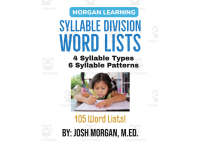
Product: Breaking the Big Words | Syllable Division Word Lists
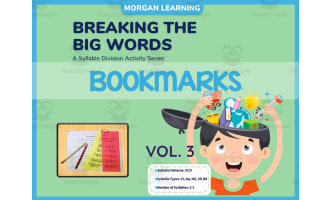
When teaching phonics, breaking up large words into syllables can pose a challenge. With the 'Breaking the Big Words | Syllable Division Word Lists', phonics practice involving encoding and decoding becomes more accessible. Equipped with 105 different word lists, this resource makes large-word syllable divisions easier.
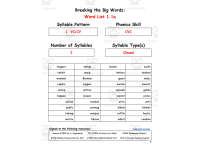
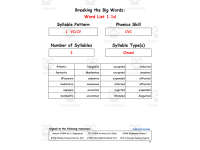
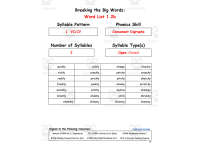
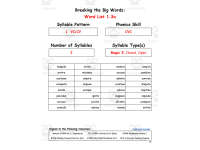
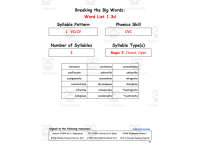
About Product:- This resource contains specific features that are teacher-friendly. Each word list contains distinct aspects like:
- List number
- Syllable type(s)
- A focus syllable pattern
- Number of syllables - all linked to aligned resources.
Tutors and service providers gain a quick point of reference for word lists capturing particular phonics skills, or syllable types or numbers, and patterns alike.
Usability:The practicality lies in offering multiple use cases—making it handy for group tasks or individual homework assignments alike—irrespective of class size! Visualize utilizing these lists during your 'Science of Reading' sessions where small groups actively engage in understanding different words’ syllables and patterns collectively.
Critical Thinking:In addition to phonetic understanding, this resource hosts two key conceptual points for discussion—the concept “Rule Breakers” challenging usual open or closed-syllables rules; and dialect-based discussions allowing students to explore how varying dialects influence their method of breaking down a word. To instigate critical thinking among pupils further, make them justify their division process choice—even transforming them from passive listeners to active participants!
In Summary:Embed the 'Breaking the Big Words | Syllable Division Word Lists' in your language arts teaching plan. It's an excellent tool for Grade 1 through Grade 3 educators focusing on enhancing Phonics proficiency amongst students—organised within a user-friendly 113-page PDF document.
Related resources
More resources teachers may find useful
24 related resources were found using this product's title, contributor, categories and tags.



In the classroom
Teaching tips & learning objectives

Learning objectives
Decode two- and three-syllable words by breaking them at VC/CV, V/CV, VC/V, and V/V junctures
Apply syllable-type knowledge (closed, open, magic e, vowel pair, bossy r, consonant-le) when reading multisyllabic words
Justify where a word breaks and what syllable type it takes, including rule breakers and dialect variations

Teaching tips
Use the clickable link index in the PDF to jump straight to the list matching your lesson's pattern, syllable type, and phonics skill
Follow the built-in routine for rule breakers — words that look open or closed but take the wrong vowel sound — the author labels them, then crosses out the label in class
The font legend matters when mixing this with the author's other materials: italics flag words shared with digraph and blend lists, and alignment shows whether a word appears in the Breaking the Big Words series

Skills covered
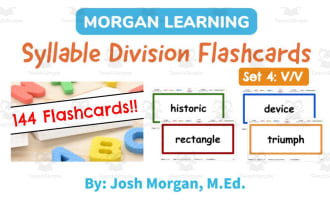
Syllable division — words are grouped by division pattern (VC/CV as in magnet and napkin, V/CV, VC/V, V/V as in quiet and triumph) for explicit breaking practice.
Syllable-type identification — lists isolate closed, open, magic e, vowel pair, bossy r, and consonant-le syllables so students name the type as they decode.
Reasoning about words — students justify break points and syllable types, including rule breakers and dialect differences.
Good to know
Questions teachers ask about this resource
How are the word lists organized?
By syllable pattern first (VC/CV, V/CV, VC/V, V/V), then by syllable-type focus (closed, open, magic e, vowel pair, bossy r, consonant-le) and phonics skill (CVC, digraphs, blends), in two- and three-syllable versions. The table of contents gives page numbers; linked index pages jump directly to each numbered list.
What do the asterisks and italics on the lists mean?
An asterisk marks a nonsense or pseudoword included for pure decoding practice; italics mark words that also appear on both the digraph and blend lists; and a word's alignment shows whether it belongs to the companion Breaking the Big Words series or was newly added.
What are 'rule breakers' and how does the author suggest handling them?
Words that break like an open or closed syllable but take the wrong vowel sound or break another rule. The how-to-use page suggests labeling them with the expected type — 'Op' for open — and then crossing the label out with students, turning exceptions into a discussion point.

No reviews yet
Downloaded this resource? Tell other teachers how it went.
Curriculum
Standards, concepts & topics
Standards
 Standards
- RF.1.3.d
Core concepts
 Core concepts
Syllable division
Syllable types
Phonics
Decoding
Science of Reading
 Topics
Explore more
Categories this resource belongs to
Explore related searches
More to explore
You may also like