One Unique Triangle, Many or None - Notes and Practice
- Grades
- Grade 7
- Pages
- 13
- File type
- Answer key
- Included


- Subject
- Math, Geometry
- Topic
- Triangles, Notes
- Resource types
- Worksheets
- Answer key
- Included
- Standards
- 7.G.A.2
Product description
From the author
This resource was created to PARTIALLY meet the requirements for the 7th Grade Math Geometry Standard below:
Draw (freehand, with ruler and protractor, and with technology) geometric shapes with given conditions. Focus on constructing triangles from three measures of angles or sides, noticing when the conditions determine a unique triangle, more than one triangle, or no triangle.
Related resources
More resources teachers may find useful
24 related resources were found using this product's title, contributor, categories and tags.

In the classroom
Teaching tips & learning objectives

Learning objectives
Determine whether three given side lengths can form a triangle using the Triangle Inequality Theorem.
Find a missing interior angle of a triangle using the Triangle Angle Sum Theorem.
Classify a set of side lengths or angle measures as producing one unique triangle, many triangles, or no triangle.

Teaching tips
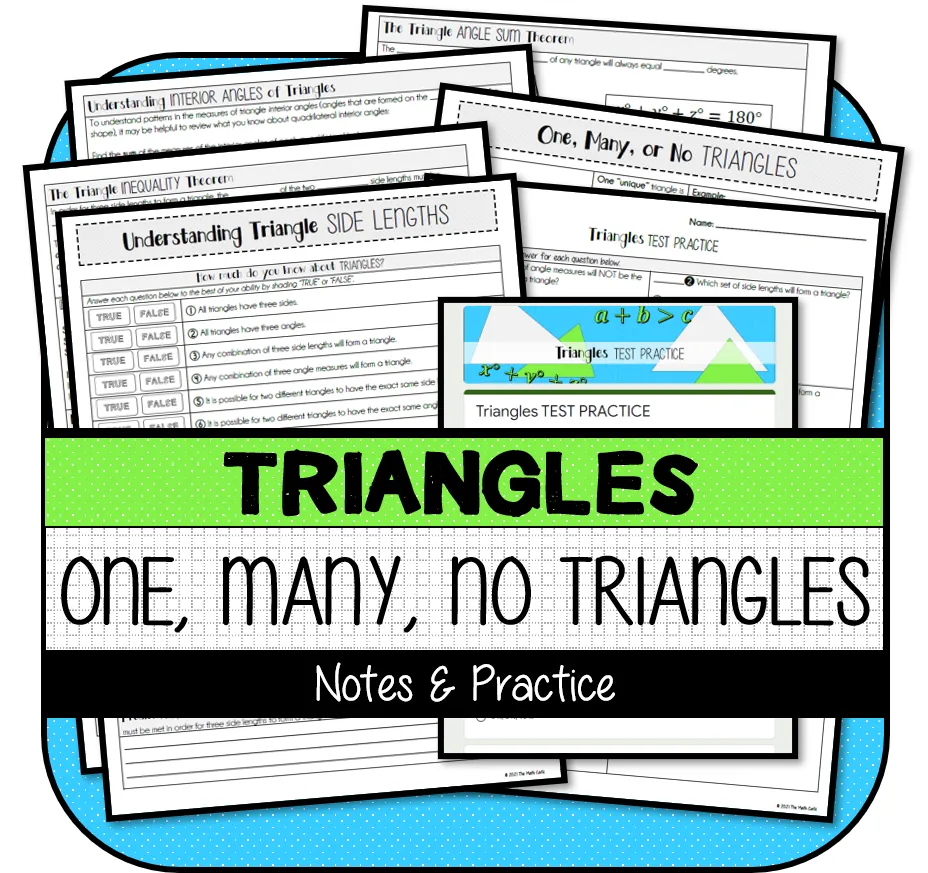
Have students shade the true/false warm-up on the first notes page before instruction, then revisit it with the answer key afterward per the two suggested usage options printed in the file.
Use the linked Google Forms version of the Triangles Test Practice for a self-grading digital assessment instead of the printable version.
Consider the two separately available 'hands-on activity' resources referenced in the file (Triangle Inequality and Triangle Angle Sum explorations) before these notes if students haven't yet built intuition for the theorems.

Skills covered
Triangle Inequality Theorem application -- students test whether three given side lengths (e.g., 9 in, 13 in, 5 in) can form a triangle by checking that the two shorter sides sum to more than the longest.
Triangle Angle Sum Theorem application -- students solve for a missing interior angle given two known angles, using the fact that all three sum to 180°.
Triangle classification -- students determine whether a set of measurements produces one unique triangle, many triangles, or no triangle, applying both theorems together.

No reviews yet
Downloaded this resource? Tell other teachers how it went.
Curriculum
Standards, concepts & topics
Standards
 Standards
- 7.G.A.2 — Draw (freehand, with ruler and protractor, and with technology) geometric shapes with given conditions. Focus on constructing triangles from three measures of angles or sides, noticing when the conditions determine a unique triangle, more than one triangle, or no triangle.
Core concepts
 Core concepts
Triangle inequality theorem
Triangle angle sum theorem
Triangle classification
Seventh-grade geometry
Topics
 Topics
More to explore
You may also like