Come | Phrasal Verbs Exercises
- Grades
- Not Grade Specific
- File type
- Preparation
- Print ready


- Subject
- ELA, Language Development, ESL
- Topic
- English language, language arts
- Resource types
- Worksheets & Printables, Worksheets
- Preparation
- Print ready
About this resource
What's inside this resource
Come | Phrasal Verbs Exercises: An Overview
Experience a teaching resource like no other! Introducing 'Come | Phrasal Verbs Exercises', a well-crafted tool explicitly designed to help language arts and English as a second language (ESL) students grasp the usage of the phrasal verb 'come.' Its versatility ensures it cuts across varying educational requirements regardless of grade levels.
Diverse and Comprehensive Learning Approach
- The resource offers four carefully designed exercises with diverse applications, from initiating insightful conversations centered around usage to posing multiple-choice questions that strengthen understanding.
- The primary aim is to broaden students' knowledge about English Language's specificity and versatility.
Time-Saving Features for Teachers
An indispensable supportive tool for teachers!
- The inclusion of an answer key facilitates ease while correcting or addressing queries.
- A total of 10 ready-to-print pages stored in two different PDFs provides sufficient material for reinforcing sentence construction and word use.
Easily Integrable with Google Apps Ecosystem
Adapting to the digital age, Come | Phrasal Verbs Exercises fluidly integrates with virtual learning platforms due its compatibility with Google Apps ecosystem. Thus transitioning these worksheets into your curriculum becomes unbelievably convenient!
Multipurpose Implementation & Dynamic Learning Environment - A Promise!"Make every learner involved. Adapt based on needs!"
- This ingenious product could be conducted as whole group activities, or as part of small group lessons, or it can be assigned for individual practice at home.
- Suits public school teachers or homeschoolers alike with room to modify according to their students' needs.
- Not limited to cultivating literacy skills, the resource also fosters critical thinking due its interactive nature.
Discover how 'Come | Phrasal Verbs Exercises' can be an asset to your teaching journey. Encourage aspirant scholars into exploring languages while mastering vital grammar rules through practical application. Inculcate confidence by offering clarity on confusing phrases and catalyzing enhanced language proficiency!
Related resources
More resources teachers may find useful
24 related resources were found using this product's title, contributor, categories and tags.

In the classroom
Teaching tips & learning objectives

Learning objectives
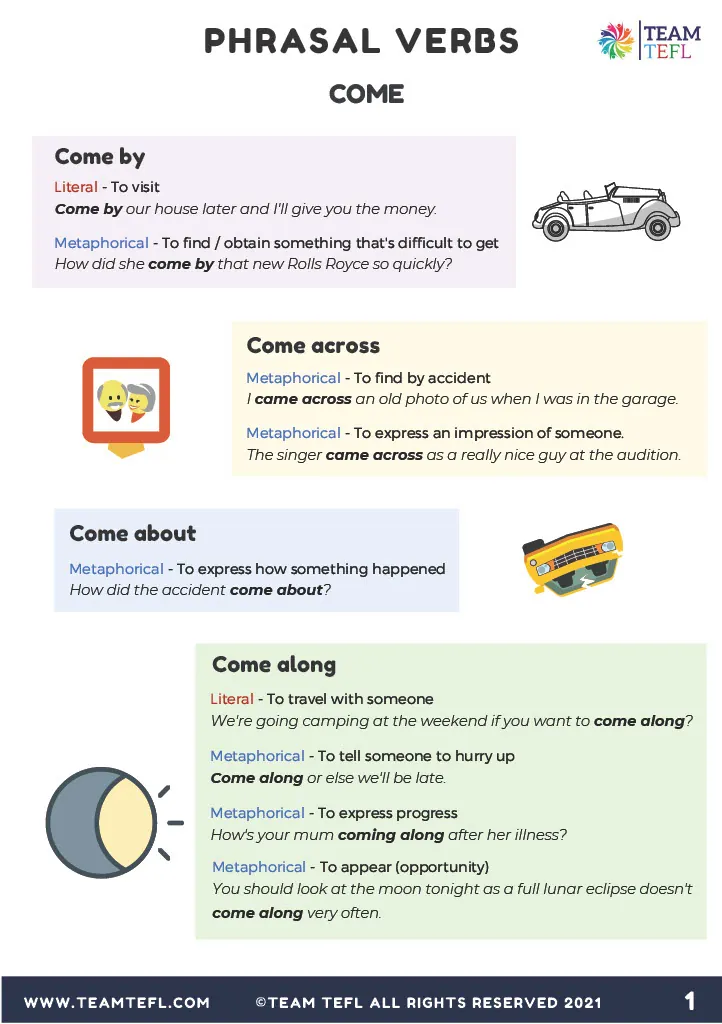
Distinguish literal and metaphorical uses of the same phrasal verb, such as 'come by' meaning to visit versus to obtain something hard to get
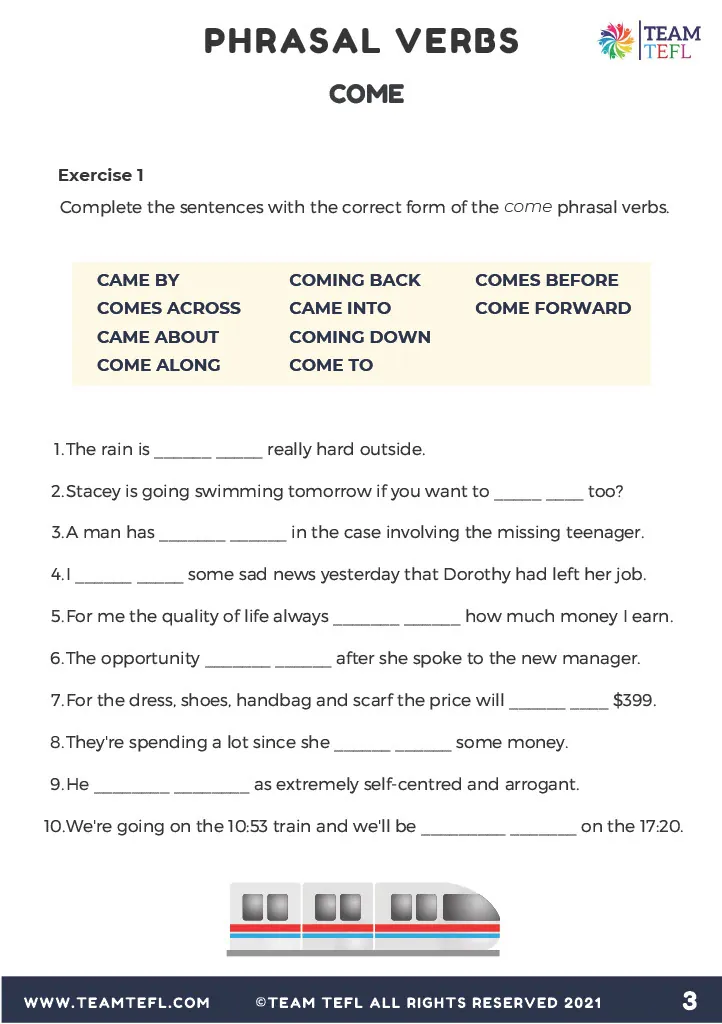
Select the correct form of a 'come' phrasal verb to complete a sentence in context
Use a 'come' phrasal verb correctly in a spoken or written response to a personal conversation question

Teaching tips
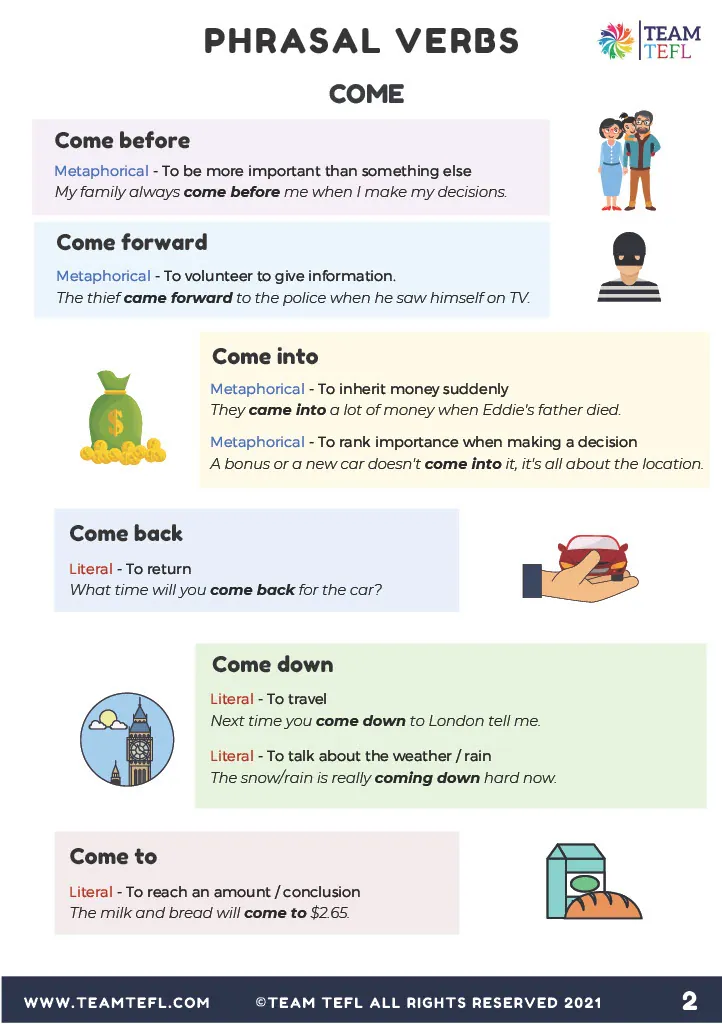
Introduce the reference pages before the exercises, since Exercises 1 through 3 draw directly on the meanings and examples listed there
Use the answer sheet to self-check or peer-check Exercises 1 through 3 before moving to the open conversation questions
Assign Exercise 4's conversation questions as a speaking activity or pair discussion once the written exercises are complete

Skills covered
Phrasal verb recognition — students identify the correct 'come' phrasal verb form to complete a sentence from a word bank in Exercise 1.
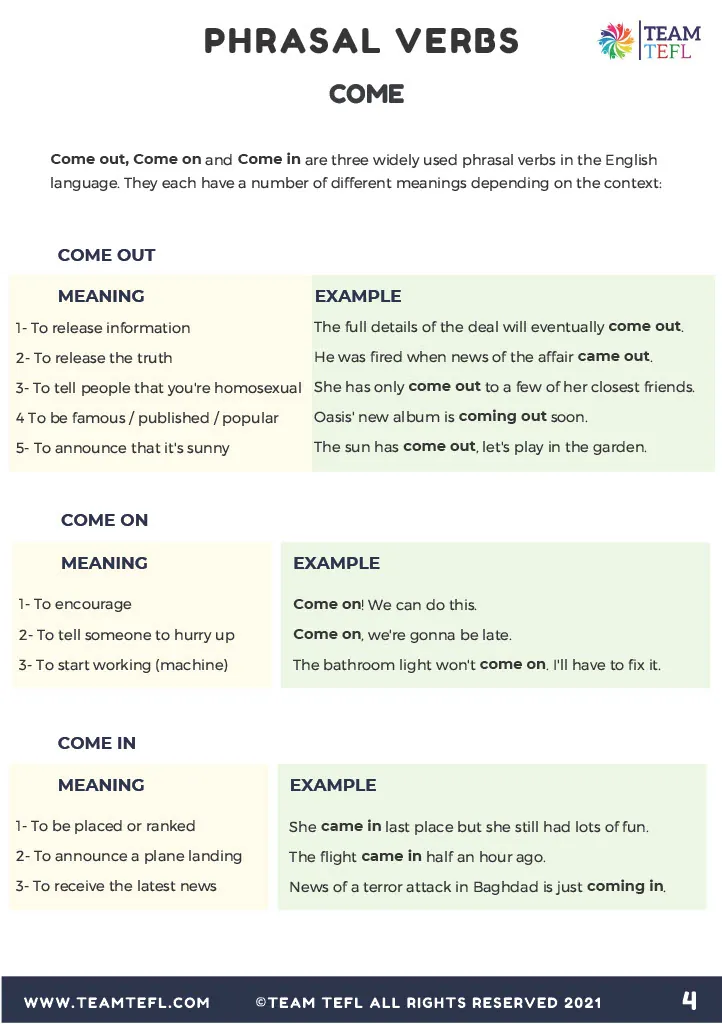
Meaning discrimination — students choose between near-identical phrasal verbs, such as 'come out' versus 'coming in,' in Exercise 2's multiple-choice items.
Contextual matching — students pair a phrasal verb such as 'come down on' or 'come up against' to the sentence context it fits in Exercise 3.
Good to know
Questions teachers ask about this resource
Does the same phrasal verb appear with more than one meaning?
Yes — several verbs such as 'come by' and 'come along' are given both a literal sense (to visit, to travel with someone) and a metaphorical sense (to obtain something hard to get, to make progress), each with its own example sentence.
Is there a speaking component, not just written exercises?
Yes — Exercise 4 provides ten open conversation questions, such as asking when a student last came up with a good plan, for spoken or written personal response.

No reviews yet
Downloaded this resource? Tell other teachers how it went.
Resource details
Concepts & topics
Core concepts
 Core concepts
Phrasal verbs
Idiomatic expressions
ESL grammar
 Topics
Explore more
Categories this resource belongs to
Explore related searches
More to explore
You may also like