Cool Runnings (1993): Complete Movie Guide


- Grades
- Grades 6–8, Middle School
- File type
- Multiple File Types


- Subject
- P.E. & Health, Sports
- Topic
- sportsmanship, perseverance
- Resource types
- Activities
About this resource
What's inside this resource
Designed to engage middle-grade students, from grade 6 to 8, particularly those with interest in Physical Education and Health, this comprehensive teaching resource provides an excellent way for educators to teach significant life values and knowledge about various sports.
Developed around the popular 1993 comedy Cool Runnings, based on the true account of the Jamaican National bobsleigh team's journey to the Calgary Winter Olympics in 1988; this resource provides both insight and inspiration. The film showcases how four determined athletes represent their country on a global platform while dealing with obstacles including discrimination and ridicule.
Comprehensive learning approach:
Cool Runnings (1993): Complete Movie guide's standout feature is its comprehensive approach towards learning through entertainment. The package includes thought-provoking questions devised to keep learners engaged throughout the film screening — suitable for either whole group discussions or small group activities.
- Fact vs Fiction Powerpoint presentation: A detailed comparison between real events versus movie fiction revolving around Jamaican bobsled team - great supplement for post-movie analysis.
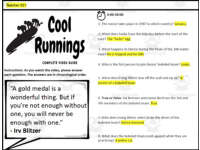
- Teacher version: Aids in focusing better on individual student needs – ideal for diverse classroom environments or homeschooling scenarios. Ready-to-use making it highly time-effective too!
- Editablse student version: Adds room for personalization as per unique requirements – can be used as homework assignment or extra challenges designed per capability levels of each student.
Easily manageable & Comprehensive:
The 'Cool Runnings' teaching resource supports multiple file types hence easily manageable digital addition. It efficiently encompasses education and entertainment making learning about sports, values and the world truly engaging.
Related resources
More resources teachers may find useful
8 related resources were found using this product's title, contributor, categories and tags.



In the classroom
Teaching tips & learning objectives

Learning objectives
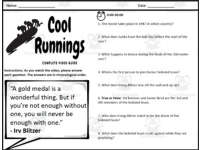
Follow a film's plot closely enough to answer twenty-five sequenced questions in real time
Distinguish what a based-on-a-true-story film invents from what actually happened, using six specific checks
Recall named details from the film, including the sled's name, the qualifying time and the team's placing after the second day

Teaching tips
Time codes on each block make it easy to pause the film at 30 minutes and again at an hour and check answers before continuing
The Fact vs. Fiction deck is best held back until after the viewing, since several of its slides give away what happens in the race
Question 9 asks for three fund-raising methods and the key lists four, so it works as a small-group listing task rather than a single-answer item

Skills covered
Active viewing - students answer twenty-five questions in chronological order while the film plays, guided by three time-coded blocks.
Recall of specific detail - items ask what Sanka has the children kiss, what the sled is named, what qualifying time the team posts and what place they hold after day two.
Fact-checking a dramatisation - the deck sets six of the film's episodes against the record, from the invented chant to the real cause of the crash.
Good to know
Questions teachers ask about this resource
How are the twenty-five questions organised?
By time code, in three blocks. Questions 1 to 8 cover the first half hour, 9 to 17 the second, and 18 to 25 run to 1:35:00. The sheet states that the answers come in chronological order, so students follow the film without hunting back and forth.
What does the Fact vs. Fiction deck check?
Six claims. Whether the athletes' real names were used (they were not - the characters are loosely based on real people), who coached the team and where they trained (coaches from the United States and Austria, training in Austria and Lake Placid), whether they were disliked at the Olympics (they were immensely popular), whether the bobsled chant was real (invented for the film), how the trip was funded (two wealthy Americans, not a car sale) and what caused the crash (driver error rather than the technical fault shown).
What kinds of question appear on the viewing sheet?
Four kinds. Short-answer recall, four true-or-false statements, two complete-the-quote items, and one item asking for three examples at once - the ways the team raises money, for which the key offers four possibilities.

No reviews yet
Downloaded this resource? Tell other teachers how it went.
Resource details
Concepts & topics
Core concepts
 Core concepts
Movie guide
Fact and fiction
Olympics
Viewing comprehension
 Topics
Explore more
Categories this resource belongs to
Explore related searches
More to explore
You may also like