24 related resources

Coordinates in 4 Quadrants – Plotting Worksheet Set

Five paired worksheets ask students to plot and find x-y coordinates of leaves, astronomy icons, shapes, and letters across all four quadrants of a grid.
Grades
Grades 5–6, Middle School, Elementary
File type
PDF
Preparation
Print ready

Updated Oct 19, 2023

Subject
Math, Geometry
Topic
math, coordinates
Resource types
Worksheets & Printables, Worksheets
Preparation
Print ready

About this resource

What's inside this resource

Five paired coordinate-plotting worksheets ask students to identify the x-y coordinates of leaves, astronomy icons, geometric shapes, and letter-labelled points scattered across a four-quadrant grid, with a matching answer page immediately following each worksheet. Two additional blank templates let a student design an original coordinate quiz for a partner to solve, complete with a second blank sheet for recording answers. A six-page teacher guide explains how the ten numbered worksheets progress from object identification (leaves, icons) through geometric shapes to fully letter-labelled, formally notated points, and it suggests extension tasks such as joining plotted points to form and name shapes, drawing lines of symmetry, and applying simple transformations. Together the set moves students from locating pre-placed objects toward plotting and manipulating their own coordinates in all four quadrants.

Product description

From the author

This set of worksheets will enable your students practice plotting and reading coordinates in all 4 quadrants of a Cartesian plane where the numbers are positive and negative with a range of different graphic images leading up to points located on an x-y graph simply with letters.

For each set of graphics (leaves, astronaut icons, geometric shapes, and letters)

There are two separate activities:

  • - Finding the coordinates of points on an x-y Grid in the 4 Quadrants

  • - Given set of coordinates, locate their position on an x-y Grid in the 4 Quadrants

In addition, for a final set of worksheets, again there are the two activities, however this time the coordinates or points drawn on the axis form geometric shapes. This provides a good starting point for further questioning or investigation that could include:

  • - naming the shapes

  • - drawing lines of symmetry and labeling coordinates on the line

  • - finding the coordinate of the center of each shape

  • - apply simple transformations and noting the new coordinates ..........

How many Worksheets in total ?

Virtually Unlimited, because at the click of a button all the numbers or positions of the objects are randomized providing you with a new set of questions for classwork, homework, revision, assessments etc.

You could also use any of the worksheets to explain or introduce the subject to your class as you will have almost unlimited examples to work with and they will be different from the actual worksheets you hand out to your students.


You will also have 2 sets of blank worksheets so that your students can create their own worksheets, or use them for the investigations suggested above

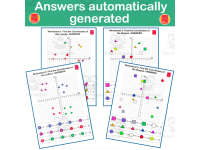
Answers can be found on the second page of every worksheet, automatically generated when you create a new worksheet.

Note
These resources are PDF documents and work with the official Adobe Acrobat Reader on Windows or Mac computers with the randomising buttons also working via a touchscreen (PC or Mac)or on an Interactive Whiteboard.

Common Core Standards

CCSS5.G.A.1

Use a pair of perpendicular number lines, called axes, to define a coordinate system, with the intersection of the lines (the origin) arranged to coincide with the 0 on each line and a given point in the plane located by using an ordered pair of numbers, called its coordinates. Understand that the first number indicates how far to travel from the origin in the direction of one axis, and the second number indicates how far to travel in the direction of the second axis, with the convention that the names of the two axes and the coordinates correspond (e.g., 𝘹-axis and 𝘹-coordinate, 𝘺-axis and 𝘺-coordinate).

Australian Curriculum

Introduce the Cartesian coordinate system using all four

quadrants (ACMMG143)

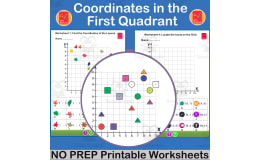
You may also like Coordinates in the first Quadrant. Plotting and Locating Points

In the classroom

Teaching tips & learning objectives

Learning objectives

  • Plot and identify ordered pairs (x, y) in all four quadrants of a coordinate grid, including negative values.

  • Use letter labels to record the coordinates of points representing objects, shapes, and icons.

  • Extend coordinate work by joining plotted points to form shapes, naming them, and locating lines of symmetry.

Teaching tips

  • Introduce the ten worksheets in the guide's suggested order (leaves and icons first, then shapes, then formal letters) to build from concrete objects to abstract notation.

  • Use the two blank quiz templates once students are confident, letting them design a coordinate puzzle for a partner to solve.

  • Extend the shape-based worksheets by having students join the plotted points, name the resulting polygon, and find its centre, as suggested in the guide.

Skills covered

  • Four-quadrant coordinate plotting - students locate points such as (-8, 0) and (6, 6) across all four quadrants of an x-y grid.

  • Coordinate notation with negative values - students record ordered pairs, including negative x and y values, as letter-labelled positions on leaf, icon, shape, and letter grids.

  • Peer-created assessment - students design their own coordinate quiz using the blank templates and record a matching answer key.

Good to know

Questions teachers ask about this resource

How are the five themed worksheet sets meant to build on each other?

The guide sequences them from object recognition (leaves, then astronomy icons) through geometric shapes to fully letter-labelled, formal notation, with the two blank templates reserved for open-ended, pupil-created quizzes.

What follow-up tasks can extend the shape-based worksheets once students finish plotting?

The guide suggests joining the plotted points to form and name shapes, drawing lines of symmetry, finding each shape's centre, and applying simple transformations using the blank worksheets.

No reviews yet

Downloaded this resource? Tell other teachers how it went.

Curriculum

Standards, concepts & topics

Standards

  • 6. NS.C.8 — Solve real-world and mathematical problems by graphing points in all four quadrants of the coordinate plane. Include use of coordinates and absolute value to find distances between points with the same first coordinate or the same second coordinate.
  • 6. NS.C.6 — Understand a rational number as a point on the number line. Extend number line diagrams and coordinate axes familiar from previous grades to represent points on the line and in the plane with negative number coordinates. a. Recognize opposite signs of numbers as indicating locations on opposite sides of 0 on the number line; recognize that the opposite of the opposite of a number is the number itself, e.g., –(–3) = 3, and that 0 is its own opposite. b. Understand signs of numbers in ordered pairs as indicating locations in quadrants of the coordinate plane; recognize that when two ordered pairs differ only by signs, the locations of the points are related by reflections across one or both axes. c. Find and position integers and other rational numbers on a horizontal or vertical number line diagram; find and position pairs of integers and other rational numbers on a coordinate plane.

Core concepts

  • coordinate plane

  • ordered pairs

  • four quadrants

Explore more

Categories this resource belongs to

Explore related searches

More to explore

You may also like