Culturally Responsive Teaching and the Brain Teacher Professional Development


- Grades
- Adult Education
- File type
- Answer key
- Included


- Subject
- Resources for Teachers
- Topic
- Culturally responsive teaching, Teacher professional development
- Resource types
- Activities, Teacher Tools
- Answer key
- Included
Product description
From the author
Has your school been studying the Zaretta Hammond book Culturally Responsive Teaching and the Brain?
Are you looking to give a 15-20 minute professional development training to your staff using the book as a reference?
Check out this ready-to-use Information Gap activity to guide your participants through a short training session.
The documents in this activity will allow you to lead a 15-20 minute activity using the sheltered instructional strategy called Information Gap.
Information Gap is a collaborative activity that will get your students or participants up and moving, talking to one another, and using targeted academic vocabulary and concepts. The activity has people working in pairs and each person has a different piece of missing information. Participants must listen and talk to each other in order to fill in the information gap.
Documents included in this PDF:
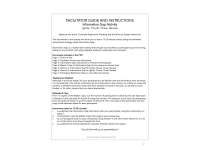
PDF page 1: Facilitator Guide and Instructions
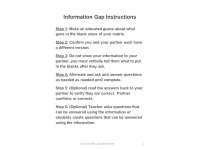
PDF page 2: Information Gap Instructions to Provide to Participants
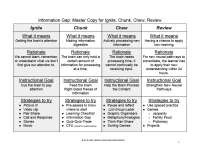
PDF page 3: Master Copy of Information Gap (to be used as an answer key)
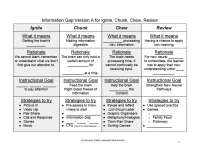
PDF page 4: Version A: Information Gap for Ignite, Chunk, Chew, Review
PDF page 5: Version B: Information Gap for Ignite, Chunk, Chew, Review
PDF page 6: Participant Reflection Sheet to Use After the Activity
Background Needed:
Although it would be helpful for your participants to be familiar with the information from the book, it is not essential. This activity could serve as an introduction to the content, an activity to review the content, a refresher activity for those who have studied the book in the past, an activity for book studies, or for other reasons that you deem appropriate.
Materials & Prep:
Print 1-2 copies of the Master Copy. Cut the number of participants in half and print one stack each of Version A and one stack of Version B using that number. For example, if you have 20 participants, print 10 copies of Version A and 10 copies of Version B. Print one copy of the instructions and one copy of the reflection sheet for each participant.
Instructions: (plan for 15-20 minutes)
1.(2 min) Review the Information Gap Instructions with your participants, using the instructions on PDF page 2.
2.The facilitator uses the Master Copy from PDF page 3 as an answer key.
3.(10 min) Participants work in pairs, one person using Version A and the other using Version B. It is ok to cut this short if not done if needed for time.
4.(3 min) Debrief the activity afterwards using the reflection sheet from PDF page 6.
Related resources
More resources teachers may find useful
24 related resources were found using this product's title, contributor, categories and tags.


In the classroom
Teaching tips & learning objectives

Learning objectives
Explain the purpose and instructional goal of each phase in the Ignite, Chunk, Chew, Review framework.
Practice the Information Gap collaborative structure as a model for classroom use.
Reflect on how the strategy could be adapted to one's own classroom, content area, or grade level.

Teaching tips
Print one Master Copy for the facilitator, and split remaining participants evenly between Version A and Version B.
Budget about 15-20 minutes total: a few minutes reviewing instructions, most of the time for paired information-gap work, and a few minutes to debrief.
Use the Master Copy as an answer key to verify pairs completed their matrices correctly.

Skills covered
Collaborative communication — participants describe information to help a partner fill gaps in a complementary chart.
Teaching-framework review — participants consider the Ignite, Chunk, Chew, Review model in instructional planning.
Reflective discussion — participants discuss the activity’s benefits and possible classroom adaptations.
Good to know
Questions teachers ask about this resource
How do Version A and Version B differ from each other?
Each is the same four-phase chart with a different set of blanks removed, so a pair of participants -- one with Version A, one with Version B -- must ask and answer questions to reconstruct the full chart together.
Do participants need to have read the book beforehand to take part?
It's helpful but not essential -- the guide notes the activity can serve as an introduction to the book's content, a review, or a refresher for those who studied it previously.

No reviews yet
Downloaded this resource? Tell other teachers how it went.
Resource details
Concepts & topics
Core concepts
 Core concepts
Culturally Responsive Teaching and the Brain
Ignite Chunk Chew Review
Professional development
Information gap activity
 Topics
More to explore
You may also like