24 related resources

Deductive Reasoning Puzzles #1: Beginning Links to Logic
Logic activities excerpted from a Lorenz Educational Press book ask students to spot errors, identify what doesn't belong, and decode word and picture puzzles, with a full explained answer key.
Grades
Grades 2–4, Elementary
File type
PDF
Preparation
Print ready

Updated Feb 03, 2022

Topic
deductive reasoning, links to logic
Resource types
Worksheets & Printables, Worksheets
Preparation
Print ready

About this resource

What's inside this resource

Deductive Reasoning Puzzles #1: Beginning Links to Logic
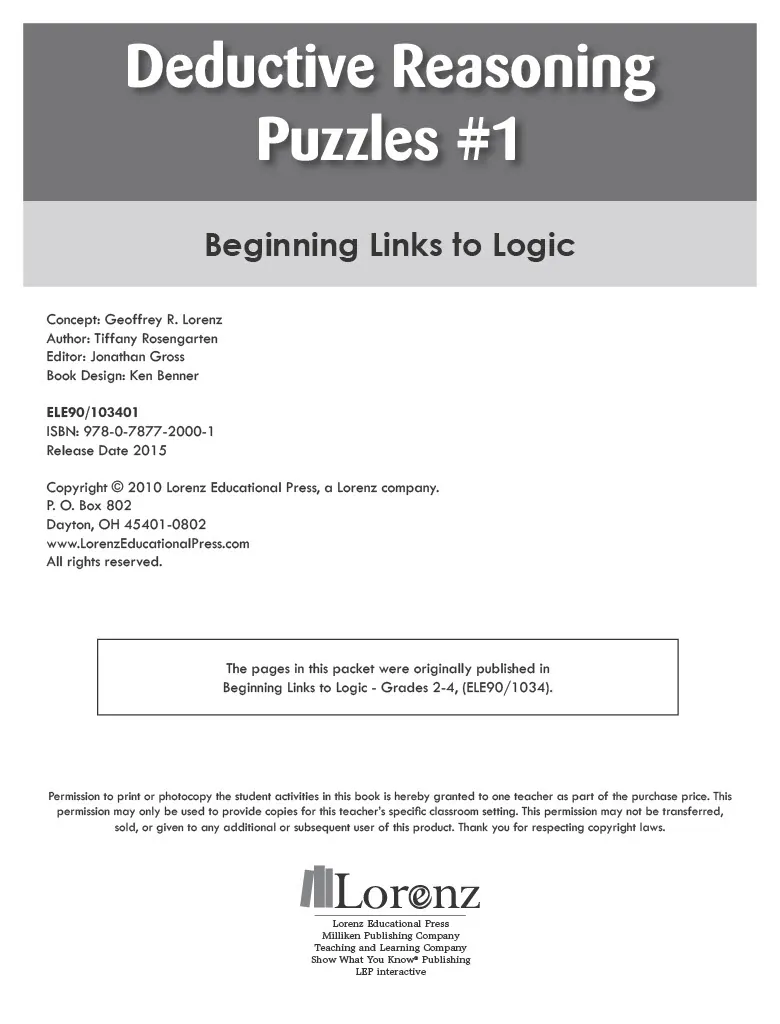
A comprehensive teaching resource designed to foster logical thinking skills in students. This material serves as an excellent tool for educators—both public school teachers and homeschoolers—to help pupils master deductive reasoning.

What is included?

  • A downloadable PDF with eight ready-to-print pages
  • Engaging activities that prompt students to identify anomalies within given puzzles.

The tasks are thoughtfully designed, subtly encouraging children to utilize their deductive abilities in recognizing what doesn't fit or seems incorrect within the puzzle set.

Versatility of the Resource

This is a versatile resource which makes it suitable for a variety of instructional settings—it can be employed during whole group instruction for collaborative problem-solving scenarios or as an individual task during small group activities. Given the printable nature of these materials, they are also fitting homework assignments, allowing further practice opportunities outside the classroom.

Target Audience and Universal Application

With contents specifically targeted towards Grade 2 through Grade 4 learners, this product embodies practicality across multiple year levels. Although categorized under 'Other' subjects at its core, it highlights the universal application of logical thinking—a skill advantageous across all disciplines.

The principle underlying Deductive Reasoning Puzzles #1: Beginning Links to Logic:

Echoes an important truth about educative processes—logical thinking is not spontaneously acquired but cultivated over time through consistent practice and structured challenges. This resource kick-starts this remarkable journey towards refining students' reasonableness and critical analysis capabilities—a vital intellect attribute honed beyond grade-school years and into adulthood.

In Conclusion

If you're on the lookout for impactful mediums designed explicitly around enhancing students' logic skills while also fueling their pleasure for learning then Deductive Reasoning Puzzles #1: Beginning Links to Logic certainly deserves consideration in your teaching toolkit.
In the classroom

Teaching tips & learning objectives

Learning objectives

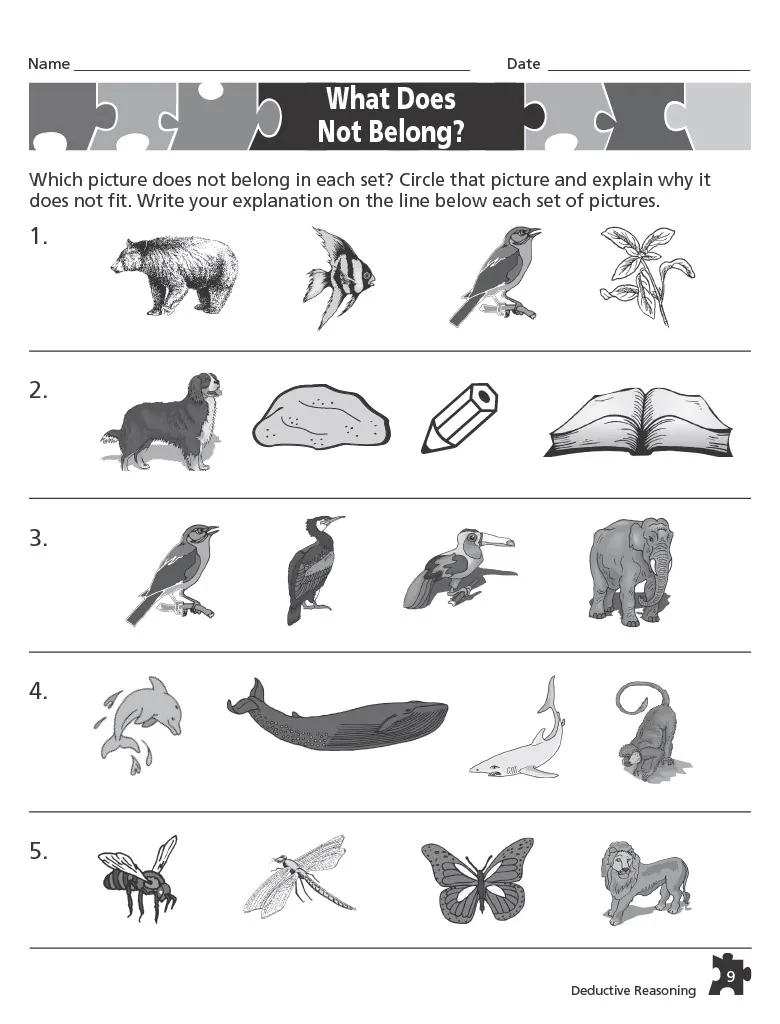
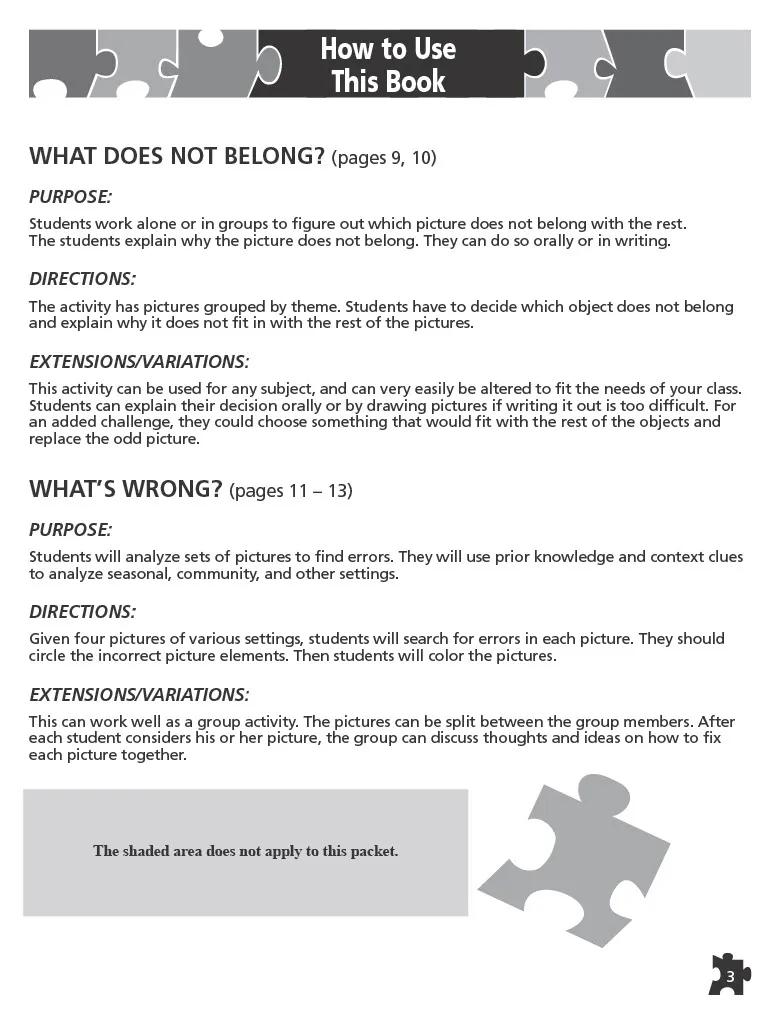
  • Identify which item in a themed group doesn't belong and justify the reasoning

  • Locate and explain an inconsistency or error in an illustrated scene

  • Diagnose a specific arithmetic error, such as incorrect regrouping, in a worked example

  • Use context and picture clues to decode a familiar rhyme, tale, or quote

Teaching tips

  • Use "What Does Not Belong?" as a discussion starter — the file suggests students explain their choice orally or in writing, so pair students to compare reasoning.

  • For "Finding Errors," walk through the answer key's explanation of each mistake to model correcting the same misconception in class.

  • The word-puzzle pages can be split by group or done as a whole-class warm-up, since each requires only picture or word decoding.

Skills covered

  • Deductive reasoning / odd-one-out — students identify and explain which picture doesn't belong in a themed set.

  • Visual error analysis — students spot incongruous details in illustrated scenes and justify the error.

  • Error analysis in arithmetic — students find and explain a peer's regrouping or borrowing mistake in an addition or subtraction problem.

  • Decoding puzzles — students use picture and word clues to identify nursery rhymes, fairy tales, world landmarks, and famous quotes.

Good to know

Questions teachers ask about this resource

What kind of mistake does 'Finding Errors' ask students to diagnose?

Specific arithmetic reasoning errors, such as placing a regrouped digit in the wrong place value or forgetting to carry a ten, which students must identify and correct.

How does this excerpt relate to the full 'Beginning Links to Logic' book?

It is a themed excerpt covering the 'What Does Not Belong,' 'What's Wrong,' word-puzzle, and error-analysis activity types from the larger Grades 2-4 book.

No reviews yet

Downloaded this resource? Tell other teachers how it went.

Resource details

Concepts & topics

Core concepts

  • deductive reasoning

  • critical thinking

  • error analysis

  • logic puzzles

Explore related searches

More to explore

You may also like