Developing Reading Power 3 - Stories With Comprehension Activities


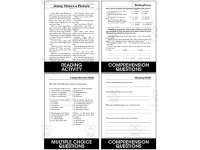

- Grades
- Grade 3, Elementary
- Pages
- 64
- File type
- Answer key
- Included


- Subject
- ELA, Reading
- Topic
- primary, comprehension
- Answer key
- Included
- Standards
- CCSS.RL.3.1 CCSS.RL.3.3 +1
About this resource
What's inside this resource
Product description
From the author
This language arts-based resource is designed for grade 3. Basic reading skills are developed through the use of this resource. High-interest stories are presented in a way that encourages students to start reading. Students learn what they have read through literal and inferential comprehension. Each story presented in this resource falls within the appropriate grade 3 readability range—from 39 to 49 Degrees of Reading Power (DRP) units. Aligned to the International Reading Association and National Council of Teachers of English Standards 1 and 3.
Related resources
More resources teachers may find useful
24 related resources were found using this product's title, contributor, categories and tags.


In the classroom
Teaching tips & learning objectives

Learning objectives
Answer literal and inferential comprehension questions about a short story, citing details from the text.
Complete a cloze passage by supplying words that fit the grammar and meaning of a sentence drawn from a story just read.
Respond in writing to open-ended questions that connect a story's events to the student's own experience.

Teaching tips
Use the teacher footnote on each cloze page to discuss how different word choices change or preserve a sentence's meaning, rather than treating every blank as having one right answer.
Assign the twelve units in book order rather than at random, since the stories are sequenced from easier to more demanding by DRP readability level.
Pair the personal-response prompt on each Thinking Skills page with a short class discussion before students write, since prompts ask students to connect the story to their own experience (for example, "Write about a time when you did something difficult").

Skills covered
Literal and inferential comprehension — students answer six multiple-choice questions per story covering main idea, sequence, character motivation, and cause-and-effect, such as identifying who doubts Turtle can reach the party.
Context-based cloze completion — students fill blanks in a passage drawn from the story itself, choosing words that fit both grammar and story meaning.
Open-response reading reflection — students answer short-answer "Thinking Skills" questions that require recounting story events and connecting them to personal experience.
Good to know
Questions teachers ask about this resource
Do the twelve stories need to be completed in a set order?
Not strictly, but the stories are sequenced from easier to more challenging using DRP readability levels, so working through them in book order builds difficulty gradually.
What does the cloze section ask students to do beyond picking one answer?
The first three blanks are multiple choice, but the last three ask students to brainstorm as many grammatically fitting words as they can think of, which the teacher footnote suggests discussing for shades of meaning.
Does every story end with a personal-writing prompt?
Yes — each Thinking Skills page closes with an open prompt inviting students to connect the story to their own experience, such as writing about a time they did something difficult.

No reviews yet
Downloaded this resource? Tell other teachers how it went.
Curriculum
Standards, concepts & topics
Standards
 Standards
- CCSS.RL.3.1 — Ask and answer questions to demonstrate understanding of a text, referring explicitly to the text as the basis for the answers.
- CCSS.RL.3.3 — Describe characters in a story (e.g., their traits, motivations, or feelings) and explain how their actions contribute to the sequence of events.
- CCSS.L.3.4 — Determine or clarify the meaning of unknown and multiple-meaning word and phrases based on grade 3 reading and content, choosing flexibly from a range of strategies. a. Use sentence-level context as a clue to the meaning of a word or phrase. b. Determine the meaning of the new word formed when a known affix is added to a known word (e.g., agreeable/disagreeable, comfortable/uncomfortable, care/careless, heat/preheat). c. Use a known root word as a clue to the meaning of an unknown word with the same root (e.g., company, companion). d. Use glossaries or beginning dictionaries, both print and digital, to determine or clarify the precise meaning of key words and phrases.
Core concepts
 Core concepts
reading comprehension
cloze passage
literal vs. inferential questions
story sequencing
 Topics
Explore related searches
More to explore
You may also like