Dialogue Puzzles

- Grades
- Grades 2–3, Elementary
- Pages
- 23
- File type
- Answer key
- Included


- Subject
- ELA, Grammar, Language Development
- Topic
- Dialogue puzzles, Grammar activity
- Resource types
- Worksheets, Worksheets & Printables
- Answer key
- Included
Product description
From the author
If you are looking for some interactive and fun grammar practice for your students, this packet of Dialogue Puzzles is a great implementation in your classroom.
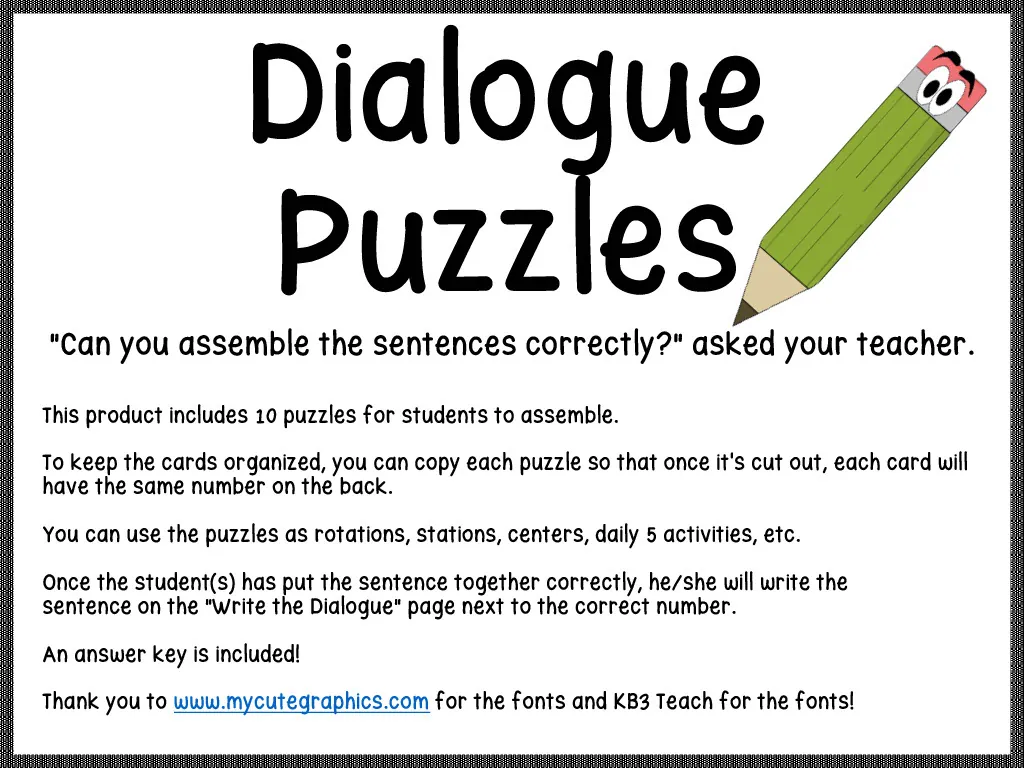
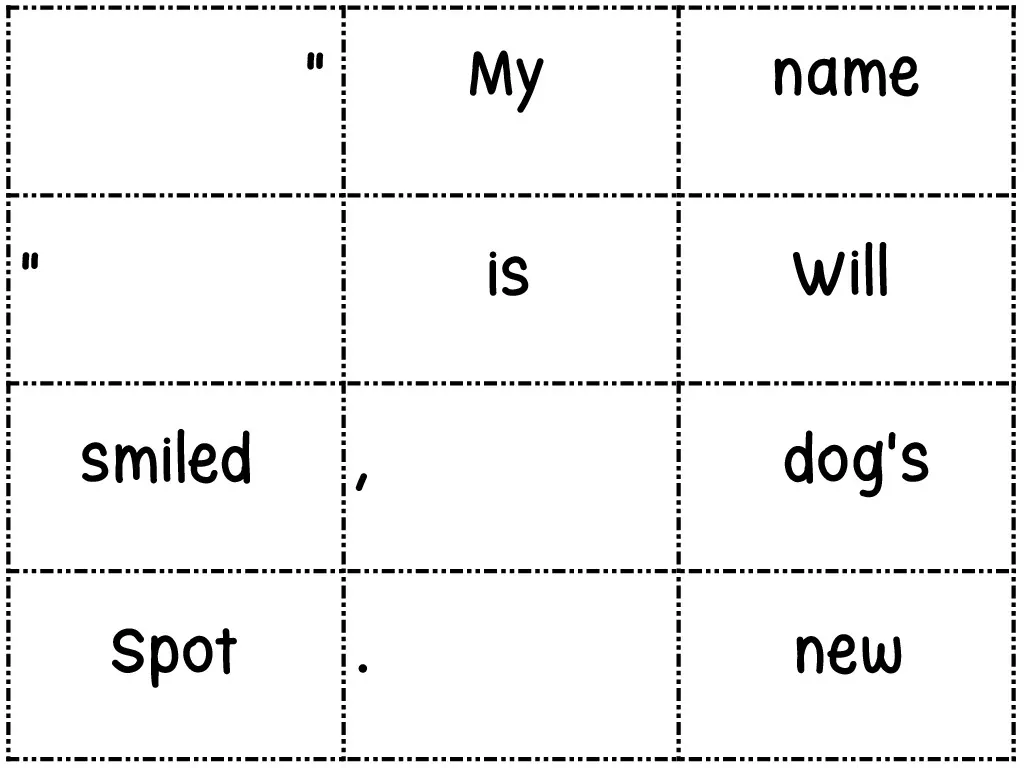
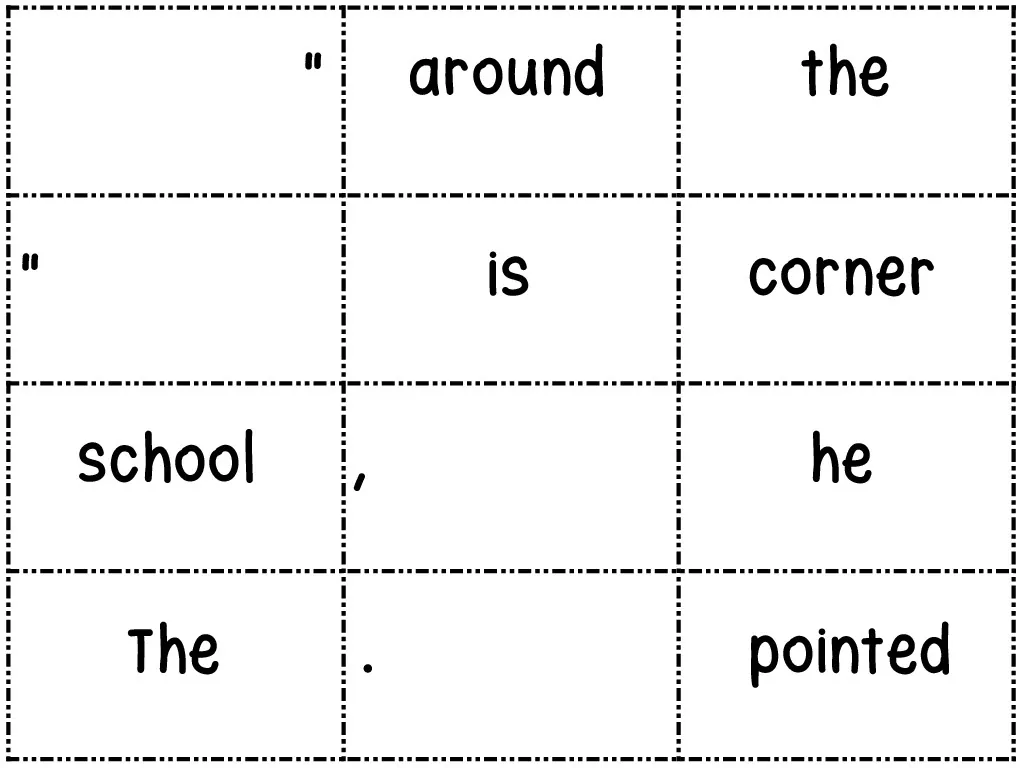
This product includes 10 puzzles for students to assemble. Each puzzle has 12 pieces to put together.
To keep the cards organized, you can copy each puzzle so that once it’s cut out, each card will have the same number on the back.
You can use the puzzles as rotations, stations, centers, daily 5 activities, etc.
If you pull students into small groups, you will be able to assess their level of mastery. Can they find the proper nouns? Do they understand that a sentence begins with a capital letter? Are they able to put quotation marks in the correct place?
These are puzzles that also work well in partner groups or small groups. Partners can work together to form each sentence one at a time. You can also have partners quiz each other by allowing one partner have a copy of the answer key while the other partner is in control of assembling the sentence. Then they can check the work for accuracy.
Once the student(s) has put the sentence together correctly, he/she will write the sentence on the “Write the Dialogue” page next to the correct number.
An answer key is included!
If you need an extension activity for students who finish quickly and need an additional challenge, you may have them select a sentence and build a short story based on that particular sentence.
Related resources
More resources teachers may find useful
24 related resources were found using this product's title, contributor, categories and tags.
In the classroom
Teaching tips & learning objectives

Learning objectives
Place opening and closing quotation marks around the spoken words only, treating the marks as separate elements of the sentence
Capitalise the first word of the sentence and the first word inside the quotation, recognising that these are not always the same word
Move a speaker tag to the front or the back of a sentence and keep the punctuation correct, as the key's multiple accepted answers require

Teaching tips
Copy each puzzle onto its numbered backing page before cutting, as the title page suggests; every one of a puzzle's twelve cards then carries the same number on the reverse and a spilled tray can be re-sorted in seconds
Start with puzzles 2, 6 and 7, where the speaker tag comes first - Betty asked, Peter shouted, Lisa asked shyly - since a leading tag makes the comma placement easiest to see
The key accepts several arrangements for puzzles 1, 5, 8, 9 and 10, so treat a student answer that differs from the first line printed as correct if the punctuation follows the move

Skills covered
Punctuating dialogue - opening and closing quotation marks, the comma before or after a speaker tag, and the end mark are all separate cards students must place themselves.
Choosing the right terminal punctuation - the ten sentences need a mixture of full stops, question marks and exclamation marks, supplied as distinct pieces ("Why is the sky blue?", "I want this room clean!").
Recognising dialogue verbs and adverbs - the puzzles use smiled, asked, yelled, pointed, said, shouted, screamed, thought and blurted, four of them modified by shyly, frantically, angrily or quickly.
Good to know
Questions teachers ask about this resource
How do ten decks of small cards stay apart in a centre?
Each puzzle has a partner page printed with its own number filling all twelve cells. The title page's method is to copy a puzzle onto its numbered page before cutting, so every card in that deck carries the same number on the reverse and a mixed tray can be sorted back by number.
Can a puzzle be assembled more than one way?
Yes, and the key says so. It is headed "Possible correct answers" and lists alternatives wherever the speaker tag can move: puzzle 1 accepts "smiled Will" or "Will smiled", puzzle 5 accepts three arrangements, and puzzle 9 accepts five, including both "Chris thought angrily" and "thought Chris angrily".
What happens after a sentence is built?
It gets written down. A "Write the Dialogue" sheet carries a Name line and ten numbered lines, with the instruction "After assembling your sentences correctly on your desk, write them on the lines below. Don't leave anything out!" - so the punctuation has to be reproduced by hand, not just arranged.

No reviews yet
Downloaded this resource? Tell other teachers how it went.
Curriculum
Standards, concepts & topics
Standards
 Standards
- L.2.1
- L.3.2
Core concepts
 Core concepts
Dialogue punctuation
Quotation marks
Sentence construction
Grammar centers
 Topics
Explore more
Categories this resource belongs to
Explore related searches
More to explore
You may also like