Duck On A Bike: Language-Literacy Book Companion Packet

- Grades
- Preschool–2, Elementary
- File type
- Preparation
- Print ready


- Subject
- Special Resources, Special Education Needs (SEN), Speech Therapy, ELA, Language Development
- Topic
- aac, book companion
- Resource types
- Worksheets & Printables, Novel Studies
- Preparation
- Print ready
- Standards
- CCSS.RF.K.2.a CCSS.RL.K.2
About this resource
What's inside this resource
Related resources
More resources teachers may find useful
24 related resources were found using this product's title, contributor, categories and tags.


In the classroom
Teaching tips & learning objectives

Learning objectives
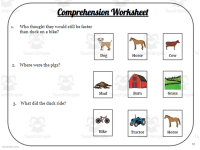
Retell Duck On A Bike by pasting the animal pictures in their order of appearance
Recognize words that do not rhyme with story words such as duck, pig, and bike, and generate new rhymes for them
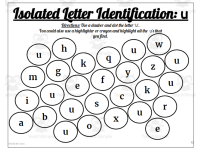
Identify the letter u by name and sound, in isolation, inside words, and within connected text

Teaching tips
Run the picture walk before the first reading: students name what they see on the cover and predict the story, without the text being read aloud yet
Laminate the story props and mount them on craft sticks as puppets; the thought-bubble props show when an animal is thinking something it does not say
Cut the CAR comments into a bookmark or transfer them to sticky notes placed on the matching book pages so the prompts are at hand mid-reading

Skills covered
Story retelling — students cut out and paste the farm-animal pictures in order of appearance, from Bike and Cow through Mouse, Kids, and All.
Rhyme recognition and production — students cross out the two words that do not rhyme with duck, pig, bike, cat, dog, and kid, then write a rhyme of their own for each.
Letter identification — students dot isolated u's with a dauber, mark u-words such as duck and unless, and highlight u's inside a short paragraph.
Good to know
Questions teachers ask about this resource
How does the packet support students who communicate with AAC?
Core-word cards for On, Hello, I, and Thought are provided for aided language input during shared reading, cut-apart fringe strips name the story's animals and actions, and the directions ask adults to model on the student's own AAC symbol set when it differs from the printed symbols. Both craft pages also list core words to model while making the project.
Which letter gets the dedicated letter-work pages?
The letter u. Students identify its name and sound, dot isolated u's with a dauber, mark u-words such as duck, under, and unless, and highlight every u inside a short paragraph about feeding ducks at the park.
How do the CAR and CROWD cards fit into a read-aloud of the book?
Each card is keyed to specific pages of Duck On A Bike — comments such as 'Look! No feet!' for pages 18-19, and questions such as 'What is the goat eating?' — and the directions suggest cutting them into a bookmark or clipping them to the matching pages. The storybook itself is used alongside the packet and is not part of the download.

No reviews yet
Downloaded this resource? Tell other teachers how it went.
Curriculum
Standards, concepts & topics
Standards
 Standards
- CCSS.RF.K.2.a — Recognize and produce rhyming words.
- CCSS.RL.K.2 — With prompting and support, retell familiar stories, including key details.
Core concepts
 Core concepts
Shared reading
Phonological awareness
Letter recognition
AAC core vocabulary
Story retelling
 Topics
Explore more
Categories this resource belongs to
Explore related searches
More to explore
You may also like