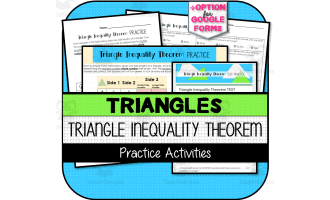
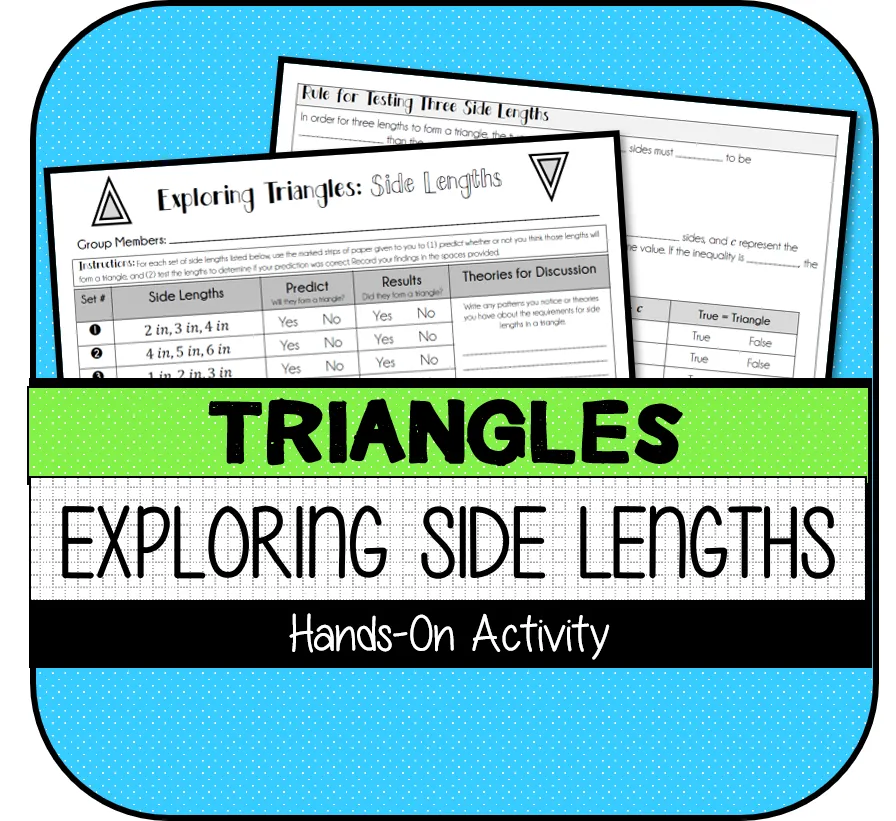
Exploring the Triangle Inequality Theorem: A Hands-On Side-Lengths Activity
- Grades
- Grade 7, Middle School
- Pages
- 9
- File type
- Answer key
- Included


- Subject
- Math, Geometry
- Topic
- Triangles, Hands-on
- Resource types
- Worksheets, Worksheets & Printables
- Answer key
- Included
- Standards
- 7.G.A.2
Product description
From the author
This resource was created to PARTIALLY meet the requirements for the 7th Grade Math Geometry Standard below:
Draw (freehand, with ruler and protractor, and with technology) geometric shapes with given conditions. Focus on constructing triangles from three measures of angles or sides, noticing when the conditions determine a unique triangle, more than one triangle, or no triangle.
Related resources
More resources teachers may find useful
24 related resources were found using this product's title, contributor, categories and tags.

In the classroom
Teaching tips & learning objectives

Learning objectives
Predict, then physically test with cut paper strips, whether three given side lengths can form a triangle
State the triangle inequality rule: the two shorter sides must sum to more than the longest side
Apply the inequality a + b > c to determine whether a new set of three side lengths forms a triangle

Teaching tips
Cut and, if reusing the set in future years, laminate the side-length strips ahead of time so groups can start testing right away
Put students in groups of 2-3, give each group one set of strips and one worksheet, and reserve the last 5-10 minutes of class for groups to share what they discovered
Show the page-4 example (strip ends must exactly touch to count as a triangle) before groups start testing, so they know what a valid match looks like

Skills covered
Triangle inequality reasoning — students test twelve side-length sets by hand, then generalize the rule that the two shorter sides must sum to more than the longest.
Inequality application — students use a + b > c to check six new side-length sets given in centimeters, inches, feet, millimeters, and yards.
Empirical mathematical discovery — students record a prediction, physically test it with the paper strips, and compare the result to what they predicted.
Good to know
Questions teachers ask about this resource
Do later triangle problems use the same measurement unit as the paper strips?
The hands-on strips are all in inches, but the six practice problems on the rule page switch to centimeters, feet, millimeters, and yards, so students apply the same rule across different units.

No reviews yet
Downloaded this resource? Tell other teachers how it went.
Curriculum
Standards, concepts & topics
Standards
 Standards
- 7.G.A.2
Core concepts
 Core concepts
Triangle inequality theorem
Side lengths
Inequalities
 Topics
Explore more
Categories this resource belongs to
Explore related searches
More to explore
You may also like