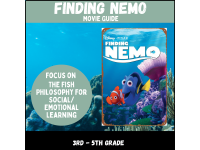
Finding Nemo Movie Guide (Fish Philosophy - Social/Emotional)

- Grades
- Grades 3–5, Elementary
- Pages
- 2
- File type
- Answer key
- Included


- Subject
- Special Resources, Social Emotional Learning (SEL), Social Skills
- Topic
- Disney Pixar, Movie guide
- Resource types
- Teacher Tools, Worksheets
- Answer key
- Included
- Standards
- CCSS.SL.3.1 CCSS.SL.3.2 +1
About this resource
What's inside this resource
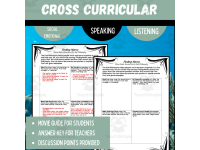
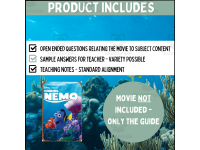
The Finding Nemo movie guide combines writing and social emotional learning (social studies) as students must find examples of the Fish Philosophy in the movie and provide evidence of how these concepts are used. Using movies and movie guides in the classroom can make learning more engaging and relatable for students. Movies bring lessons to life by showing scientific concepts and social issues in an entertaining way, while movie guides help students focus on important details and think critically about what they watch.
Movie Synopsis: Marlin, a clown fish, is overly cautious with his son, Nemo, who has a small fin (Some consider it a disability). When Nemo swims too close to the surface to prove himself, he is caught by a diver, and now Marlin must set out to find him, even though he is afraid of the ocean. A blue reef fish named Dory, who has a really short memory, meets up with Marlin and complicates (and sometimes helps with) the chance meetings of sharks, jellyfish, and a host of ocean dangers. At the same time, Nemo plots his escape from a dentist's fish tank, with the help of another fish with a shortened fin and a seagull.
Speaking and listening standards can also be covered depending on how many of the above topics you cover in your classroom. The movie guide provides an opportunity for teachers to "get back" some of that class time at the end of a unit, whether needed for grading projects, working one on one with students, or finishing up assessments. Other students are engaged and still actively searching for the topics covered in the unit discussed.
The activities provided allow for:
Class discussion
Small group discussion
Informal assessment
Movie Rating: G
Grades: 3rd - 5th
Tags: Finding Nemo, Disney Pixar, movie guide, Fish Philosophy, social emotional learning, behavior management, Choose your Attitude, Play, Make Their Day, Be There
File type: PDF
Pages: 2 - including answer key
Related resources
More resources teachers may find useful
24 related resources were found using this product's title, contributor, categories and tags.


In the classroom
Teaching tips & learning objectives

Learning objectives
Identify a specific scene, quote, or character action in Finding Nemo that demonstrates each of the four Fish Philosophy concepts.
Support an observation about a character's behavior with a specific example from the movie rather than a general summary.
Participate in a class or small-group discussion, building on classmates' examples of each concept.

Teaching tips
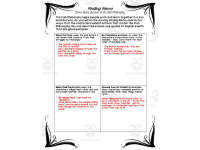
Use the completed example page as a model of the specificity expected before students fill in their own blank version — it cites exact scenes, such as 'the sharks having their Fish are Friends meeting,' rather than vague summaries.
Assign each of the four Fish Philosophy sections to a different small group so each group can report back on one concept, since the guide already separates the prompts into four distinct sections.
Save the guide for the end of a unit, as the teacher-talk page frames it as a way to keep students engaged while the teacher finishes grading or works one-on-one with individuals.

Skills covered
Evidence-based observation — students find and cite a specific scene, quote, or action from the movie that matches a given concept, such as Choose Your Attitude.
Collaborative discussion — students explain and build on their examples with a partner or group, matching the guide's own class and small-group discussion format.
Character analysis — students connect a character's specific behavior (e.g., Gill helping Nemo, Crush trusting his son) to an abstract social-emotional concept.

No reviews yet
Downloaded this resource? Tell other teachers how it went.
Curriculum
Standards, concepts & topics
Standards
 Standards
- CCSS.SL.3.1 — Engage effectively in a range of collaborative discussions (one-on-one, in groups, and teacherled) with diverse partners on grade 3 topics and texts, building on others’ ideas and expressing their own clearly. a. Come to discussions prepared, having read or studied required material; explicitly draw on that preparation and other information known about the topic to explore ideas under discussion. b. Follow agreed-upon rules for discussions (e.g., gaining the floor in respectful ways, listening to others with care, speaking one at a time about the topics and texts under discussion). c. Ask questions to check understanding of information presented, stay on topic, and link their comments to the remarks of others. d. Explain their own ideas and understanding in light of the discussion.
- CCSS.SL.3.2 — Determine the main ideas and supporting details of a text read aloud or information presented in diverse media and formats, including visually, quantitatively, and orally.
- CCSS.SL.3.3 — Ask and answer questions about information from a speaker, offering appropriate elaboration and detail.
Core concepts
 Core concepts
Fish Philosophy (Play, Be There, Make Their Day, Choose Your Attitude)
evidence from a media source
collaborative discussion
 Topics
Explore more
Categories this resource belongs to
Explore related searches
More to explore
You may also like