French Forbidden Words Game: 32 Aller Expression Cards
Teams take turns describing 32 aller expressions in French, covering transport, places, countries and everyday phrases, without saying the expression, any form of aller or the four forbidden words on each card.


- Grades
- Grades 6–12, Middle School, High School
- Pages
- 8
- File type
- Preparation
- Print ready


- Subject
- Foreign Languages, French
- Topic
- French vocabulary, Language learning
- Resource types
- Games, Activities
- Preparation
- Print ready
About this resource
What's inside this resource
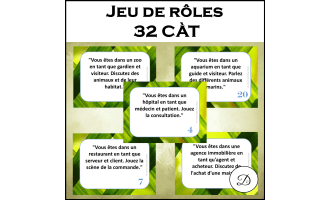
Aller en avion, aller aux États-Unis, aller faire du ski and s’en aller are among the thirty-two expressions built on aller in this French forbidden words game. Each picture card gives the expression, its English meaning and four Ne dis pas words. The clue-giver has one minute to make a teammate guess the expression in French only, while a checker from the other team listens for any word from the expression, any form of aller and the four forbidden words.
The rules page sets out four steps, a score box for Équipe A and Équipe B, six clue starters with English meanings and a worked clue for aller au parc, then asks students to draft clues for aller à la piscine and aller chez le médecin. Page 2 lists all 32 expressions with their meanings in four groups: getting there, places and countries, aller with an activity, and everyday phrases such as Allons-y and Ça te va bien.
Six card pages hold six cards each, sized for cutting and laminating, and the last page adds four blank cards for students’ own aller expressions.
Related resources
More resources teachers may find useful
24 related resources were found using this product's title, contributor, categories and tags.




In the classroom
Teaching tips & learning objectives

Learning objectives
- Explain the meaning of thirty-two common expressions with aller, including s’en aller, aller chercher and Ça te va bien.
- Choose the right preposition with aller for a means of transport, a place or a country, as in aller à vélo, aller en France and aller au Canada.
- Describe an expression in French with places, actions and opposites instead of its key words.

Teaching tips
- Preview page 2 with the class before the first round; reading the expressions and meanings aloud helps beginners recognize them on the cards.
- Do Part C before playing: drafting clues for aller à la piscine and aller chez le médecin on paper shows students how to talk around nager, eau or docteur before the clock is running.
- Point out that every form of aller is banned, so clues for Allons-y and Vas-y have to describe the moment instead, such as leaving together or cheering a friend on.

Skills covered
- Idiomatic expressions — students see aller used for health (aller bien, aller mal), for suiting someone (Ça te va bien) and for fetching (aller chercher).
- Prepositions with places and transport — cards contrast en bus, à vélo, au marché, en France and aux États-Unis.
- Circumlocution — students describe an expression without its key words, as in the model clue for aller au parc: « C’est un endroit où il y a des arbres et des jeux. »
Good to know
Questions teachers ask about this resource
What counts as breaking a rule during a round?
Saying any word from the expression, any form of aller or one of the card’s four Ne dis pas words, or using English or gestures. The checker from the other team calls « Interdit » and the card goes back without a point.
How is the expression list on page 2 organized?
The 32 expressions sit in four groups: seven ways of getting there (aller en bus, aller en avion), eleven places and countries (aller à la bibliothèque, aller au Canada), seven aller + infinitive phrases (aller danser, aller faire du ski) and seven everyday phrases (aller bien, Vas-y). Each line gives the card number and the English meaning.
What goes on the four blank cards?
Each blank card on page 8 has a line for an aller expression and four lines for forbidden words. Students can write their own expression, or reuse aller à la piscine or aller chez le médecin from the practice task.

No reviews yet
Downloaded this resource? Tell other teachers how it went.
Resource details
Concepts & topics
Core concepts
 Core concepts
- Aller expressions
- Prepositions with places
- Idioms
- Circumlocution
- Speaking practice
 Topics
Explore more
Categories this resource belongs to
Explore related searches
More to explore
You may also like