COD and COI French Exercises with Answers: Object Pronouns
French object pronoun practice: students label direct and indirect objects, replace them with le, la, l’, les, lui or leur, and place the pronoun correctly in negative sentences and before an infinitive.


- Grades
- Grades 7–12, Middle School, High School
- Pages
- 3
- File type
- Answer key
- Included


- Subject
- Foreign Languages, French
- Topic
- French worksheets, direct objects
- Resource types
- Worksheets & Printables, Worksheets
- Answer key
- Included
About this resource
What's inside this resource
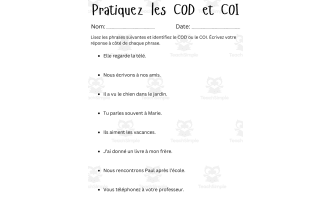
Eight French sentences with an underlined object open this COD and COI practice, and students tick whether each group, such as la télévision or à sa grand-mère, is a direct or an indirect object. A rule box gives the test (no à and the question qui ? or quoi ? for a COD, à plus a person for a COI), lists the pronouns le, la, l’, les, lui and leur, and warns that écouter, regarder, chercher, attendre and aider take a COD in French while parler à, téléphoner à and répondre à take a COI.
Page 2 asks for seven rewrites with the pronoun before the verb: Il aide ses parents becomes Il les aide, and J’attends le bus needs elision. Six more sentences add placement, three negatives with ne … pas and three with aller + infinitive, such as Elle va répondre à ses amies.
Answers for all 21 items follow on page 3, along with notes on aider and on l’ before a vowel, a pronoun chart, a short oral follow-up and six common mistakes with corrections.
Related resources
More resources teachers may find useful
24 related resources were found using this product's title, contributor, categories and tags.


In the classroom
Teaching tips & learning objectives

Learning objectives
- Tell a direct object (COD) from an indirect object (COI) by checking for à.
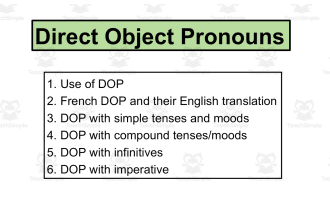
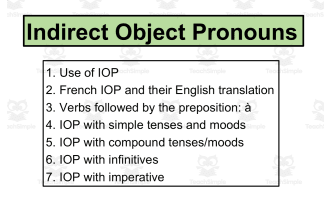
- Replace a COD with le, la, l’ or les and a COI with lui or leur.
- Place the object pronoun before the conjugated verb, using l’ before a vowel.

Teaching tips
- Spend a minute on the Watch out line in the rule box: regarder, écouter and attendre take a direct object in French although English says look at, listen to and wait for.
- In Part A, have students ask à qui ? or qui ? / quoi ? about the underlined group, the test the rule box gives.
- Item 14, J’attends le bus, shows two changes at once: le becomes l’, and J’ goes back to Je.

Skills covered
- Identifying objects — students label eight underlined groups, such as le journal and au professeur, as COD or COI.
- Direct object pronouns — students replace la pomme, ses parents, son chien and le bus with la, les, le and l’.
- Indirect object pronouns — students replace à la directrice, à tes grands-parents and à Marc with lui or leur.
Good to know
Questions teachers ask about this resource
Why are aider and écouter treated as COD verbs?
In French they take a direct object with no à, even where English uses a preposition, as in listen to. The rule box lists écouter, regarder, chercher, attendre and aider, and items 7 and 10 test them: Vous écoutez la radio, and Il les aide rather than leur.
Which object pronouns does the worksheet practice?
The third-person set: le, la and l’ for a singular COD, les for a plural COD, lui for one person after à and leur for several. Every item replaces a named person or thing, so me, te, nous and vous do not come up.
Where does the pronoun go when a sentence has two verbs?
Before the infinitive it belongs to, not before aller: Nous allons les inviter and Elle va leur répondre. Items 19 to 21 practice this, and the common mistakes box on page 3 shows Nous les allons inviter corrected.

No reviews yet
Downloaded this resource? Tell other teachers how it went.
Resource details
Concepts & topics
Core concepts
 Core concepts
- Direct object pronouns (COD)
- Indirect object pronouns (COI)
- Pronoun placement
- Negation (ne … pas)
- Aller + infinitive
Topics
 Topics
Explore more
Categories this resource belongs to
Explore related searches
More to explore
You may also like