Greatest Common Factor and Distributive Property - Scoffolded Practice


- Grades
- Grade 6, Middle School
- Pages
- 4
- File type
- Answer key
- Included


- Subject
- Math, Algebra
- Topic
- greatest common factor, distributive property
- Resource types
- Worksheets & Printables, Worksheets
- Answer key
- Included
- Standards
- 6. NS.B.4
About this resource
What's inside this resource
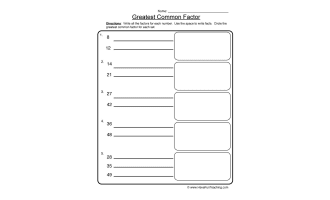
This file contains a practice sheet for 6th grade math students to factor a common factor which leads to a distributive property problem. The practice is scaffold for students. The first few problems give a step-by-step guide for students to complete the problem: 1) find the factors of a, 2) find the factors of b, 3) find the common factors of a and b, 4) find the greatest common factor of a and b, 5) fill in the blanks to factor the expression (write a distributive property problem). This skill is a pre-requisite for expanding and simplifying expressions which leads to factoring, solving equations, solving word problems, and many more advanced topics. This covers the standard: Use the distributive property to express a sum of two whole numbers 1-100 with a common factor as a multiple of a sum of two whole numbers with no common factor. The answer key is included.
Related resources
More resources teachers may find useful
24 related resources were found using this product's title, contributor, categories and tags.

In the classroom
Teaching tips & learning objectives

Learning objectives
List all factors of a whole number up to 40
Identify the common factors of two numbers and pick out the greatest
Rewrite a sum as its greatest common factor times a sum of two numbers, as in 8 + 12 becoming 4(2 + 3)

Teaching tips
The support fades on purpose — five sub-steps, then three, then two, then none — so the sheet can be cut at whichever point a group is ready to work unaided
Items 1 and 2 print the answer blanks as ___ ( ___ + ___ ), which fixes the shape of the expression before students have to produce it themselves
Item 9 is 8 + 40, where the reduced sum is 1 + 5; students who expect both bracket terms to be greater than one will need that case discussed

Skills covered
Listing factors — students write out every factor of numbers such as 12, 18, 24 and 32 before doing anything else with them.
Finding the greatest common factor — items work from the full common-factor list (1, 2, 4 for 8 and 12) down to the single greatest value.
Applying the distributive property in reverse — each sum is rewritten as a factor outside a bracket and a reduced sum inside, as in 24 + 32 becoming 8(3 + 4).
Good to know
Questions teachers ask about this resource
How does the support change across the sheet?
It thins in four stages. Items 1 to 3 give five labelled sub-steps each, items 4 and 5 give three, items 6 and 7 give two, and items 8 to 12 give only the sum under the heading "Factor the following."
How does the sheet handle a sum that cannot be factored this way?
Item 11 pairs 14 and 25, whose only common factor is 1, so the procedure produces nothing to pull out. It works as a deliberate check that students test for a shared factor rather than assume one — the key writes the result as "prime", which is worth settling into your own preferred wording since 14 itself is not a prime number.
What form does a finished answer take?
A common factor outside a bracket with the reduced sum inside: 8 + 12 becomes 4(2 + 3), 24 + 32 becomes 8(3 + 4) and 27 + 12 becomes 3(9 + 4). The first two items print the blanks as ___ ( ___ + ___ ) so the shape is set before students write one unaided.

No reviews yet
Downloaded this resource? Tell other teachers how it went.
Curriculum
Standards, concepts & topics
Standards
 Standards
- 6. NS.B.4 — Find the greatest common factor of two whole numbers less than or equal to 100 and the least common multiple of two whole numbers less than or equal to 12. Use the distributive property to express a sum of two whole numbers 1–100 with a common factor as a multiple of a sum of two whole numbers with no common factor. For example, express 36 + 8 as 4 (9 + 2).
Core concepts
 Core concepts
Greatest common factor
Distributive property
Factors
Factoring expressions
 Topics
Explore more
Categories this resource belongs to
Explore related searches
More to explore
You may also like