Factors and Multiples Worksheet Set for 6th Grade


About This Product
Finding the greatest common factor (GCF) and least common multiple (LCM) may seem like small topics, but they provide a wealth of foundational math practice! This comprehensive 9-set resource creatively reinforces these concepts for 6th graders through differentiated, randomized worksheets.
Students will strengthen multiplication, division, factoring, and prime numbers competency through scaffolded practice. The differentiated activities allow them to focus on mastering the GCF and LCM processes before applying stronger math skills. Methods go beyond rote memorization to make meaningful connections between common factors/multiples and other areas like the distributive property and notation using exponents.
The ready-to-go worksheets that require no extra prep or grading time. Just click, print, and hand out.
A standout feature is the worksheet randomization. With a single click, educators can generate an entirely new set of questions, making it a renewable resource for the entire school year. Be it for classwork, revision, or homework, adaptability ensures students achieve proficiency in the topic.
Each worksheet concludes with an automatically generated answer key on its second page, offering a quick reference point for educators. And if there's ever a need for a last-minute lesson or work for a substitute
- Unlimited differentiated practice generates new worksheet versions for as much review and reinforcement work as needed.
- Start with simpler number ranges to learn steps before advancing to complex questions
- Cross-curricular approach reinforces understanding across math topics
This resource engages students in learning concepts that prime them for later algebra success. Students can progress at their own pace from basic competency to fluid skill application.
The 9 Sets cover:
Factor pairs
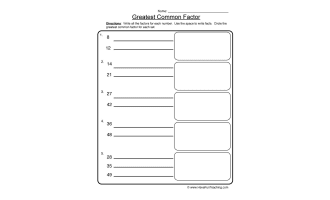
Finding the Greatest Common Factor of two numbers ( listing of factors)
Finding the Greatest Common Factor of three numbers (listing factors))
Prime Factorization
Finding the Greatest Common Factor with Prime Factorization
Using the Greatest Common Factor with the distributive property of multiplication
Finding the Lowest Common Multiple of two Numbers
Finding the Lowest Common Multiple of two Numbers (listing multiples)
Finding the Lowest Common Multiple using Prime Factorization
Finding the Lowest Common Multiple using the Greatest Common Factor
Lastly, it's essential to note that these resources can be downloaded as PDF documents. They operate seamlessly with the official Adobe Acrobat Reader on both Windows and Mac. Plus, the randomizing features are effortlessly accessible via touchscreen devices or interactive whiteboards.
Resource Tags
0 Reviews
Check out these other great products