The Distributive Property Guided Notes + Homework Set
- Grades
- Grades 9–12, High School
- File type
- Preparation
- Print ready


- Subject
- Math, Algebra
- Topic
- algebra, distributive property
- Resource types
- Worksheets & Printables, Worksheets
- Preparation
- Print ready
About this resource
What's inside this resource
This is a The Distributive Property Guided Notes + Homework Set.
Students will learn more about this math skill as they walk through guided notes allowing them to learn and apply as they go along.
A homework assignment is included to further student understanding of this algebra skill.
Answer key included.
Related resources
More resources teachers may find useful
24 related resources were found using this product's title, contributor, categories and tags.
In the classroom
Teaching tips & learning objectives

Learning objectives
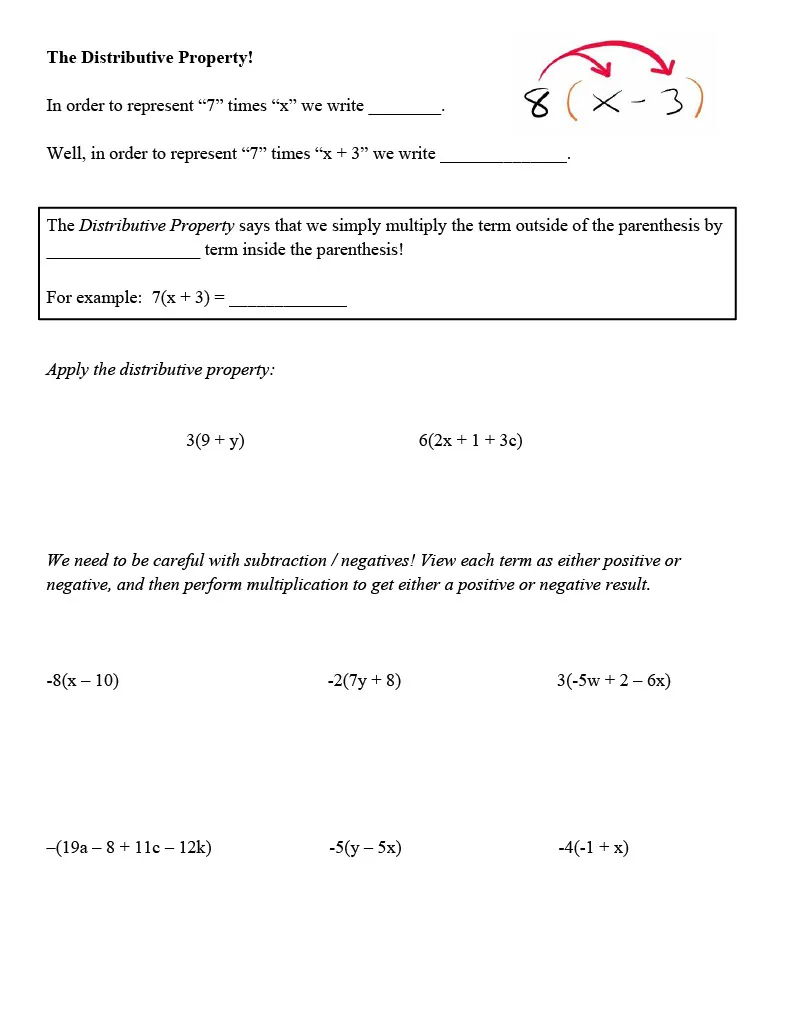
State and apply the rule that a term outside a parenthesis multiplies every term inside it
Distribute a negative multiplier correctly, treating each term inside as positive or negative before multiplying
Distribute a bare negative sign, as in –(12 – 4x + 5y), where the multiplier is an unwritten -1

Teaching tips
Work the notes in printed order: positives, then negatives, then combining like terms, then parentheses that are not at the front — each block adds exactly one new difficulty
The bare-negative cases, –(19a – 8 + 11c – 12k) on the notes and –(12 – 4x + 5y) on the assignment, are where most errors start; the notes give the sign rule immediately before them
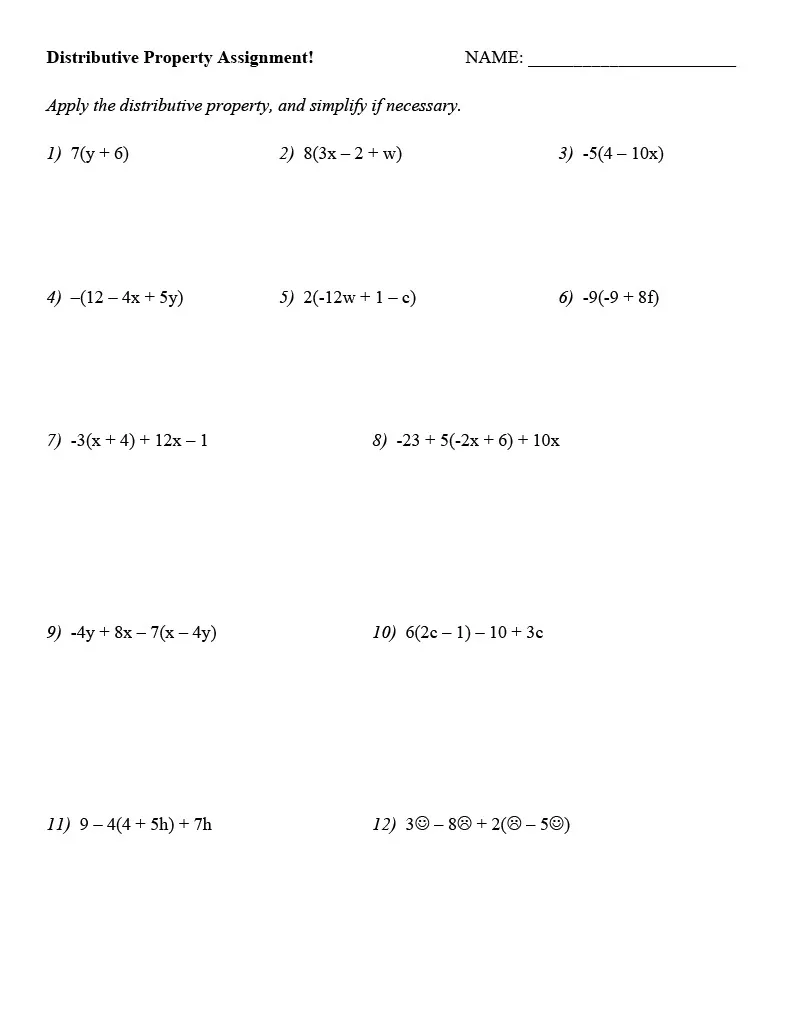
Question 8 on the assignment, -23 + 5(-2x + 6) + 10x, is the one that tests all three skills at once — distributing, handling the negative constant, and combining like terms

Skills covered
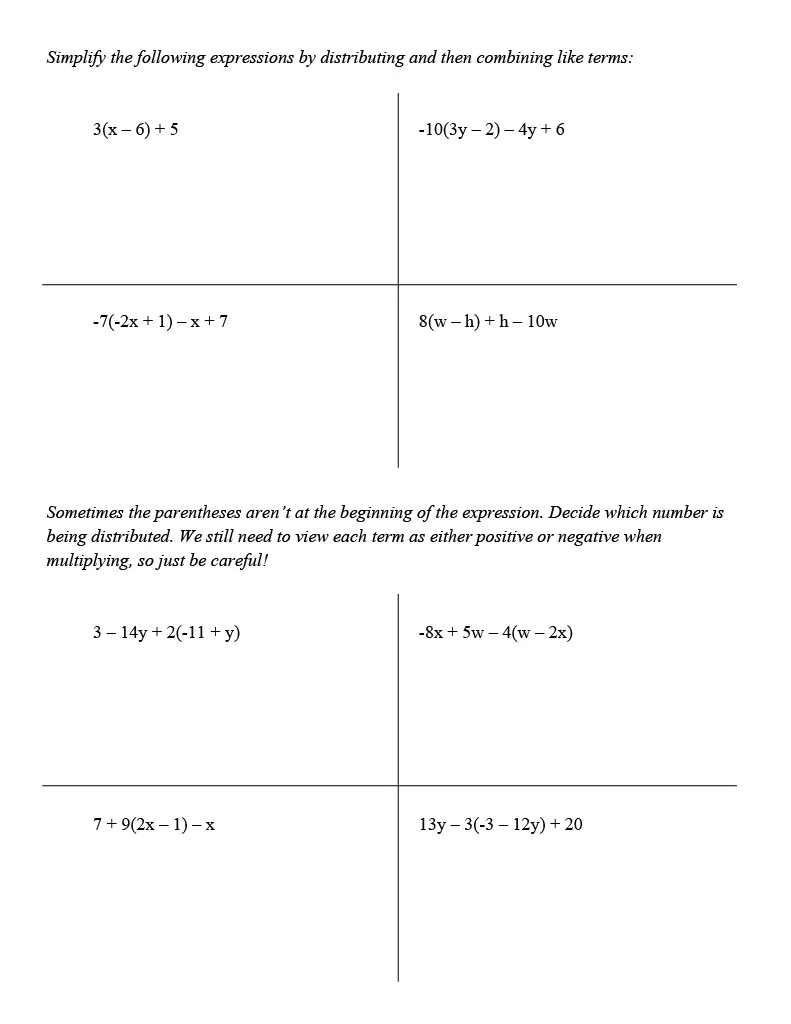
Applying the distributive property — students complete the rule in the notes and then expand expressions from 7(y + 6) to 8(3x – 2 + w).
Distributing negatives — six notes expressions and several assignment questions put a negative outside the parenthesis, as in -9(-9 + 8f) and -5(4 – 10x).
Handling an implicit -1 — expressions written as –(12 – 4x + 5y) require students to recognise the unwritten multiplier.
Good to know
Questions teachers ask about this resource
How do the notes and the assignment relate to each other?
They follow the same four steps. The notes build the rule with blanks, then work positives, negatives, distribute-and-combine, and parentheses that are not at the front. The twelve-question assignment repeats those steps without the scaffolding — questions 1 to 6 are straight expansions, 7 to 11 add like terms, and the difficulty tracks the notes throughout.
Which variables do students meet in these expressions?
More than the usual x and y. The notes and assignment use w, c, h, k, a and f as well — 6(2x + 1 + 3c), 8(w – h) + h – 10w, –(19a – 8 + 11c – 12k) and -9(-9 + 8f) — so students practise treating any letter as a term rather than pattern-matching on x.
Which expressions have no number written outside the parenthesis?
Two: –(19a – 8 + 11c – 12k) in the notes and –(12 – 4x + 5y) as question 4 of the assignment. Both require students to read the bare minus sign as multiplying by -1, which is the step the notes' sign discussion sets up immediately beforehand.

No reviews yet
Downloaded this resource? Tell other teachers how it went.
Resource details
Concepts & topics
Core concepts
 Core concepts
Distributive property
Algebraic expressions
Like terms
Negative coefficients
 Topics
Explore more
Categories this resource belongs to
Explore related searches
More to explore
You may also like