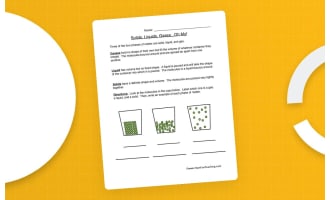
States of Matter Questions, Notes, and Simulation




About This Product
Lesson 5.1 - States of Matter is an all-inclusive learning resource designed to simplify the complex concepts of chemistry and physics for students from grades six through twelve. This tool excellently illustrates the theory that everything is made up of particles, and introduces learners effortlessly into understanding the four different states of matter.
The package incorporates a range of resources, including:
- Notes
- Foldables
- Simulations
- Whiteboard practices
- Powerpoint presentations.
The materials provided are versatile in their application with opportunities to use them in several settings such as full classroom groups, more intimate teaching clusters or even for independent student studies like homework tasks.
Note structure:
Students will find comprehensive notes which cover the four states of matter in-depth with interactive blanks to practice their assimilation alongside theoretical instructions. A considerate feature includes completed versions for learners who may have been absent or those requiring certain accommodations.
Foldables:
Engagingly interactive foldables serve not only as note holders but also act as academic creativity stimuli. Leaves detailing each state's specific properties come both blank and prefilled similar to the note structure approach adopted previously ensuring regular revision aids are at hand irrespective of absence or special requirements.
Innovative Features:
An intriguing computer simulation provides students hands-on experience into exploring particle structures within each state fostered by user friendly URL embedded navigations leading them through modelled scientific data gathering whilst simultaneously answering corresponding queries growing their practical comprehension.
Whiteboard practises move away from traditional methods engaging participants visually classifying matter types via pictures showcased on slides reinforcing identification skills real-time in a dynamic setting further enhancing memory retention strategies thereby improving exam performance rates overall.
This tool adequately addresses multiple 2016 Indiana State Standards for Integrated Chemistry & Physics such as:
- Particle representation methods (ICP 5.1)
- Assumptions leading up to kinetic theory development (ICP 5.2)
- Explaining how forces change between particles (ICP 5.6)
- Density effects along with molecular structures contributing towards distinguishing gas properties versus liquid or solid(ICP 6.7)
Thus this tool is an investment well worth considering.
Your Download:
The files come as editable docx or pptx formats in addition to non-editable PDFs, ensuring options to suit varying teaching styles based on preference and available software.
In conclusion :
Last but not the least, get charged up and ready with a lesson plan for academic success leveraging from Lesson 5.1 - States of Matter!
What's Included
Note: all files included in this resource come as a .docx file (or a .pptx file for PowerPoints) and a .pdf file. The .docx files may be edited to your preferences as long as you have a version of Microsoft Word or a similar word processor that supports the .docx file type. The .pptx files may be edited to your preferences as long as you have a version of Microsoft PowerPoint or a similar presentation software that supports the .pptx file type. The .pdf files are non-editable but can be opened using any PDF viewing software, like Adobe Reader. Please make sure you have software capable of opening and/or editing the files before purchasing and downloading.
Resource Tags
0 Reviews
Check out these other great products