Letter B Games
- Grades
- Preschool–2, Elementary
- Pages
- 4
- File type
- Preparation
- Print ready


- Subject
- ELA, Phonics
- Topic
- Letter B, Letter B Activities
- Resource types
- Games, Activities
- Preparation
- Print ready
- Standards
- RF.K.3.a
Product description
From the author
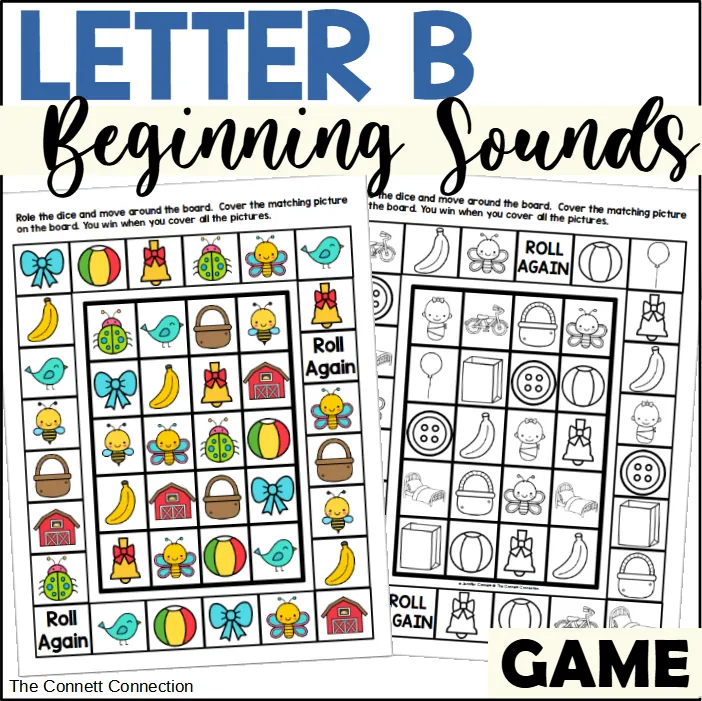
Letter B Games provides two roll-and-cover boards for picture matching and beginning-sound discussion. One board is in color and one is black-and-white, with different B-word pictures on each. The four-page PDF also includes thank-you and credit pages.
Provide a die, playing pieces and counters. Roll, move around the track and cover a matching central picture. The printed goal is to cover all the pictures; there are twenty central spaces on each board, with repeated images.
For phonics practice, have children name each picture and say its beginning sound before covering it. Shorter rounds or timed partner games are optional teacher adaptations.
Related resources available separately
centers
Related resources
More resources teachers may find useful
24 related resources were found using this product's title, contributor, categories and tags.
In the classroom
Teaching tips & learning objectives

Learning objectives
Match a picture on the board to the one landed on, which is the single decision every turn asks for
Hold a three-step rule - roll, move, cover - across a whole game rather than checking it each turn
Take turns and recognise a win condition, ending the round only when every picture on the board is covered

Teaching tips
Nothing on the boards specifies what covers a picture, so decide before play - counters, linking cubes, mini erasers or paper squares all suit a preschool table
Both boards use the same wording, so a second pair can start on the other board while the first is still playing
Name each picture and say its beginning /b/ sound before covering it to connect the matching game with letter-sound practice.

Skills covered
Picture matching - the only action each turn requires is finding the picture on the board that matches the one the player has landed on.
Turn-taking with a die - players roll, move around the track and pass on, which is the social routine a small-group literacy centre depends on.
Following a multi-step rule - roll, move, check for a match, cover - carried through a whole game from the single instruction line at the top of the board.
Good to know
Questions teachers ask about this resource
What do players need alongside the printed boards?
A die and something to cover pictures with. The instruction line calls for rolling the dice, moving around the board and covering the matching picture, but names no particular counter, so classroom cubes, chips or paper squares all work.
How does a round end?
When the whole board is covered rather than when a player reaches a finishing square. The rule line states it directly: "You win when you cover all the pictures."

No reviews yet
Downloaded this resource? Tell other teachers how it went.
Curriculum
Standards, concepts & topics
Standards
 Standards
- RF.K.3.a
Core concepts
 Core concepts
Picture matching
Board game play
Letter B
 Topics
Explore more
Categories this resource belongs to
Explore related searches
More to explore
You may also like