Literary Term Lessons with Presentations and Notes




About This Product
Discover the essential writing strategies employed in creative writing through TWO comprehensive literary terms lessons included in this resource. Designed as introductory or supplementary materials, these lessons delve into various concepts related to Creative Writing Strategies.
To enable students to grasp the art of literature creation, a solid understanding of the underlying concepts and techniques is vital. L-EA's literary terms lessons empower students to learn and apply these techniques, while equipping teachers with valuable resources for assessing student understanding.
Engage students in an enriching exploration of writing strategies, nurturing their ability to comprehend and craft impactful literary works. This resource complements units focused on the creative writing process and literary analysis, fostering students' growth as proficient writers.
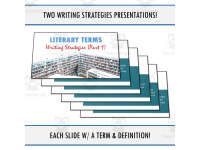
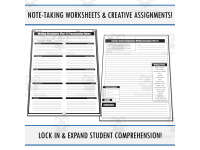
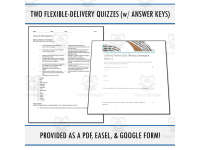
Teaching this resource is simple! Start it by presenting the included slideshow of literary terms and definitions while students use the accompanying worksheet to take notes. The, handout the accompanying homework assignment. Later in the week or following week, administer the quiz, which is provided as a printable or Google Form quiz (ideal for Google Classroom distribution!)
“Literary Terms Lessons: Writing Strategies” includes:
- Two presentations of 33 literary terms and definitions connected to writing strategies
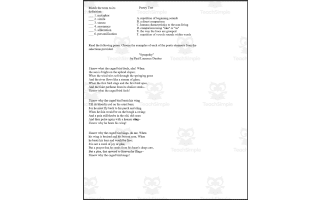
- Two presentation note-taking activities (w/ answer keys)
- Two writing assignments that ask students to use presented terms in a piece of original writing
- Two quiz assessments that include definition matching (or drop-down selection) and one essay question, provided in 5 file types (Google Form, Easel assessments, PDF, ExamView test file, and ExamView test bank file)
TERMS INCLUDED IN THIS LESSON:
Allegory, Allusion, Ambiguity, Apostrophe, Aside, Connotation, Convention, Crisis, Paradox, Paraphrase, Parody, Pun, Satire, Sentimentality, Stock responses, Comedy, High comedy, Low comedy, Romantic comedy, Farce, Tragedy, Tragicomedy, Irony, Verbal irony, Dramatic irony, Tragic irony, Colloquial, Cliché, Hyperbole, Understatement, and Formula literature
Although this resource can be fitted for any secondary Language Arts classroom, it has been carefully designed to work best in grades 9, 10, 11, and 12. The included activities and quizzes are subtly but specifically tied to Common Core ELA Standard for Language (6). This resource is provided in a print-ready, bookmarked, and adjustable PDFs, Google Form, and PowerPoint Show files.
This resource contains: 14 Pages; 35 Slides; 2 Google Forms; 4 Test Files.
Resource Tags
0 Reviews
Check out these other great products