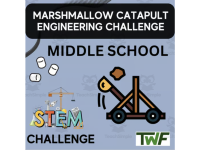
Marshmallow Catapult - MIDDLE SCHOOL - STEM Engineering

- Grades
- Grades 6–8, Middle School
- Pages
- 7
- File type
- Multiple File Types
- Editable
- Yes


- Subject
- Science, Basic Science, Technology, Engineering, Physics, STEM
- Topic
- stem, engineering
- Editable
- Yes
About this resource
What's inside this resource
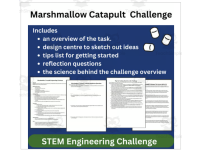
Marshmallow Catapult STEM Challenge for Middle School Students.
My Marshmallow Catapult Challenge is an excellent way to get your students' excited for STEM in an engaging hands-on way. It also is a great way to introduce them to the world of engineering.
This activity is designed for Middle School students. If you're looking for something for High School, please click here.
In this activity, students will work in groups to design and build a catapult using only popsicle sticks, rubber bands, a spoon, and a marshmallow. Their goal is to build a catapult that is capable of launching a marshmallow.
By doing this activity, your students will experience the process of creating something new as they brainstorm, plan, design, and test their ideas.
This challenge allows students to apply what they're learning in science and math classes, including geometry, physics, material science and more as they problem-solve to create a strong, stable catapult using only simple materials. Additionally, they will develop critical thinking, creativity, communication, and collaboration skills while working in a group setting.
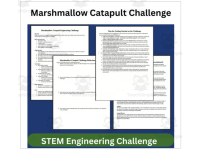
Your STEM Challenge comes with:
A full set of instructions
Reflection questions
An explanation on the science behind the challenge
Instructions on creating their design
Tips for getting started on the challenge
The Marshmallow Catapult Challenge is an activity your students will enjoy. It will allow them to:
explore how shapes and structure affect stability.
learn principles of weight distribution.
use the engineering design process.
develop perseverance, resourcefulness and an ability to learn from setbacks and mistakes.
This activity is easy to implement with step-by-step instructions and is adaptable to different learning styles and abilities as you can customize it however you like to suit your students. It encourages students to embrace productive failure and to work together to create something tangible.
Related resources
More resources teachers may find useful
24 related resources were found using this product's title, contributor, categories and tags.

In the classroom
Teaching tips & learning objectives

Learning objectives
- Apply the engineering design process to plan, build and test a catapult
- Explain how design choices affect how far a projectile travels

Teaching tips
- Each group needs 30 popsicle sticks, 10 rubber bands of various sizes, a plastic spoon, a marshmallow and a tape measure, and the rules require safety goggles during testing.

Skills covered
- Data collection — measuring three launches and recording the longest distance
- Presenting results — explaining the group's design and findings to the class

No reviews yet
Downloaded this resource? Tell other teachers how it went.
Resource details
Concepts & topics
Core concepts
 Core concepts
- Engineering design process
- Projectile motion
- Trajectory
- Mechanical energy
 Topics
Explore related searches
More to explore