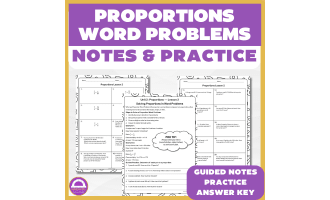
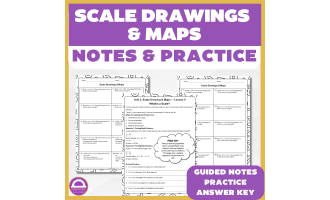
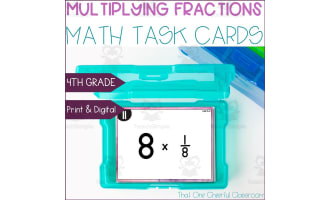
Multiplying and Dividing Fractions Guided Notes with Practice & Answer


- Grades
- Grades 5–7, Middle School, Elementary
- Pages
- 9
- File type
- Answer key
- Included


- Subject
- Math, Fractions
- Topic
- Matemaths, Guided Notes
- Resource types
- Worksheets, Worksheets & Printables, Teacher Tools, Presentations
- Answer key
- Included
About this resource
What's inside this resource
Get your students to master fraction multiplication and division finally with these handy, easy-to-follow guided notes and practice exercises. Designed for 6th grade math, this item breaks up fraction operations into brief, comprehensible steps — perfect for direct instruction, intervention, or independent practice.
These notes do more than show how to multiply and divide fractions — they get students to see why every step works. With built-in scaffolding, worked examples, and 30+ practice exercises, your students will gain the fluency and confidence they need to master this fundamental skill.
What's Included
2 Pages of Guided Notes – Student-friendly explanations for multiplying and dividing fractions and mixed numbers.
Worked Examples – Clear, step-by-step models for each operation.
Guided Practice (10 Problems) – Scaffolded exercises to aid in reinforcing understanding.
Independent Practice (20 Problems) – A mixture of computational and real-world word problems.
Complete Answer Key – Makes for easy grading or self-checking.
Pro Tips Section – Handy reminders like "simplify before multiplying" and "keep-change-flip" to aid students in recalling key strategies.
Skills Covered
✔ Multiplying fractions and mixed numbers
✔ Dividing fractions and mixed numbers using reciprocals
✔ Simplifying fractions and mixed numbers
✔ Applying operations to real-world word problems
✔ Building fluency through repetition and proportional reasoning
Teachers Love It Because
No Prep Required – Simply print and teach. Perfect for classwork, homework, sub plans, or review packets.
Student-Friendly Format – Step-by-step directions and examples make challenging concepts student-friendly.
CCSS Aligned (6.NS.A.1, 6.NS.B.3) – Offers quality, standards-based instruction.
Versatile Use – May be used as guided notes, independent practice, small-group support, or intervention review.
Presenting fraction operations for the first time or reviewing before a test, these guided notes and practice activities make teaching and learning fractions clear, structured, and stress-free.
Prep time saved and students learning fraction multiplication and division — one clear step at a time.
Centers, Rotations, or Partner Work
Homework, Sub Plans, or Early Finishers
Give your students ample practice without the prep time. With interactive pixel art and flexible printing options, fraction multiplication and division have never been this engaging — or this easy to teach.
Related resources
More resources teachers may find useful
24 related resources were found using this product's title, contributor, categories and tags.
In the classroom
Teaching tips & learning objectives

Learning objectives
Multiply fractions and mixed numbers, then simplify
Divide fractions by multiplying by the reciprocal

Teaching tips
Have learners convert mixed numbers before choosing multiplication or reciprocal-based division steps. Focus more closely on division with these dividing fractions guided notes.

Skills covered
Multiplying and dividing fractions — Multiply fractions and mixed numbers, then simplify
Reciprocals and simplification — Divide fractions by multiplying by the reciprocal

No reviews yet
Downloaded this resource? Tell other teachers how it went.
Curriculum
Standards, concepts & topics
Standards
 Standards
- 6. NS.B.3 — Fluently add, subtract, multiply, and divide multi-digit decimals using the standard algorithm for each operation.
- 6. NS.A.1 — Interpret and compute quotients of fractions, and solve word problems involving division of fractions by fractions, e.g., by using visual fraction models and equations to represent the problem. For example, create a story context for (2/3) ÷ (3/4) and use a visual fraction model to show the quotient; use the relationship between multiplication and division to explain that (2/3) ÷ (3/4) = 8/9 because 3/4 of 8/9 is 2/3. (In general, (a/b) ÷ (c/d) = ad/bc.) How much chocolate will each person get if 3 people share 1/2 lb of chocolate equally? How many 3/4-cup servings are in 2/3 of a cup of yogurt? How wide is a rectangular strip of land with length 3/4 mi and area 1/2 square mi?
Core concepts
 Core concepts
Multiplying and dividing fractions
Reciprocals and simplification
 Topics
Explore more
Categories this resource belongs to
Explore related searches
More to explore
You may also like