ng Phonic Worksheets
- Grades
- Preschool–K
- File type
- Preparation
- Print ready


- Subject
- ELA, Language Development, Phonics, Reading, Spelling
- Topic
- ng phonic worksheets, ng special friends worksheets
- Resource types
- Worksheets & Printables, Worksheets
- Preparation
- Print ready
About this resource
What's inside this resource
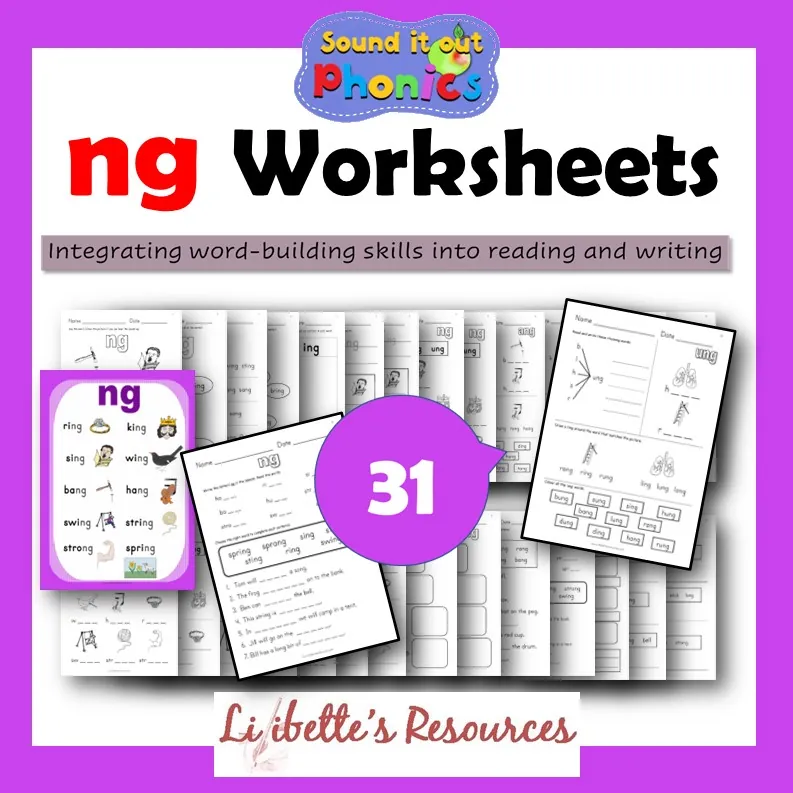
This is a pack of 31 worksheets for the teaching of the phonic/Special Friends digraph 'ng'.
Who can use these worksheets?
Anyone who needs to teach 'ng'!
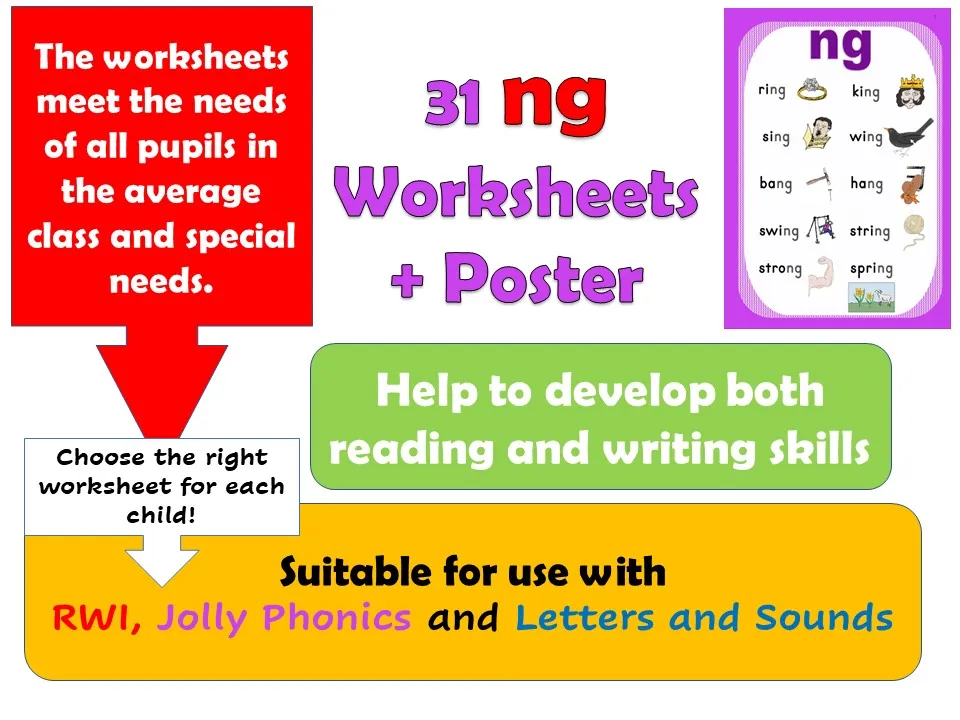
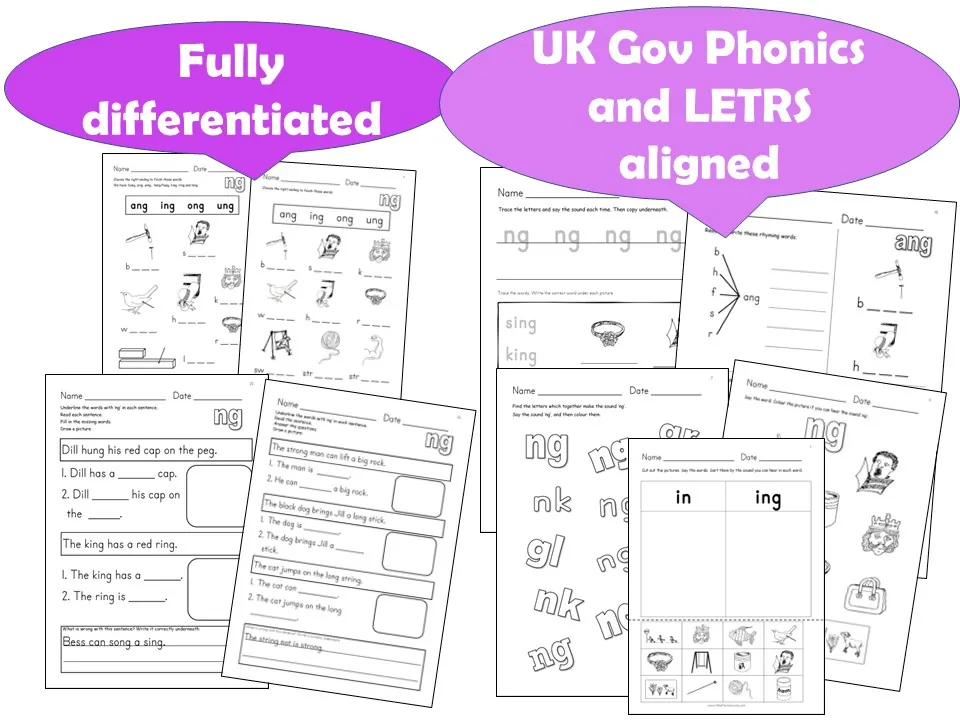
The worksheets are fully differentiated to cater for all abilities.
They can be used with any phonic programme, including RWI (Set 1), Jolly Phonics and Letters and Sounds (Phase 3 set 3).
These ‘ng’ worksheets cater for the needs of the average class.
They can also be used successfully with EFL pupils, ESL pupils, SEND pupils, and by private tutors.
They can be used for lessons, homework or for intervention work
These worksheets are suitable for use in the early stages of phonics learning. They do not include the addition of ‘ing’ to verbs.
What is included in the pack?
31 unique worksheets with our own hand-drawn, realistic pictures that children appreciate.
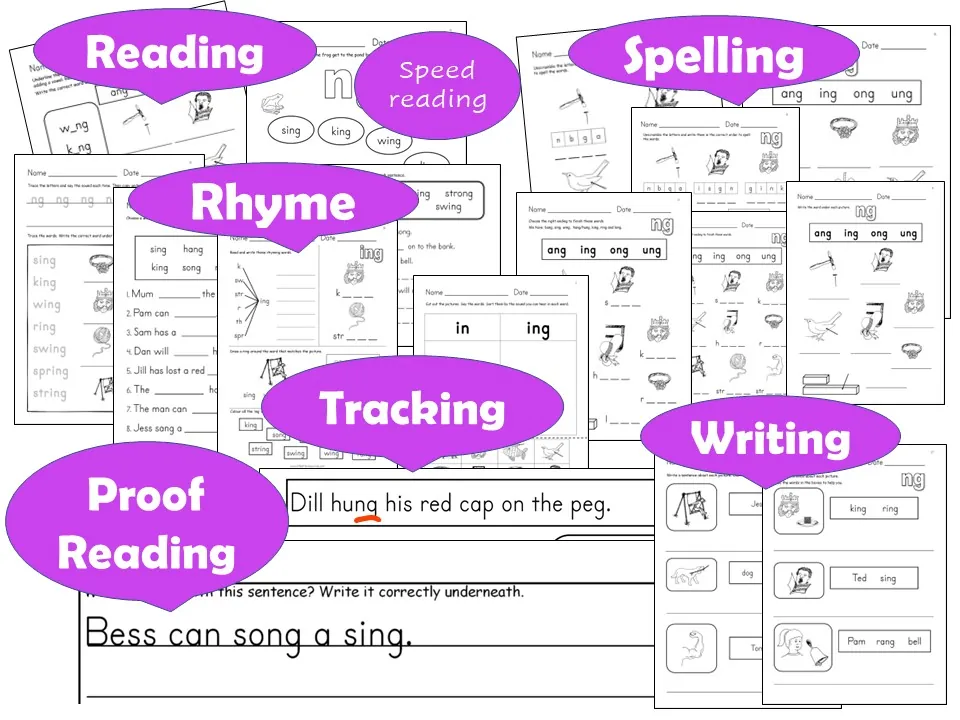
The ‘ng’ worksheets included in this pack give practice in the following areas:
The reading and spelling of ‘ng’ words
The tracking of the ‘ng’ sound in words and sentences
Proofreading sentences with words containing the sound ‘ng’
Comprehension exercises
The writing of sentences using words with ‘ng’
There are two kinds of worksheets for most activities: one without consonant blends, and one with, so that the teacher can fully differentiate.
The worksheets assume no knowledge of other digraphs, except where stated on 2 worksheets.
Special features of the 'ng' worksheets:
Children find it easy to understand what is required of them due to the clear layout and simple nature of the exercises.
These sheets have been devised as I have worked with many children in a range of settings, including in the classroom, in small groups and one-to-one as a private tutor.
1 PDF, including 31 worksheets and an A$ poster of 'ng' words to pin on the wall!
Related resources
More resources teachers may find useful
24 related resources were found using this product's title, contributor, categories and tags.


In the classroom
Teaching tips & learning objectives

Learning objectives
Recognize and produce the 'ng' sound in single-syllable words across four common endings (-ang, -ing, -ong, -ung).
Read and spell 'ng' family words, including blend-extended forms such as string, spring, and swing.
Complete and write full sentences containing 'ng' words, including identifying and correcting an error in a given sentence.

Teaching tips
Confirm students are already blending and segmenting CVC words securely and know their vowel sounds before assigning these sheets, since the teacher notes specifically caution against introducing 'ng' too early.
Follow the pack's built-in sequence: sound recognition and tracing first, then word-family sorting and rhyming, then sentence-level reading, writing, and proofreading.
Hold back the two pages using the word 'thing' (pages 18 and 29) and the page using the 'ck' blend (page 33) until those sounds have been taught separately, per the teacher notes.

Skills covered
Phonemic recognition of 'ng' — students identify the 'ng' sound in words by colouring, underlining, or circling it across multiple exercise formats.
Word-family reading and spelling — students read, trace, and write 'ng' words sorted by ending (-ang, -ing, -ong, -ung), including blend-extended forms like string and spring.
Sentence construction with 'ng' vocabulary — students complete cloze sentences and write original sentences using word banks tied to pictures.
Good to know
Questions teachers ask about this resource
Which additional sounds appear alongside 'ng' later in the pack?
A couple of pages layer in words that need 'th' (thing, on pages 18 and 29) or the 'ck' blend (black, on page 33), which the teacher notes flag as needing to be taught first if a student doesn't already know them.
How does the proofreading task work?
Students read a sentence with a built-in error, such as 'The string not is strong,' and rewrite it correctly underneath — a check that goes beyond simple word recognition.

No reviews yet
Downloaded this resource? Tell other teachers how it went.
Resource details
Concepts & topics
Core concepts
 Core concepts
ng sound family
word families (-ang, -ing, -ong, -ung)
phonics-based sentence writing
proofreading
 Topics
Explore more
Categories this resource belongs to
Explore related searches
More to explore
You may also like