Solving Equations Codebreaker: One-Step Equations Riddle
Students solve 20 one-step equations with integer answers, turn each answer into a letter with a decoder that includes slip-based decoys, and spell out the answer to an original riddle.


- Grades
- Grades 5–7, Elementary, Middle School
- Pages
- 4
- File type
- Answer key
- Included


- Subject
- Math, Algebra
- Topic
- Math, Algebra
- Resource types
- Activities
- Answer key
- Included
- Standards
- 6.EE.B.5
About this resource
What's inside this resource
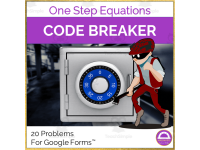
An original riddle about the variable x sets up this solving equations codebreaker. Students solve 20 one-step equations, find each answer in a 30-value decoder, copy its letter, then write the letters into numbered boxes on page 3 to spell the reply.
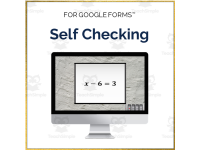
The equations come in sets. Six add or subtract, six multiply or divide, and six mix all four operations, with the variable on either side in some of them. Every answer is an integer and three are negative. Two short stories, about boxes of markers and chairs lent to the gym, ask students to write their own equation before solving it. A worked example, x − 15 = 26, models the inverse step.
Ten decoder values come from real slips, such as adding when the equation calls for subtracting, and none of their letters belong in the riddle, so a letter that does not fit tells students which problem to recheck. Page 4 lists the inverse step, answer, letter and matching decoy for every problem, together with the riddle’s answer.
Related resources
More resources teachers may find useful
24 related resources were found using this product's title, contributor, categories and tags.

In the classroom
Teaching tips & learning objectives

Learning objectives
- Solve one-step equations with addition, subtraction, multiplication and division by applying the inverse operation.
- Solve equations with the variable on either side of the equal sign.
- Solve one-step equations whose answers are negative integers.

Teaching tips
- Work the example x − 15 = 26 together and point out that 15 is added to both sides.
- Repeat the decoder warning that wrong answers have letters too; when a letter makes no sense, have students substitute that answer back, as the teacher tip suggests.
- Section C mixes the operations without labels, so ask students to name the operation to undo before they solve each one.

Skills covered
- Addition and subtraction equations — students solve x + 17 = 42, 56 = n + 29 and 9 + k = 4.
- Multiplication and division equations — students solve 6x = 84, 132 = 12t, w ÷ 7 = 9 and 4r = −36.
- Choosing the inverse operation — students decide what to undo in a mixed set such as 15 + b = 100, 9c = 117 and z ÷ 4 = 12.
Good to know
Questions teachers ask about this resource
What are the extra values in the decoder for?
The decoder holds 30 values but only 20 are answers. Each of the other 10 is what a student gets by using the wrong operation on one problem, such as 59 for x + 17 = 42 when 17 is added instead of subtracted. None of those letters appear in the riddle answer, so a stray letter shows which problem needs another look.
Are there fractions or decimals?
No. All 20 answers are integers, and three of them are negative. The equations stay at the one-step level with a single inverse operation.
Do students need to solve every problem to read the riddle?
Each of the 20 boxes on page 3 matches one problem number, so every answer supplies one letter. Students can fill the boxes as they go and use partly spelled words to spot a problem that needs checking.

No reviews yet
Downloaded this resource? Tell other teachers how it went.
Curriculum
Standards, concepts & topics
Standards
 Standards
- 6.EE.B.5 — Understand solving an equation or inequality as a process of answering a question: which values from a specified set, if any, make the equation or inequality true? Use substitution to determine whether a given number in a specified set makes an equation or inequality true.
Core concepts
 Core concepts
- One-step equations
- Inverse operations
- Integers
- Writing equations
- Variables
 Topics
Explore more
Categories this resource belongs to
Explore related searches
More to explore
You may also like