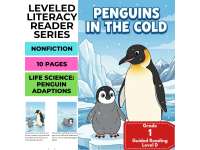
Penguins in the Cold Cored Literacy Readers Level D



ELA, Resources for Teachers, Reading Comprehension, Reading, Common Core, Library, Animals, Life Sciences, Science, Language Development
Kindergarten, Grade 1, 2
Worksheets & Printables, Worksheets, Teacher Tools, Centers, Activities, Writing Prompts, Literacy Readers


About This Product
Book Snapshot
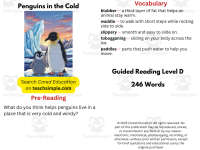
Title: Penguins in the Cold
Genre: Narrative Nonfiction
Subject: Life Science
Primary Topic: Penguin adaptations for living in the cold
Estimated Guided Reading Level (A–Z): D
What This Book Teaches Best
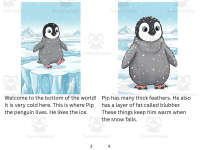
How penguins stay warm in a cold place using thick feathers and blubber.
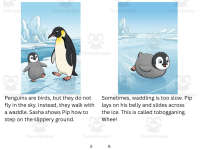
Ways penguins move on ice, including waddling and tobogganing.
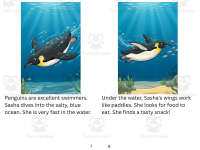
How penguins swim well, using their wings like paddles to move underwater.
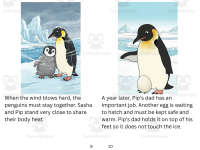
How penguins stay together to share body heat when the wind blows hard.
Penguin family/life cycle details shown through an egg hatching and a chick growing.
Learning Goals
Students will describe how feathers and blubber help a penguin stay warm.
Students will identify two ways penguins move across the ice in the book.
Students will explain what “tobogganing” means using details from the text.
Students will describe how penguins move in water and how their wings help them swim.
Students will explain why penguins stand close together when the wind blows hard.
Students will recount how Pip’s dad keeps the egg safe and warm.
Key Vocabulary From the Text
blubber — a thick layer of fat that keeps an animal warm.
waddle — walk with short steps, rocking side to side.
slippery — smooth and easy to slide on.
tobogganing — sliding on your belly across the ice.
paddles — parts that push water to help you move.
Discussion Prompts
Pre-reading question: What do you think helps penguins live in a very cold place?
Comprehension questions: Where does Pip the penguin live?
Comprehension questions: What is tobogganing in the story?
Comprehension questions: What does Pip’s dad do to keep the egg safe and warm?
FULL CATALOG OF DOWNLOAD LINKS HERE
Printing Tips
1. Best Printing Method (Recommended)
“Booklet” Printing (Best if Available)
If your printer or PDF viewer supports Booklet Printing, use this.
Settings to use:
Print mode: Booklet
Paper size: Letter or A4 (either works)
Orientation: Landscape
Print on both sides: Yes
Flip on: Short edge
Scaling: Fit to printable area
Booklet subset:
First test: Front sides only
Then: Back sides only
This will automatically:
Pair pages correctly
Put the cover on the outside
Align everything for folding
After printing, fold in half and staple along the spine.
2. If “Booklet” Printing Is NOT Available
You can still print this correctly with manual duplex printing.
Step-by-step:
Open the PDF.
Choose Print.
Set:
Orientation: Landscape
Pages per sheet: 1
Print on both sides: Yes
Flip on: Short edge
Print all pages.
Because each PDF page already contains two facing book pages, the result will still fold cleanly into a book.
Literacy Readers Overview
This product is perfect for small group instruction, such as guided reading, strategy groups, or interventions. It could also be used for independent reading, homework, or holiday work. It could also be used for literacy stations, read-aloud practice, or sub plans.
Extension Ideas
There are several ways to extend the lesson, including reading twice—first for understanding, and the second time to find the key details. Perhaps you can highlight or underline a detail that answers the comprehension questions. You can also turn it into a writing activity: What did you learn, or retell the story using first, next, then, finally. You could even choose a vocabulary word, draw it, with a caption from the text. For more advanced learners, perhaps you can compare this to another text they have read recently.
Differentiation Tips
For differentiation, if the words are hard, then perhaps you can preview some of them before you begin. For responses, perhaps you can give the students the first few words, for example, “In the book…”. You can also pair up the students, which normally leads to one of them helping the other. You can read it through again for fluency. Perhaps you can read two or three pages at a time and then come together as a group and analyze.
For similar downloads and other frees, do check out Cored Group on TeachSimple.
Resource Tags
0 Reviews
Check out these other great products