Percent Word Problems – Tipping & Gratuities Math



- Grades
- Grades 6–9, Middle School, High School
- Pages
- 6
- File type
- Answer key
- Included


- Subject
- Life Studies, Home Economics, Special Resources, Life Skills, Math, Multiplication, Multiplication and Division, Percentages, Money
- Topic
- Tipping, Percent Word Problems
- Resource types
- Worksheets & Printables, Word Problems, Teacher Tools, Lesson Plans
- Answer key
- Included
- Standards
- 7.RP.A.3
Product description
From the author
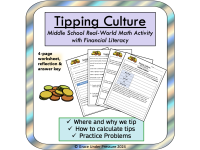
Practise percentages by calculating tips and discussing the tipping situations described in the handout.
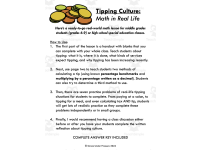
Here’s a ready-to-print real-life percent math lesson for middle school students (in grades 6-9) or special education or life skills classes in a high school setting.
Use the handout’s Canada and United States examples as discussion prompts; add context from your own community.
Why do people tip or give certain people a gratuity?
What places do we tip? What places do we not?
Has tipping been increasing recently ("tip-flation")?
Show students how the math skills and concepts that they have been learning in class (percentages, decimals, division, fractions) can be useful in their everyday lives!
How to Use:
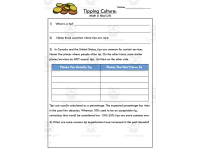
1. The first student page, PDF page 2, is a handout that you complete with your students (with fill-in-the-blanks) to teach them the ins and outs of tipping: where and when you do it, etc.
2. The next student page teaches students two simple methods of calculating tips (using well-known percentage benchmarks OR multiplying the price by a percentage written in decimal form). Encourage your students to determine a third method they could use.
3. After that, there are 7 practice word problems of realistic tipping situations that your students can complete. From tipping for a meal to paying at a salon, or even calculating tax AND tip together, your students will get a lot of real-life practice completing these problems in small groups or on their own.
4. To finish, you can have a class discussion about tipping in general and what your students think about our system.
What's Included: 6 Page PDF
- Teacher Instructions
- Handout with Fill-in-the-Blanks about Tipping
- 3-Page Worksheet and Written Reflection
- Complete answer key included
Related resources
More resources teachers may find useful
24 related resources were found using this product's title, contributor, categories and tags.


In the classroom
Teaching tips & learning objectives

Learning objectives
Calculate a percentage tip using either percentage benchmarks (e.g., 10% doubled to 20%) or decimal multiplication
Apply percent calculations to seven real-world service scenarios, including one combining tax and tip in a single total
Form and support an opinion about tipping culture using evidence from the lesson

Teaching tips
Use the fill-in-the-blank handout on PDF page 2 as a whole-class discussion to build background before introducing the calculation methods on PDF page 3
Have students attempt to find a third way to calculate a 20% tip on Jacob's $24 bill before revealing the alternate method in the answer key (dividing by 5 for 20%)
Problem 7 combines tax and tip in one multi-step calculation; consider modeling it together first since it is a step up from the earlier single-step problems

Skills covered
Percent-of-a-quantity calculation — students find a percentage tip using benchmark reasoning or decimal multiplication across seven real-world problems.
Multi-step problem solving — students combine a sales-tax calculation with a tip calculation to find a grand total in Problem 7.
Persuasive/opinion writing — students form and support an opinion about tipping culture using lesson evidence.

No reviews yet
Downloaded this resource? Tell other teachers how it went.
Curriculum
Standards, concepts & topics
Standards
 Standards
- 7.RP.A.3 — Use proportional relationships to solve multistep ratio and percent problems. Examples: simple interest, tax, markups and markdowns, gratuities and commissions, fees, percent increase and decrease, percent error.
Core concepts
 Core concepts
Percentages
Real-world math
Personal finance
Multi-step word problems
 Topics
Explore more
Categories this resource belongs to
Explore related searches
More to explore
You may also like