Physics Newton's Law of Gravitation Subplots



About This Product
Have you encountered substitute teachers who struggled with comprehending high school physics textbooks? This substitute plan aims to address this issue by introducing an engaging WebQuest to challenge your students.
Objective
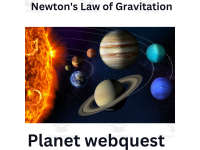
The project focuses on applying Newton's Law of Gravitation by utilizing a website that visualizes stars and planets visible at any specific date, time, and location in recent history. Originating in the mid-1600s, Isaac Newton's Law of Universal Gravitation revolutionized the understanding of gravitational attraction between two objects based on their masses and separation distance. Through this project, students will explore and compare gravitational forces between objects of varying sizes placed at different proximities.
Utilize the provided website to observe the celestial configuration on the date and time of your birth.
HS-ESS1-4: Orbital Motions
Use mathematical or computational representations to predict the motion of orbiting objects in the solar system. (Scale, Proportion, and Quantity)
Clarification Statement: Emphasis is on Newtonian gravitational laws governing orbital motions, which apply to human-made satellites as well as planets and moons.
Assessment Boundary: Mathematical representations for the gravitational attraction of bodies and Kepler’s Laws of orbital motions should not deal with more than two bodies, nor involve calculus.
0 Reviews
Check out these other great products