Newton's 3 Laws of Motion – Slides Lesson Package
- Grades
- Grades 10–12, High School
- File type
- Multiple File Types


- Subject
- Science, Physics
- Topic
- newton's laws of motion, newton
- Resource types
- Presentations, Teacher Tools
About this resource
What's inside this resource
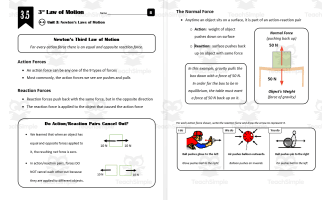
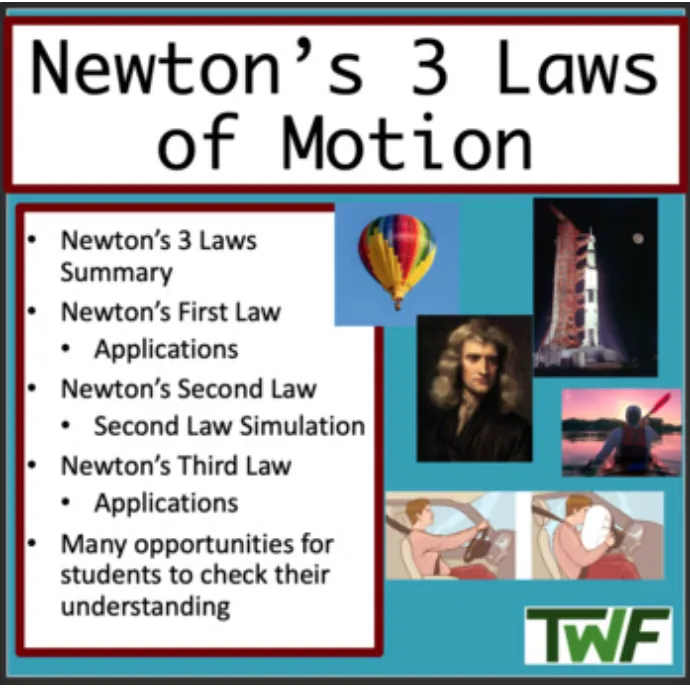
This Newton's 3 Laws of Motion lesson package begins with an overview of the 3 Laws then goes into specifics regarding Newton’s First Law and its applications. The lesson then covers Newton’s Second Law and Newton’s Third Law as well as their Applications.
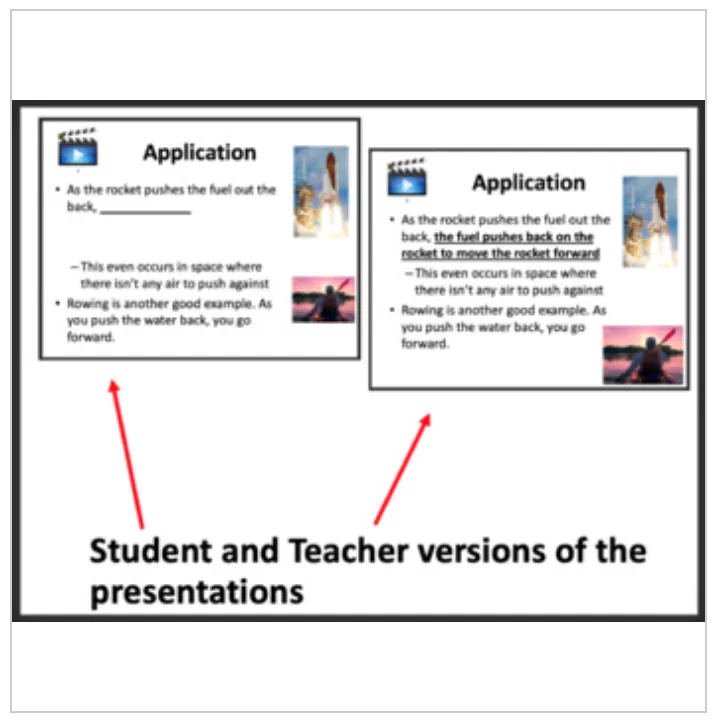
This package includes the lesson (student and teacher versions of the presentation), an auto-graded Exit Ticket, SIX videos, and a student lesson handout as a document. The presentation is fun and applicable with many opportunities for inquiry-based learning and discussion.
In order, the lesson covers:
Newton’s 3 Laws Summary
Newton’s First Law
Applications
Newton’s Second Law
Second Law Simulation
Newton’s Third Law
Applications
Many opportunities for students to check their understanding
Included in the lesson package is:
The teacher version of the presentation
The student version of the presentation
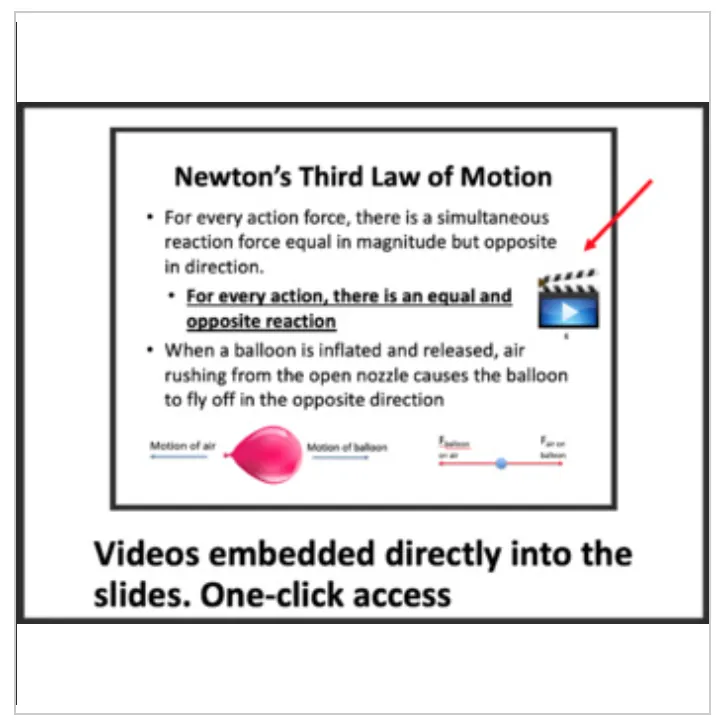
6 videos embedded into the presentation
An auto-graded Exit Ticket and a separate quiz with an answer key
Student lesson handout
Google and Distance Learning Ready
This lesson includes both Office and Google formats for ALL resources. The presentation is in PowerPoint and Google Slides while all documents contain Word and Google Doc versions.
Your resource is perfect for distance learning and integrates seamlessly with Google Classroom as I've included a link that will automatically create a copy of the resources and put them directly into your Google Drive with one click.
Purchase --> Open --> Click --> Assign to your students
Having both options allows you to use either without worrying about formatting issues as all the work has already been done for you. It safeguards you in case your department or school decides to go Google 100% and allows you as well as your students to access everything no matter where you are or what kind of equipment is being used.
The student version of the presentation contains multiple blanks that need to be filled in throughout the lesson. These blanks are conveniently underlined and bolded on the teacher copy. I have found this to be the most effective means of keeping my students engaged and active without having them write everything out. This also leaves more time for discussion and activities.
This lesson is part of my Force Unit which includes the following lessons plus many activities, assessments, etc. You can access the entire unit by clicking here.
Lesson 1 - Forces Introduction
Lesson 2 - Newton's 3 Laws of Motion
Lesson 3 - Friction
Lesson 4 - Universal Gravitation
Lesson 5 - Ramps, Pulley's and Forces
I also have a range of assignments and lessons/units from other grade levels at my store. Please CLICK HERE to have a look around and don’t forget to follow if you like what you see.
Also, please visit my blog Teach With Fergy for my thoughts on teaching, learning, and everything in between.
Related resources
More resources teachers may find useful
24 related resources were found using this product's title, contributor, categories and tags.


In the classroom
Teaching tips & learning objectives

Learning objectives
State and apply Newton's First Law (the Law of Inertia) to explain why a net force is required to change an object's motion.
Apply Newton's Second Law (F = ma) to calculate acceleration, force, or mass in real-world scenarios.
Apply Newton's Third Law (action-reaction pairs) to explain phenomena such as rocket propulsion and rowing.

Teaching tips
Use the student deck and Student Lesson Outline together for guided note-taking, since both share the same blanked-out structure the teacher deck fills in live.
Save the traction-system, two-sled, and skater "Check Your Understanding" problems for after the basic F=ma examples, since they require combining multiple forces or objects rather than a single-step calculation.
Point students to the linked PhET forces-and-motion simulation in the Additional Resources document for a hands-on complement to the Second Law demonstration slide.

Skills covered
Newton's First Law application — students explain real-world inertia examples (seatbelts, airbags) using the requirement that a net force must act to change motion.
Newton's Second Law calculation — students solve for acceleration, force, or mass using F = ma across problems ranging from a single ball to a braking car.
Newton's Third Law application — students explain action-reaction pairs in rocket propulsion, balloon release, and rowing.
Good to know
Questions teachers ask about this resource
How does the lesson build difficulty across the Second Law practice problems?
It starts with a single-object, single-force calculation (a hot-air balloon's vertical acceleration), moves to a straightforward net-force problem (a water polo ball), then to a braking-car problem requiring both acceleration and force, and finally to two-object systems (connected sleds, two skaters pushing off each other) that require combining multiple forces before applying F = ma.
What does the traction-system problem ask students to find?
Using the hint that a traction system creates a net force of zero to hold a leg in place, students find the force the tibia exerts on the pulley from the angles and hanging mass shown in the diagram; the worked answer is 26 N at 13 degrees below horizontal.

No reviews yet
Downloaded this resource? Tell other teachers how it went.
Resource details
Concepts & topics
Core concepts
 Core concepts
Newton's laws of motion
Force and acceleration
Free-body reasoning
Multi-step physics problem solving
 Topics
Explore more
Categories this resource belongs to
Explore related searches
More to explore
You may also like