Pythagorean Theorem | Around the World in 20 Problems, Digital Escape Room



- Grades
- Grades 8–10, Middle School, High School
- File type
- Preparation
- Print ready


- Subject
- Math, Geometry
- Topic
- Matemaths, escape room
- Resource types
- Escape Room, Activities
- Preparation
- Print ready
About this resource
What's inside this resource
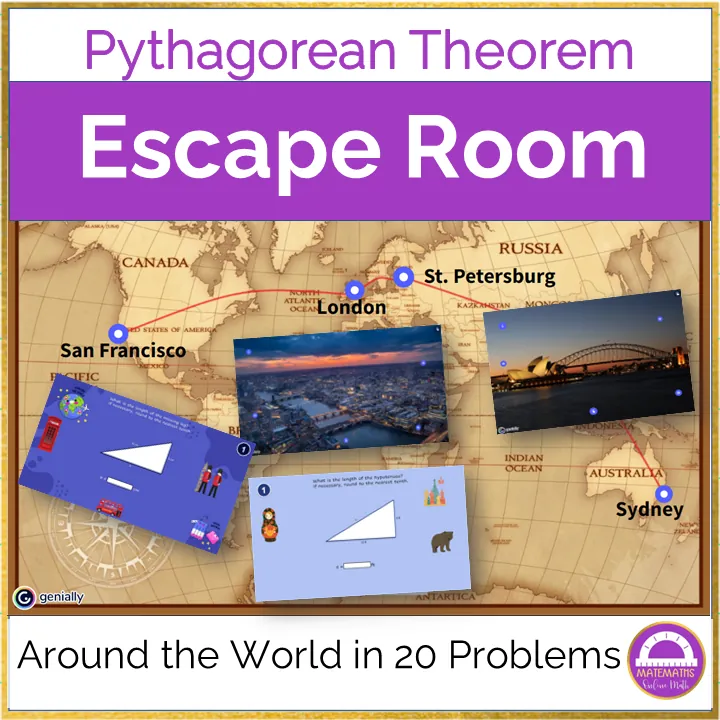
Do you want to make your middle school students practice the Pythagorean theorem and its converse in a fun and engaging way? Then try this Pythagorean Theorem Digital Escape Room: Around the World in 20 Problems!
This Pythagorean Theorem | Around the World in 20 Problems, Digital Escape Room is an interactive and immersive learning experience that will take your students to four different cities around the world: Sydney, St. Petersburg, London and San Francisco.
In each city, they will have to solve five problems related to the Pythagorean theorem.
Some problems will ask them to find the hypotenuse of a right triangle, and some will ask them to find the missing leg.
After solving all five problems in a city, they will get a link that will take them to the next city.
They will have to visit all four cities and solve all 20 problems to complete the escape room.
The best part is that this escape room is online and requires no prep from you.
You just have to provide your students with a link and they can access it from any device: laptop, tablet, or smartphone. They don't need any Google Classroom or Microsoft Teams logins either. They can work on it individually or in groups, at their own pace and convenience.
If they need to pause and resume later, they can do so by saving the address at the top of the page.
This Pythagorean Theorem | Around the World in 20 Problems, Digital Escape Room is a great way to review and reinforce this important math concept in a fun and engaging way.
Your students will love traveling around the world and solving problems with the Pythagorean theorem!
Related resources
More resources teachers may find useful
24 related resources were found using this product's title, contributor, categories and tags.


In the classroom
Teaching tips & learning objectives

Learning objectives
Apply the Pythagorean theorem to find the length of a right triangle's hypotenuse given both legs.
Apply the Pythagorean theorem to find the length of a missing leg given the hypotenuse and one leg.
Check computed triangle side lengths against a provided set of correct values.

Teaching tips
Assign the Sydney and St. Petersburg sets first, since both solve only for the hypotenuse, before moving to London and San Francisco, which mix in missing-leg problems.
Have students self-check with the per-city solutions page as they finish each set of five, rather than waiting until all 20 problems are done.
Use the four-city, travel-themed structure to frame the assignment as a single connected task rather than four separate worksheets.

Skills covered
Solving for the hypotenuse — the Sydney and St. Petersburg sets each have students find c from two given legs across 5 problems.
Solving for a missing leg — the London and San Francisco sets each have students find a or b from the hypotenuse and one leg across 5 problems.
Self-checking numeric answers — each city's problems pair with a dedicated solutions page listing all 5 correct values.
Good to know
Questions teachers ask about this resource
Do all four city sets ask students to solve for the same triangle side?
No — Sydney and St. Petersburg both solve for the hypotenuse, while London and San Francisco mix problems that solve for either missing leg instead.
Is there a way to check answers for all 20 problems?
Yes — each city has its own dedicated solutions page listing the correct value for all 5 of its problems.

No reviews yet
Downloaded this resource? Tell other teachers how it went.
Resource details
Concepts & topics
Core concepts
 Core concepts
Pythagorean theorem
right triangles
geometry
problem solving
 Topics
Explore more
Categories this resource belongs to
Explore related searches
More to explore
You may also like