Rational and Irrational Numbers Worksheet for 8th Grade Math


- Grades
- Grade 8
- Pages
- 12
- File type
- Answer key
- Included


- Subject
- Math, Numbers
- Topic
- Rational numbers, Irrational numbers
- Resource types
- Worksheets, Assessments
- Answer key
- Included
Product description
From the author
A printable worksheet for 8th grade math. This worksheet covers number system section in common core, courses 8.NS.A.1 and 8.NS.A.2 The main topics are rational numbers, irrational numbers, approximating irrational numbers, placing irrational numbers to a number line. Answers are included.
Examples of task types:
-Which of the following are rational numbers
-Which of the statements is not true (understanding the concept)
-Write fractions in decimal form
-Write repeating decimals as fractions
-Identify irrational numbers from a given set of numbers
-Explain in your own words number pi
-Write down examples of negative irrational numbers
-Rationalize why fractions have repeating decimals
-Estimate the following square roots to two decimals
-Place square roots to a number line
-Calculate the estimate of golden ratio using expression (1+sqrt5)/2
-Calculate three decimal approximation to e^2 (approximation of e given)
-Use long division to calculate decimal estimates to 1/7 and 1/14. What will you notice?
-Which square roots of integers will fit in this piece of number line?
-How can you create irrational numbers that are between 0 and 1? Write down three examples
-If you multiply irrational number by irrational number, is the answer always irrational?
-Calculate square of golden ratio using estimate 1.618. Make an educated guess how many right decimals the square has
-Write given repeating decimal as simplest fraction possible
-List square roots that are rational numbers
-Draw a mind map that includes concepts: real numbers, irrational numbers, rational numbers, whole numbers, natural numbers
-What common features do these numbers with finite decimal expression have?
This product is created for 8th grade, but it can be used with older students that need to learn about irrational numbers. This worksheet can be used individually or in small groups, during lessons or parts of it can be given as homework. This worksheet has tasks for about 3-6 hours depending if the teacher picks some tasks or if the students do them all.
Related resources
More resources teachers may find useful
24 related resources were found using this product's title, contributor, categories and tags.
In the classroom
Teaching tips & learning objectives

Learning objectives
Classify numbers and convert between fraction and decimal representations.

Teaching tips
Ask students to justify a classification using a definition or representation.

Skills covered
Number classification and fraction-decimal conversion.
Good to know
Questions teachers ask about this resource
What should students know first?
Students should be comfortable with fractions, decimals and basic square-root notation. Review the difference between terminating and repeating decimals before they classify numbers.

No reviews yet
Downloaded this resource? Tell other teachers how it went.
Curriculum
Standards, concepts & topics
Standards
 Standards
- 8.NS.A.1 — Know that numbers that are not rational are called irrational. Understand informally that every number has a decimal expansion; for rational numbers show that the decimal expansion repeats eventually, and convert a decimal expansion which repeats eventually into a rational number.
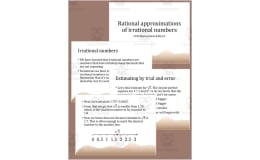
- 8.NS.A.2 — Use rational approximations of irrational numbers to compare the size of irrational numbers, locate them approximately on a number line diagram, and estimate the value of expressions (e.g., π2). For example, by truncating the decimal expansion of √2, show that √2 is between 1 and 2, then between 1.4 and 1.5, and explain how to continue on to get better approximations.
Core concepts
 Core concepts
Rational numbers; irrational numbers; decimal representations.
 Topics
Explore more
Categories this resource belongs to
Explore related searches
More to explore
You may also like