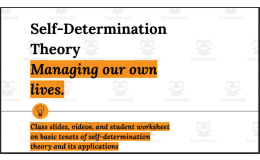
Self-Determination Theory Slides + Student Worksheet


- Grades
- Grades 9–12, High School
- File type
- Multiple File Types
- Editable
- Yes


- Subject
- Social Studies, History, Psychology
- Topic
- Social Studies Presentation, Social Studies Lesson
- Resource types
- Worksheets, Worksheets & Printables
- Editable
- Yes
About this resource
What's inside this resource
Without a doubt, history is a topic that can be easily overlooked by our students. Sometimes, it can be difficult for them to make connections with the past in a way that makes sense to them. Being able to provide students with meaningful resources is the best way to get over this learning curve. Whenever you have a social studies topic to introduce or review, you want to find engaging products that you know your students will be able to learn from. Within my store, you will find a plethora of social studies resources to utilize with your students.
What You Get:
This is a set of Self-Determination Theory Slides + Student Worksheet Resource. There are 25 slides in the presentation and 2 pages for the student work, which is an editable Word document.
The presentation will give students the opportunity to identify basic principles of self-determination theory in order to better understand the science of motivation in their life and in other’s lives.
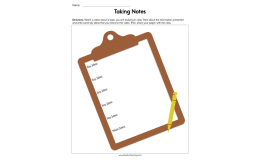
The worksheet will allow students to write as they follow along with the presentation and video. This gives them a chance to follow up on what they have learned.
How To Implement This Resource:
You should print off enough copies of the lecture notes for each student to have, so they can make notes on it as they follow along with the presentation. As students work from slide-to-slide learning about the self-determination theory, look for opportunities to engage them.
Engagement may look like:
-- Having them discuss which principle of self-determination theory resonates with them most
-- Doing a quick write about the difference between intrinsic and extrinsic motivation
-- Having a small group discussion about which type of motivator motivates them the most
I hope you enjoy!
Take A Look At More Of My Best Sellers:
27 Amendments Presentation & Chart
Crash Course Sociology Episode 8 Worksheet
Crash Course Government Episode 19 Worksheet
Monetary Policy Slides & Guided Notes
Enjoy More From My Store Here: Active Social Studies
Related resources
More resources teachers may find useful
24 related resources were found using this product's title, contributor, categories and tags.


In the classroom
Teaching tips & learning objectives

Learning objectives
Identify the basic principles of self-determination theory in order to understand motivation in one's own life and in other people's
Define autonomy, competence and relatedness in one's own words rather than by copying the slide
Recognise each of the three needs in a remembered episode from one's own experience

Teaching tips
The worksheet's boxes follow the deck's agenda in order, so it can be handed out at the start and filled in as each section arrives rather than collected afterwards
The three "in action" slides carry the concrete examples - choices and motivation, the weightlifter's one-rep max, belonging as a two-way street - and are the ones worth pausing on if the definitions land flat
Each application slide ends on an open question rather than a statement, so the school, work and life slides double as discussion prompts

Skills covered
Structured note-taking - the worksheet gives labelled boxes matching each section of the deck, so students write into a frame rather than from a blank page.
Defining in one's own words - the worksheet explicitly asks students to define autonomy, competence and relatedness themselves rather than transcribe the slide.
Applying a theory to personal experience - one section asks for a remembered moment when each of the three needs was felt most strongly.
Good to know
Questions teachers ask about this resource
How do the slides and the worksheet line up?
Section by section. The worksheet's boxes follow the deck's agenda in order - what the theory is and how it originated, the three major aspects defined, a personal example of each, intrinsic against extrinsic motivation, and finally applications in school, the workplace and life generally.
Whose research does the lesson credit?
Edward Deci and Richard Ryan. The history slide places 1970s work on motivation and behaviour first, then names their 1980s publication "Self-Determination and Intrinsic Motivation in Human Behavior" as the book that popularised the theory, and notes that research on it is far more commonplace today.
What personal writing does the worksheet ask for?
One section moves from theory to autobiography: students record an example of autonomy, competence and relatedness from their own lives, thinking of a time when they felt that aspect most strongly. The remaining sections are notes, definitions and comparisons.

No reviews yet
Downloaded this resource? Tell other teachers how it went.
Resource details
Concepts & topics
Core concepts
 Core concepts
Self-determination theory
Motivation
Autonomy
Intrinsic and extrinsic motivation
 Topics
Explore more
Categories this resource belongs to
Explore related searches
More to explore
You may also like