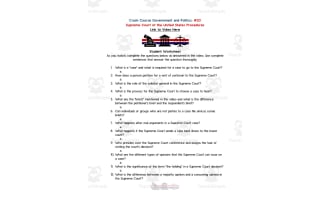
Crash Course Government Episode Worksheet | 19 - Structure of the Court System
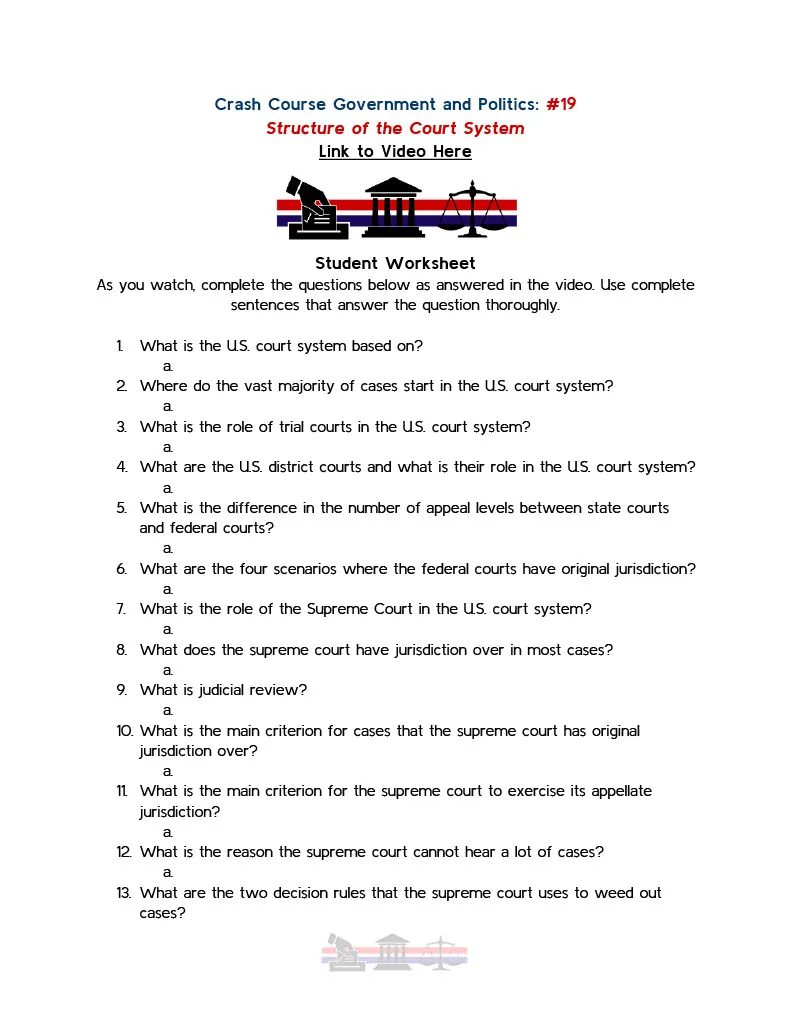

- Grades
- Grades 7–10, High School, Middle School
- File type
- Microsoft Word
- Editable
- Yes


- Subject
- Social Studies, Government
- Topic
- Crash Course Episodes, Structures of the Court System
- Resource types
- Worksheets & Printables, Worksheets
- Editable
- Yes
About this resource
What's inside this resource
Related resources
More resources teachers may find useful
24 related resources were found using this product's title, contributor, categories and tags.


In the classroom
Teaching tips & learning objectives

Learning objectives
Describe the hierarchical structure of the U.S. court system and where the vast majority of cases begin
Distinguish original jurisdiction from appellate jurisdiction at the trial, appeals, and Supreme Court levels
Identify the four scenarios in which federal courts have original jurisdiction

Teaching tips
Plan pause points at the multi-part questions — number 6 asks for four federal-jurisdiction scenarios and number 13 for two decision rules — since these need more writing time than the surrounding items
Hand out the answer document after viewing for self-checking; its responses are written as model complete sentences students can compare against their own
Question 15, on the kinds of cases the Supreme Court usually takes, extends naturally into a discussion of current circuit splits or pending constitutional questions

Skills covered
Active video note-taking — students answer fifteen sequenced questions in complete sentences while episode 19 plays, matching each answer to the video's order.
Court-system structure — students trace the hierarchy from state trial courts and U.S. district courts up through appellate levels to the Supreme Court.
Jurisdiction distinctions — students separate original from appellate jurisdiction, including the four scenarios where federal courts hear a case first.
Good to know
Questions teachers ask about this resource
Which parts of the court system do the fifteen questions actually cover?
They move through the full structure in episode order: the court hierarchy, where most cases start, trial courts and U.S. district courts, state-versus-federal appeal levels, original and appellate jurisdiction, judicial review, and how the Supreme Court chooses cases — decision rules, the political question doctrine, and the kinds of cases it usually takes.
Is the Crash Course episode part of the download?
The download supplies the question set and the completed answer document; each carries a video-link line beneath its title. The episode is third-party Crash Course video content that students watch separately online.
How detailed are the expected responses?
Full sentences, not one-word blanks. The direction reads 'Use complete sentences that answer the question thoroughly,' and the model answers run to several sentences for multi-part items such as the four federal-jurisdiction scenarios.

No reviews yet
Downloaded this resource? Tell other teachers how it went.
Resource details
Concepts & topics
Core concepts
 Core concepts
U.S. court system
Jurisdiction
Supreme Court
Judicial review
Civics
 Topics
Explore more
Categories this resource belongs to
Explore related searches
More to explore
You may also like