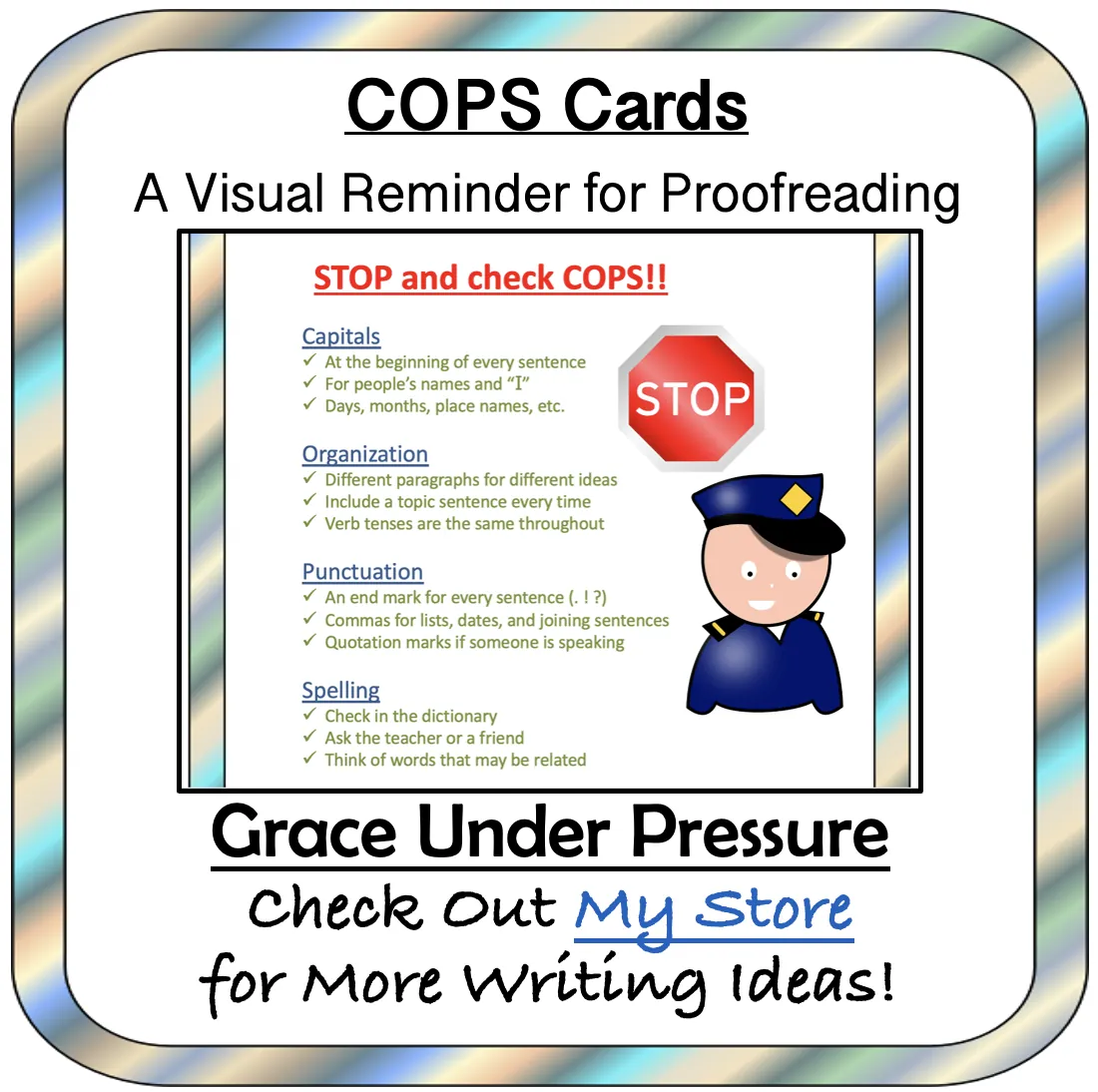
Self-Editing COPS Cards- Help your Students Proofread Their Own Work
- Grades
- Grades 2–6, Elementary, Middle School
- Pages
- 1
- File type
- Preparation
- Print ready


- Subject
- ELA, Grammar, Language Development, Strategies, Writing
- Topic
- Self-Editing, COPS Cards
- Resource types
- Worksheets & Printables
- Preparation
- Print ready
- Standards
- CCSS.W.3.5 CCSS.W.4.5 +1
About this resource
What's inside this resource
Self-Editing COPS Cards - An Effective Tool for Student Proofreading
These COPS cards are an easy way to help teach your elementary students a simple mnemonic for proofreading or editing their written work. You could teach a mini lesson for each letter of COPS: capitalization rules one day, organization another, then punctuation, and finally spelling. For each letter there are a couple of key ideas that students need to practice.
What does COPS stand for?
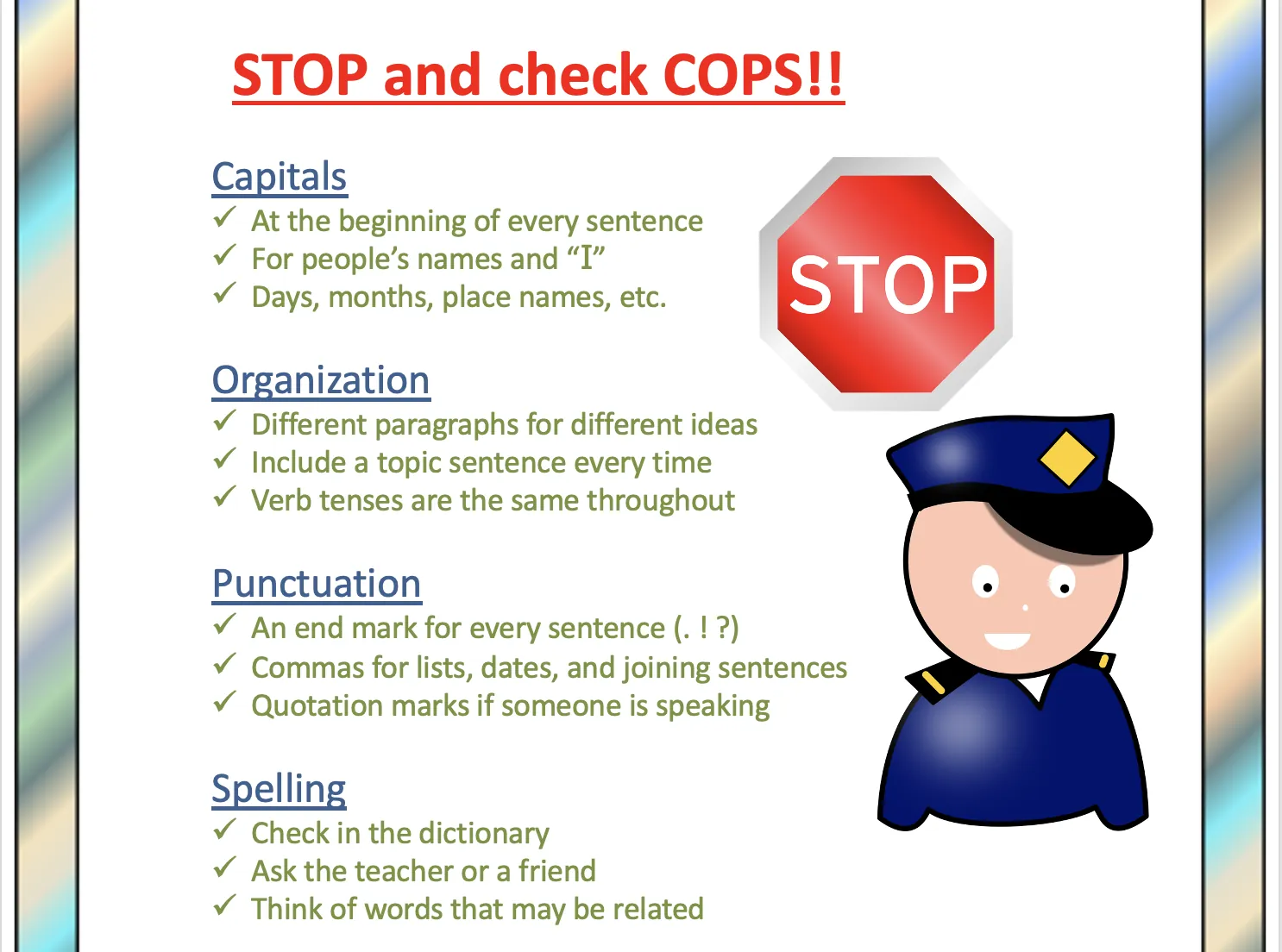
COPS is an acronym addressing the critical elements of good writing that every student should check upon completing an assignment:
Capitals
At the start of every sentence
For people’s names (proper nouns) and “I”
Other proper nouns: days, months, place names, etc.
Organization
Different paragraphs for each different idea
Include a topic sentence at the start
Verb tenses are consistent throughout
Punctuation
Use a period, question mark, or exclamation mark for every sentence
Use commas for dates, lists, and joining sentences together with a conjunction
Use quotation marks if a character is speaking
Spelling
Check in a dictionary
Ask your teacher or a friend
Think of related words to find a pattern
How to Use:
Print these cards 4 or 6 to a page. You can cut them out and laminate them so students can place them on their desks or in their writing folder. You could print a larger version to hang on your wall as a poster, or you could project the PDF on an interactive whiteboard.
Grades to Use With:
These COPS cards are appropriate for students in elementary grades (2-6) who are learning how to proofread their own written work for grammar, spelling, punctuation, and organization.
What's Included:
1 Page PDF- ready to print!
If you enjoy this writing tool, check out others in my store:
Primary Writing Scale: Checklist Assessment for Grammar, Spelling and Ideas
Related resources
More resources teachers may find useful
24 related resources were found using this product's title, contributor, categories and tags.


In the classroom
Teaching tips & learning objectives

Learning objectives
Apply the COPS checklist (Capitals, Organization, Punctuation, Spelling) to proofread a piece of writing independently.
Identify and correct common capitalization and punctuation errors using the checklist's specific checkpoints.
Organize a piece of writing into distinct paragraphs with a topic sentence and consistent verb tense.

Teaching tips
Keep a copy taped to each student's desk or writing folder so the checklist is available every time students finish a draft.
Model using the checklist on a sample paragraph with deliberate errors before asking students to apply it to their own writing.
Have students work through the four COPS categories one at a time on a single piece of writing rather than trying to catch every error type in one pass.

Skills covered
Self-editing and proofreading — students apply a four-category checklist (capitalization, organization, punctuation, spelling) to revise their own writing.
Paragraph organization — students check that their writing separates ideas into distinct paragraphs with topic sentences and consistent verb tense.

No reviews yet
Downloaded this resource? Tell other teachers how it went.
Curriculum
Standards, concepts & topics
Standards
 Standards
- CCSS.W.3.5 — With guidance and support from peers and adults, develop and strengthen writing as needed by planning, revising, and editing. (Editing for conventions should demonstrate command of Language standards 1–3 up to and including grade 3 on page 29.)
- CCSS.W.4.5 — With guidance and support from peers and adults, develop and strengthen writing as needed by planning, revising, and editing. (Editing for conventions should demonstrate command of Language standards 1–3 up to and including grade 4 on page 29.)
- CCSS.W.5.5 — With guidance and support from peers and adults, develop and strengthen writing as needed by planning, revising, editing, rewriting, or trying a new approach. (Editing for conventions should demonstrate command of Language standards 1–3 up to and including grade 5 on page 29.)
Core concepts
 Core concepts
proofreading
self-editing
writing conventions
 Topics
Explore related searches
More to explore
You may also like